

Blockchain had a moment. You couldn't go anywhere online without someone explaining how it would change everything, and the pitch always came back to the same thing: transparency. A ledger anyone could look at. Records that couldn't be quietly altered. No banks, no middlemen, just math and visibility doing the work that institutions used to do.
For cryptocurrency, that actually made sense. You send money, it shows up on the chain, anyone can verify it happened. There was something genuinely exciting about that. It felt like the financial system had finally been cracked open.
The problems started when people tried to take blockchain beyond payments.
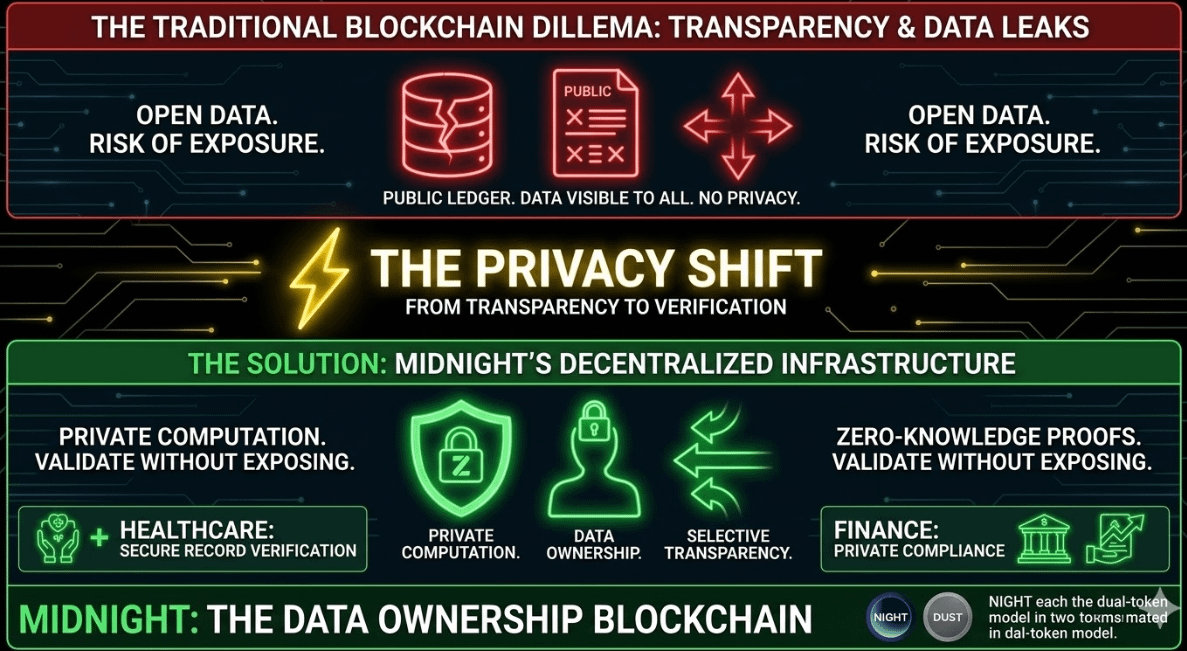
Because here's the thing, most of the world runs on privacy, not transparency. A hospital can't post patient records publicly just to prove a diagnosis is legitimate. A law firm can't put client files on a public ledger. Businesses guard internal data for obvious reasons. These aren't edge cases. They're the core of how most industries actually function.
So the early blockchain vision started showing its seams pretty quickly.
If every piece of information needed to sit on a public ledger to be verified, then the technology was always going to hit a ceiling. It would work for digital money and not much else. The moment sensitive data entered the picture, the whole model broke down.
That gap pushed researchers toward a different kind of question. Not "how do we make everything visible?" but "can a system confirm something is true without ever seeing the private information behind it?"
That sounds like it shouldn't be possible. And yet it is.
The answer lives in a corner of cryptography called zero-knowledge proofs. The math underneath is brutal, but the idea is almost elegant in its simplicity: you can prove a statement is true without revealing the data that makes it true.
Prove you're over 18 without handing over your ID. Prove your company meets regulatory requirements without exposing your books. The system validates the proof itself, the actual sensitive information never has to leave your hands.
That one shift, from transparency to cryptographic verification, is the thing that changes everything.
You no longer need a public ledger of facts. You need a network that can confirm rules were followed, and nothing more.
This is the space Midnight Network is working in.
Rather than building another public blockchain where every detail is logged and visible, Midnight is trying to make private computation work inside a decentralized system. The goal isn't to let people hide wrongdoing,it's to let people prove they followed the rules without sacrificing their data to do it.
The mechanics work roughly like this: you perform an action, a cryptographic proof gets generated confirming that action was legitimate, and you submit the proof to the network. The network checks the proof. It never touches the underlying data. Everything checks out.
Small change in design. Enormous change in what becomes possible.
Healthcare is the obvious example. Medical records are about as sensitive as data gets, but doctors still need to verify things, eligibility, diagnoses, research criteria. A system that lets institutions verify relevant facts without accessing full records could genuinely work in that environment in a way that traditional blockchains never could.
Finance runs into the same wall. Compliance requires proof, but proof can't mean dumping client data onto a public ledger. Privacy-preserving verification threads that needle, you can show the regulator what they need to see without exposing everything else.
Midnight structures its economy around two separate things. The NIGHT token handles governance; it's how people in the network have a say in how things develop. DUST is the operational side, the resource that actually powers transactions and runs private smart contracts. Keeping those roles separate reflects the reality that generating cryptographic proofs is computationally expensive, and the system needs a way to account for that work.
But the mechanics of Midnight are almost secondary to what it represents.
Web3's first wave was about moving money without banks. That worked. It proved the concept. But the second wave is trying to do something harder, make decentralized systems useful in contexts where information is as important as value, and where that information can't be made public.
Digital identity. Supply chains. Healthcare data. Enterprise coordination. All of these involve sensitive information that people and organizations can't just throw onto a public ledger.
If decentralized infrastructure can't handle that, most industries will keep using centralized systems. Which honestly makes sense, why switch to something that exposes your data more, not less?
But if blockchain can verify activity while letting people keep control of their information, the calculus flips completely.
That's the bet privacy-focused projects are making.
It also connects to something broader happening in how people think about the internet. For a long time, the dominant model was straightforward: platforms collected your data, your data made the platform better, the platform got more valuable. You got a free service. The trade felt reasonable until it didn't.
Web3 challenged that by letting people own digital assets directly. Privacy-preserving networks push that challenge further, the argument being that you should own not just your assets but the data attached to your identity and activity online.
Whether that vision actually plays out is a different question. But the direction is real.
The original blockchain promise was trust through visibility. The next version of that promise might be something quieter, trust through proof, without the exposure. A way to participate in open networks without having to hand over everything about yourself to do it.
That's a more complicated thing to build. But if it works, it's also a much more useful one.
@MidnightNetwork $NIGHT #night
