
Most token distributions work the same way. you show up, you meet some criteria, you get an allocation. everyone in the same tier gets the same amount. the formula is simple because fairness, in most cases, is treated as equality.
Scavenger Mine does something different. and the formula behind it is worth understanding properly.
the second phase of NIGHT token distribution runs for 30 days. each of those days is its own independent slot, beginning at 0:00 UTC. the pool of unclaimed Glacier Drop tokens gets divided into 30 equal daily portions and at the end of each day, rewards are calculated and allocated based on who actually showed up and how much work they did that day.
heres the exact formula from the whitepaper. let Ar be the total tokens apportioned as rewards to Scavenger Mine participants on a given day. let Cm be the share of computation that a specific participant m provided. let C be the total computation completed by all participants that day. then the reward Rm for participant m is:
Rm = Ar × (Cm / C)
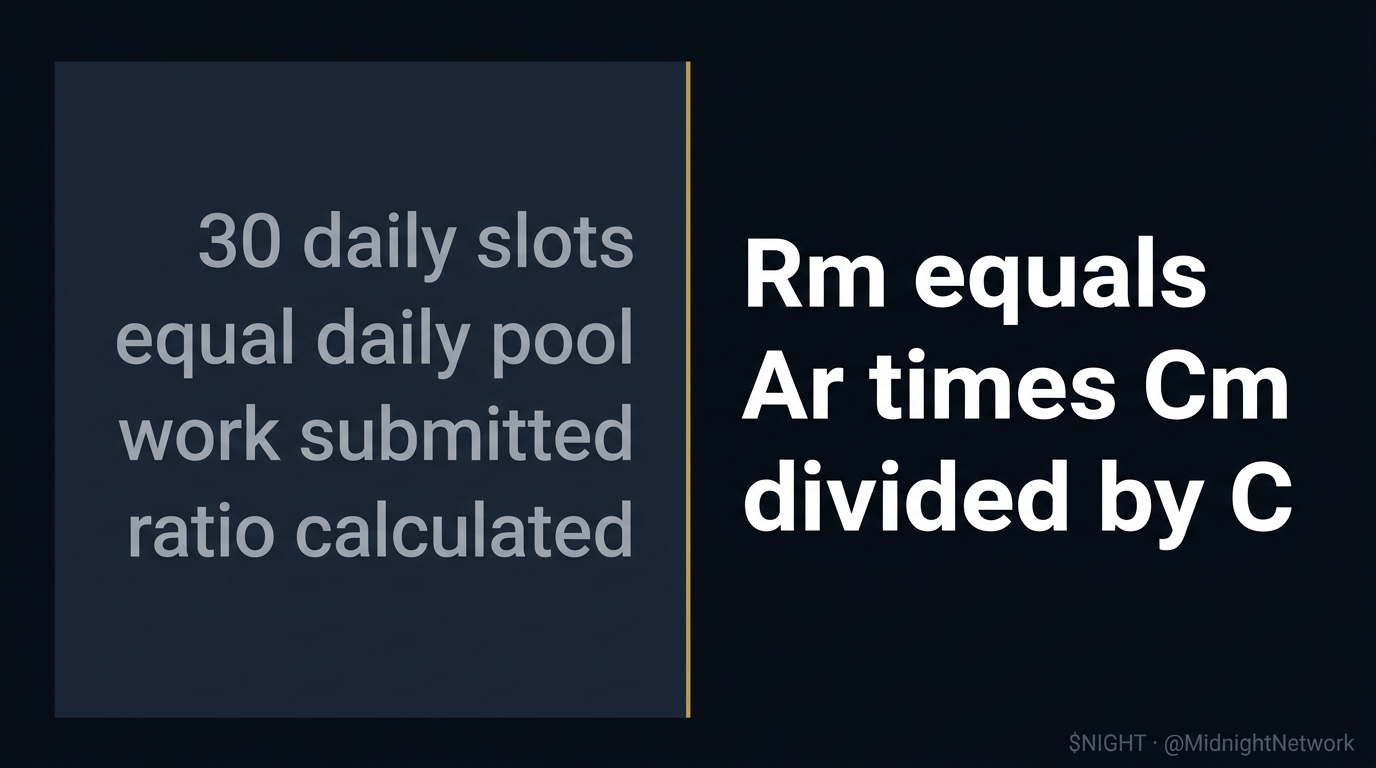
thats it. your reward isnt fixed. its a ratio. you get exactly the fraction of that days reward pool that matches the fraction of that days total computation you contributed.
what this means in practice is that the same amount of computational work can produce very different rewards depending on who else is participating that day. if you complete 100 work units on a day where the total is 1000, you get 10% of that days pool. if you complete the same 100 units on a day where total computation is only 200, you get 50%. the absolute work doesnt determine your reward the relative work does.
this design has a consequence that most people probably dont think about. early days of the 30-day window, when fewer participants are active, could be disproportionately valuable for those who show up. not because the daily pool is larger it isnt, the 30 portions are equal but because the denominator C is smaller. fewer participants means each unit of computation buys a bigger share.
the puzzles themselves are designed to be accessible to the general public. the whitepaper is explicit that they wont favor mining companies or large operators the goal is broad participation, not industrial extraction. you dont need specialized hardware. you dont need to have participated in Glacier Drop. anyone can show up.
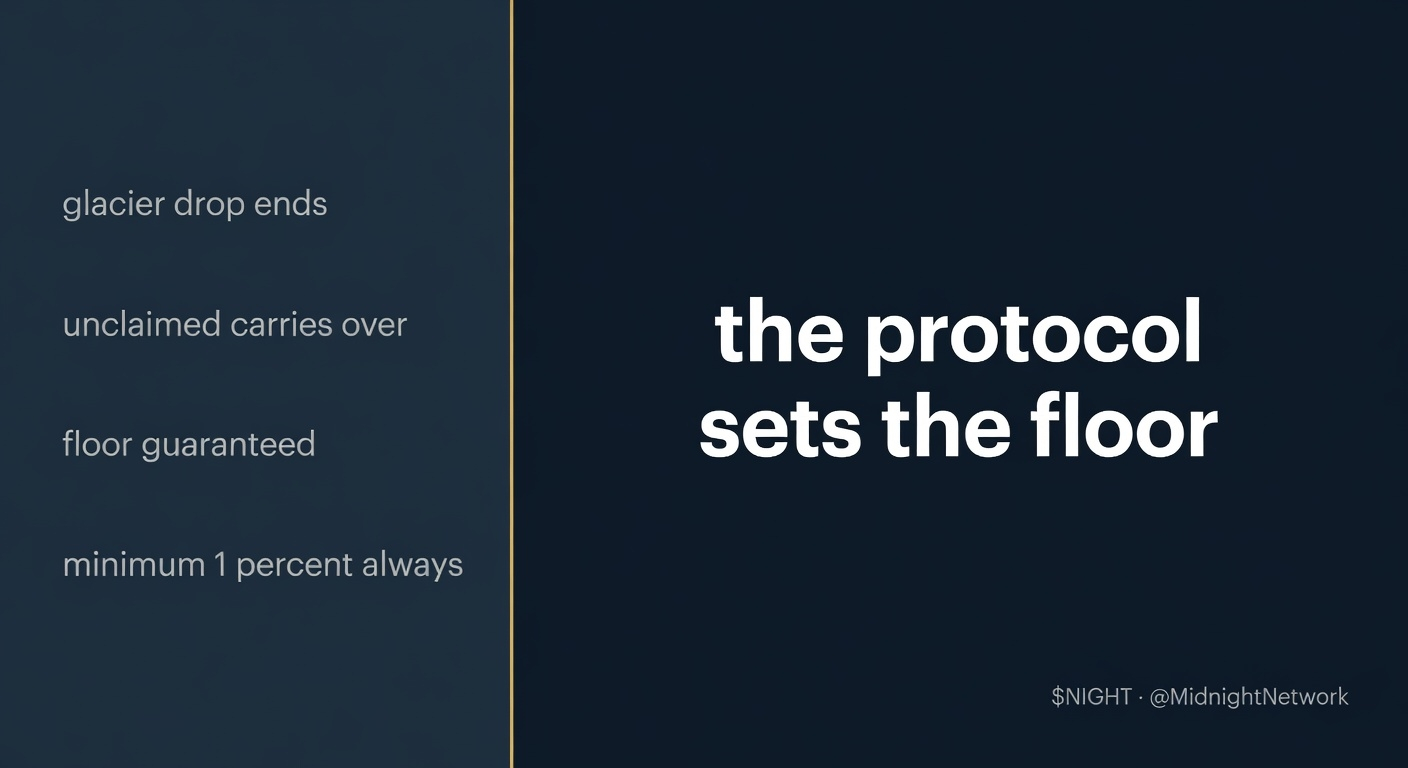
there is one floor built into the system. regardless of how much was claimed during Glacier Drop, a minimum of 1% of the total NIGHT supply is guaranteed to be available for Scavenger Mine participants. the protocol sets that floor so that even if Glacier Drop was wildly successful and left very little unclaimed, Scavenger Mine participants still have something meaningful to compete for.
once claimed, tokens from Scavenger Mine are frozen in a redemption smart contract on Cardano same as Glacier Drop and follow the same thawing schedule. four installments of 25% each, spread across 360 days, with the first unlock date randomized between day 1 and day 90.
what i find genuinely interesting about this formula is how transparent it is. you can calculate your expected reward before the day ends if you track the work being submitted. the protocol isnt hiding anything. Rm = Ar × (Cm / C) one line, fully auditable, no black box.
most distributions make you trust a team. this one makes you trust a ratio.
if you were eligible for Scavenger Mine did you track which days had the lowest participation?
#night #NIGHT $NIGHT @MidnightNetwork
