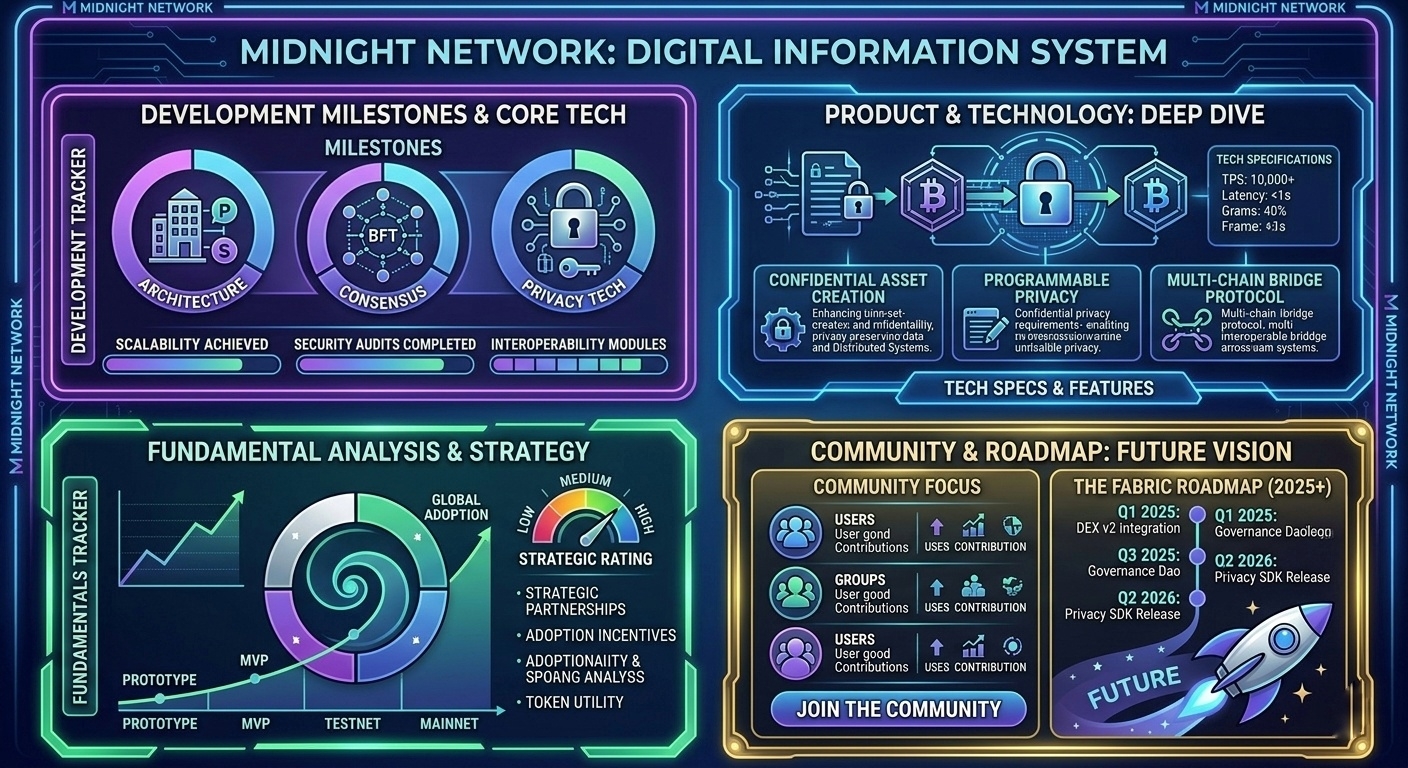
@MidnightNetwork is a next‑generation privacy‑centric Layer‑1 blockchain designed to fundamentally change how privacy, compliance, and interoperability work in decentralized systems. It aims to offer programmable privacy, meaning that users and developers can choose what data stays private and what gets disclosed, without compromising performance or regulatory adherence.
The project has strong ties to the Cardano ecosystem: it launched its $NIGHT GHT token as a Cardano Native Asset in December 2025, carried out one of the largest multi‑chain airdrops in crypto history (the “Glacier Drop”), and is built with the Cardano community and technical stack in mind.
Core Vision & Value Proposition
Midnight’s mission is to create a privacy infrastructure layer that balances confidentiality with real‑world compliance. Instead of simply hiding all transaction details like traditional privacy coins, Midnight lets applications selectively protect sensitive information — proving what’s true without revealing unnecessary data at all times. This is achieved through advanced zero‑knowledge proof systems and privacy‑first architecture.
Unlike legacy privacy solutions, Midnight is designed to support developers, enterprises, and regulated financial systems by offering controlled disclosure and auditability alongside privacy — opening the door to use cases like confidential DeFi, regulated data exchange, identity verification, and enterprise applications.
Technology & Token Design
At its core, Midnight uses zero‑knowledge proofs (ZKPs) to enable privacy‑preserving transactions and smart contracts without revealing underlying data.
Key technological aspects include:
Programmable Privacy: Developers choose what data to keep private and what to publish, enabling compliance where required.
Dual Token System:
$NIGHT — governance and utility token used for staking, governance, and generating the privacy fuel resource.
DUST — a non‑transferable, renewable resource used to pay fees for private transactions.
Developer Accessibility: Midnight supports a TypeScript‑based smart contract language (Compact) to lower barriers for developers building privacy‑enabled applications.
Hybrid Architecture: A public ledger for consensus and governance paired with a private execution environment for shielded operations.
Development Progress
2025: Foundation & Token Launch
Midnight introduced its vision and published initial research through community channels and events, including a major summit with developers and privacy advocates.
The $NIGHT token launched on Cardano in December 2025, widely distributed through a glacier‑style airdrop across multiple chains including Cardano, Bitcoin, Ethereum, Solana, and others.
Testnets saw explosive activity with millions of blocks and hundreds of thousands of transactions, demonstrating network stability and demand.
Early 2026: Mainnet Transition
Midnight entered the Kūkolu phase, building towards a Federated Mainnet launch in late March 2026, which will allow first live privacy‑preserving dApps to operate outside of test environments.
Networks partnering as initial validators include strategic infrastructure providers and early collaborators.
Roadmap (2025–2026 and Beyond)
Midnight’s planned rollout follows four structured phases, each with its own focus:
Hilo (Late 2025 – Q1 2026):
NIGHT token minting and distribution.
Establishing liquidity and community participation.
Kūkolu (Early 2026):
Federated Mainnet Launch with privacy dApps and production usage.
Onboarding initial validators and testers.
Mōhalu (Mid 2026):
Incentivized testnet with staking rewards.
Expansion of validator set, including Cardano SPOs and ecosystem participants.
Hua (Late 2026+):
Full decentralization and validator elections.
Cross‑chain bridges and interoperability for hybrid dApps operating across multiple ecosystems.
Strengths & Opportunities
Comprehensive Privacy Model: Midnight’s focus on programmable privacy positions it as an infrastructure layer suitable for both consumer and enterprise use cases — a meaningful differentiator in the privacy blockchain space.
Developer Accessibility: By using TypeScript and Compact, the network can attract a broader base of developers from Web2 and Web3 alike, accelerating ecosystem growth.
Cross‑Chain Vision: Midnight is designed to be interoperable, with the 24 billion NIGHT supply widely distributed across major ecosystems to foster multi‑chain engagement.
Risks & Challenges
Execution Complexity: Privacy at scale, especially with selective disclosure, is technically demanding and requires careful optimization and security auditing.
Decentralization Timeline: Full decentralization and validator onboarding will take time, and aggressive competition from other privacy protocols exists.
Market Volatility: As with all crypto projects, early price and supply unlock dynamics can cause significant market movements.
Conclusion
Midnight Network represents a strategically differentiated blockchain that blends privacy, compliance, and developer friendliness into a unified architecture. With real development milestones, an ambitious yet structured roadmap, and a broad airdrop‑driven community foundation, Midnight is positioned to be a key privacy infrastructure layer for the future of decentralized systems — especially as privacy and data protection become central to blockchain adoption.
However, its long‑term success depends on mainnet adoption, real‑world dApp usage, and effective cross‑chain execution.