As blockchain technology grows, one challenge continues to stand out: balancing transparency with privacy. Public blockchains allow anyone to view transactions, which builds trust but also exposes sensitive information. Businesses, institutions, and individuals often require confidentiality while still proving that rules are being followed. This is where Zero-Knowledge Proofs (ZKPs) become incredibly important. Platforms like Midnight are exploring how this technology can protect privacy while still ensuring compliance and accountability.
Understanding Zero-Knowledge Proofs
Zero-Knowledge Proofs are a cryptographic method that allows one party to prove that a statement is true without revealing the underlying information that makes it true. In simple terms, someone can confirm they know something or meet certain conditions without sharing the actual data.
Imagine proving you are over 18 without revealing your exact age, or confirming you have enough funds for a transaction without showing your full account balance. With ZKPs, this kind of selective disclosure becomes possible.
The concept was first introduced in the 1980s by cryptographers who were exploring ways to verify information without exposing secrets. Since then, the technology has become a powerful tool in modern blockchain systems.
Why Privacy Matters in Blockchain
Traditional blockchains are transparent by design. While transparency increases trust, it can also create problems. Financial transactions, identity details, or business operations recorded on a public ledger can be viewed by anyone.
For individuals, this can expose personal financial activity. For companies, it may reveal competitive data such as payment flows, supplier relationships, or trade activity.
Because of these concerns, many organizations hesitate to use blockchain technology despite its advantages. They want the security and efficiency of decentralized systems without sacrificing confidentiality.
Zero-Knowledge Proofs offer a solution to this problem by enabling verification without exposure.
How ZKPs Work in Simple Terms
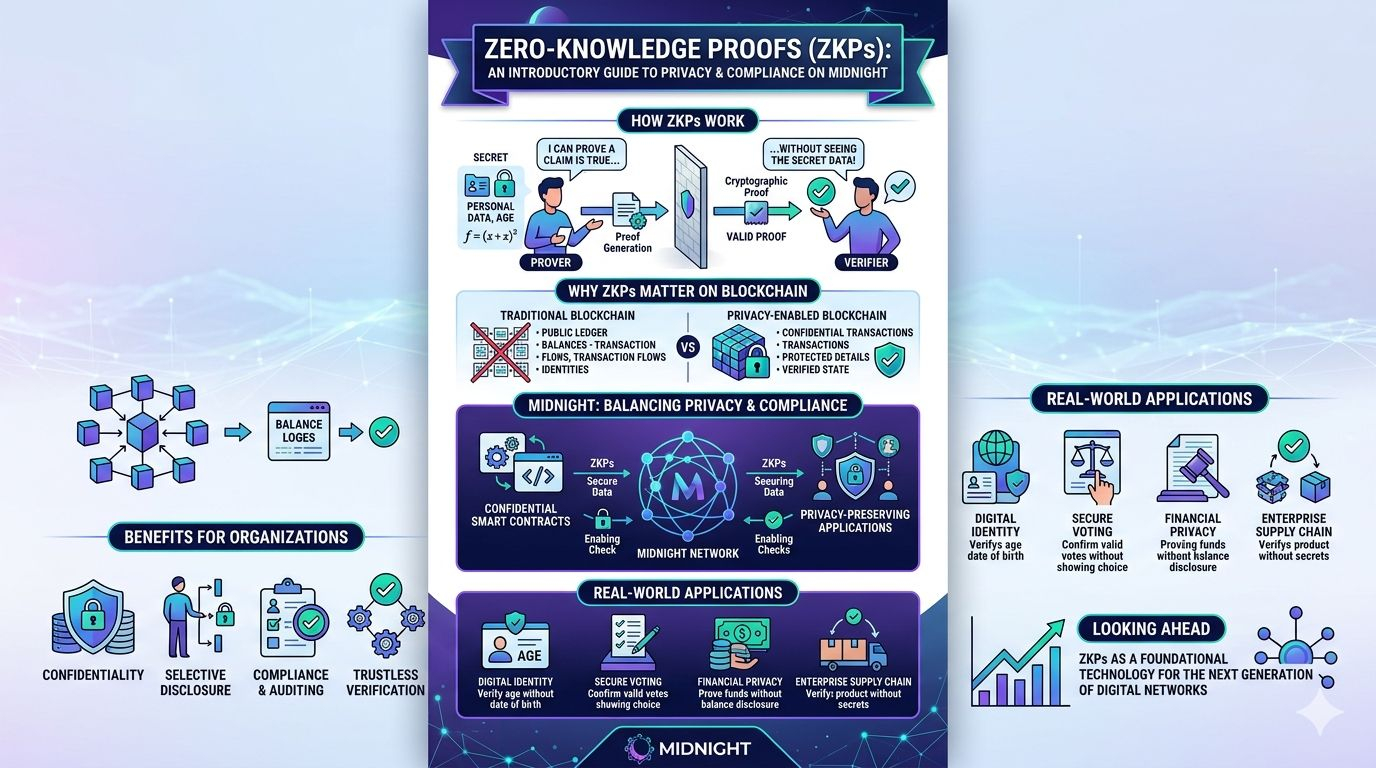
A Zero-Knowledge Proof typically involves two participants: the prover and the verifier.
The prover wants to demonstrate that a claim is true. The verifier wants confirmation of that claim but does not need access to the underlying data.
Using advanced cryptographic algorithms, the prover generates a mathematical proof that confirms the validity of the claim. The verifier can check this proof quickly and confirm its accuracy without seeing the secret data itself.
The result is trust without disclosure.
Midnight and Privacy-Focused Blockchain Infrastructure
Midnight is designed to support confidential smart contracts and privacy-preserving applications. The platform integrates technologies such as Zero-Knowledge Proofs to enable secure data handling while maintaining regulatory compliance.
Instead of exposing transaction details publicly, Midnight allows participants to prove that they meet certain rules or requirements without revealing the sensitive information behind them.
For example, a financial institution could prove that a transaction follows regulatory guidelines without exposing the identity of the client or the specific financial data involved.
This approach helps bridge the gap between decentralized technology and real-world regulatory expectations.
Supporting Compliance Without Sacrificing Privacy
One of the most powerful aspects of Zero-Knowledge Proofs is their ability to support compliance frameworks. Governments and regulators often require verification that rules are being followed, especially in industries like finance, healthcare, and supply chains.
With ZKPs, organizations can prove compliance with regulations while keeping confidential data protected.
This is especially valuable for identity verification, anti-money laundering checks, and financial audits. Instead of sharing full records, a company can provide cryptographic proof that required conditions are satisfied.
Midnight’s architecture focuses on enabling this balance between transparency and confidentiality.
Real-World Applications
The use of Zero-Knowledge Proofs extends far beyond financial privacy. Potential applications include digital identity systems, secure voting platforms, private data marketplaces, and enterprise supply chains.
In identity systems, users could prove eligibility for services without revealing unnecessary personal details. In supply chains, companies could verify product authenticity without exposing trade secrets.
As blockchain adoption grows, privacy-preserving technologies like ZKPs will likely become a standard component of decentralized infrastructure.
Looking Ahead
Zero-Knowledge Proofs represent a major step forward for blockchain technology. By allowing verification without disclosure, they solve one of the most important challenges facing decentralized systems today.
Platforms such as Midnight demonstrate how privacy and compliance can coexist in a blockchain environment. Rather than choosing between transparency and confidentiality, ZKPs make it possible to achieve both.
As research and development continue, Zero-Knowledge Proofs may become a foundational technology for the next generation of secure and privacy-focused digital networks.
@MidnightNetwork #NIGHT $NIGHT #night