@Fabric Foundation $ROBO #ROBO
In the rapidly evolving world of artificial intelligence and robotics, a new idea is beginning to reshape how humans interact with machines: verifiable intelligence. This concept lies at the heart of the vision proposed by Fabric Foundation in its research blueprint, “Verifiable Intelligence: The Fabric Foundation’s Blueprint for Autonomous Agents.” The paper outlines a future where robots and AI agents operate within a transparent, decentralized system that allows their actions, decisions, and contributions to be verified by anyone.
The Need for Trust in Intelligent Machines
As AI systems become more powerful and autonomous, society faces an important challenge: trust. Today, many advanced AI systems are controlled by centralized companies, meaning their operations are often opaque. Users must rely on the organization running the system to ensure safety, fairness, and reliability.
The Fabric Foundation proposes a different approach. Instead of centralized control, intelligent machines could operate within a public, decentralized network where their behavior is recorded and verified. This concept—called verifiable intelligence—ensures that machines can be audited, tracked, and trusted.
The Role of Fabric Protocol
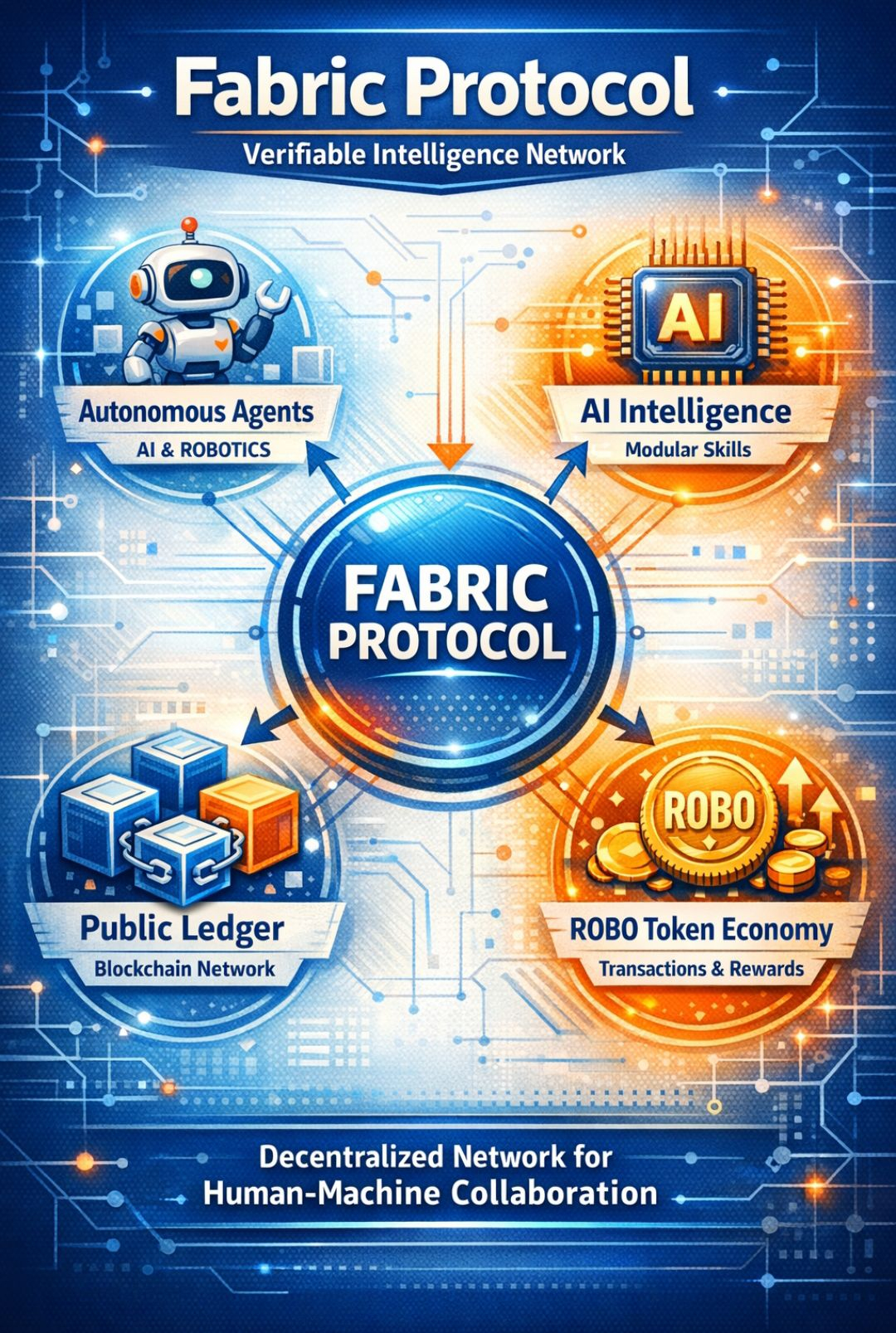
At the center of this vision is Fabric Protocol, an open infrastructure designed to coordinate robots, AI agents, and human operators across a global network. Fabric Protocol uses cryptographic verification and a public ledger to record the activities of machines.
Each robot or AI agent in the system receives a unique digital identity. This identity stores information about its tasks, capabilities, performance history, and contributions. By recording this data on a transparent ledger, the system ensures that the actions of autonomous machines can be verified by developers, businesses, and communities.
This structure creates a trustworthy environment where humans and machines can collaborate with confidence.
Modular Intelligence for Robots
Another key innovation described in the blueprint is the concept of modular intelligence. Instead of building robots with fixed capabilities, Fabric Protocol allows developers to add or upgrade individual skills. These skills can include navigation, perception, logistics management, or advanced decision-making.
This modular design works similarly to installing applications on a smartphone. Developers and researchers can create new modules that enhance robotic performance, allowing machines to evolve and improve over time.
The result is a collaborative ecosystem where innovation happens faster and robotic intelligence grows continuously.
The Economic Layer Powered by ROBO
To support this decentralized robotics ecosystem, the network introduces its native digital token, ROBO. The ROBO token functions as the economic engine of the network.
Within the ecosystem, ROBO enables:
Payments for robotic services
Rewards for developers contributing new skills or data
Governance participation in network decisions
Access to robotic resources and infrastructure
By integrating a token-based economy, the system allows robots and AI agents to participate in machine-to-machine commerce, creating a new digital marketplace for automation.
Governance and Human Oversight
While the system promotes automation and autonomy, human oversight remains essential. Fabric Foundation emphasizes decentralized governance, where developers, operators, and community members collaborate to set rules and standards for robotic behavior.
This governance model ensures that autonomous systems evolve responsibly and remain aligned with human values.
A Vision for the Robot Economy
The blueprint ultimately describes a future where robots are not isolated machines but active participants in a global digital economy. Through verifiable intelligence, decentralized governance, and open collaboration, the Fabric ecosystem aims to create a world where humans and intelligent machines work together safely and productively.
If successful, this approach could redefine how robotics and AI are built, deployed, and trusted—unlocking a new era of transparent and cooperative machine intelligence.