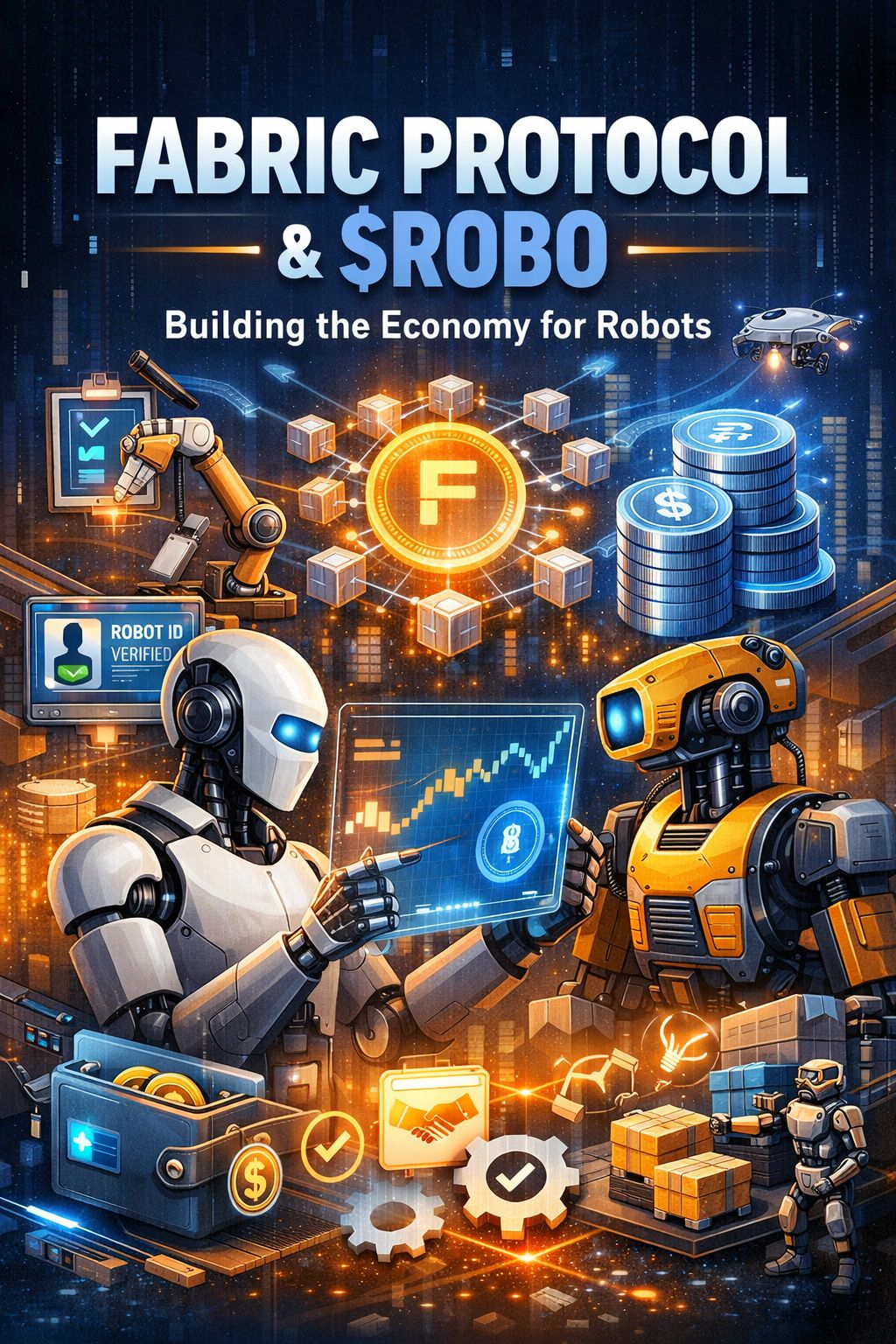
When people talk about robotics, they usually focus on the obvious things: smarter machines, better movement, stronger AI, more autonomy. Fabric Protocol feels different because it starts with a question that most projects ignore. Even if robots become highly capable, how do they actually fit into the real world in a scalable way? How do they earn, pay, prove what they did, coordinate with people, and operate inside a system that others can trust?
That is what makes Fabric interesting to me. It is not really trying to sell the idea of robots as a cool technology story. It is trying to solve the economic side of robotics. And honestly, that may end up being just as important as the hardware or the intelligence itself.
At its core, Fabric Protocol is building infrastructure for machine participation. The idea is simple, but powerful: if robots are going to become useful economic actors, they need more than good models and good hardware. They need identity, payment rails, rules, verification, incentives, and a way to coordinate with humans and with each other. Fabric is trying to create that layer.
That is where the project starts to feel more serious than a lot of “AI plus crypto” narratives. Instead of forcing a token into a robotics story, Fabric seems to be working backward from a real problem. Machines do not just need to function. They need to be trusted. They need to be accountable. They need to operate within a framework where work can be measured, rewarded, and governed. Without that, even advanced robots stay stuck as isolated tools inside closed systems.
This is also why $ROBO matters. The token is not meant to be just a branding asset floating around the ecosystem. It is tied to the network’s activity. From the protocol design, $ROBO is meant to support payments, fees, staking-like collateral, delegation, governance, and rewards for verified contribution. That gives the token more weight than the average infrastructure asset, because its purpose is connected to actual use inside the system.
Of course, that does not automatically make the token valuable. A token only becomes meaningful when the network around it is doing something real. That is the challenge Fabric still has ahead of it. The long-term value of $ROBO will not come from narrative alone. It will come from whether real machine work, real coordination, and real demand start flowing through the protocol.
What I find most compelling is the way Fabric approaches verification. In robotics, claims are cheap. A project can say a robot completed a task, contributed useful data, or followed instructions correctly, but open systems cannot rely on trust alone. Fabric tries to address that by connecting robotics to verifiable computing and economic accountability. That is a strong direction, because robot economies cannot scale on vague promises. They need proof, reputation, and consequences.
And that matters more in robotics than in pure software. Robots operate in messy environments. They break, drift, fail, and interact with people in unpredictable ways. They are not clean digital systems. So any serious protocol for robotics has to deal with friction, not just theory. Fabric seems to understand that. Its model is not built around a fantasy where machines suddenly become perfect. It is built around the idea that robots, operators, developers, validators, and capital all need to coordinate under shared rules.
That makes the project feel more grounded. It is not pretending the future arrives just because the language sounds futuristic. It is trying to build the missing structure that would let robot economies actually work.
The token design also becomes more interesting when you look at incentives. A lot of crypto networks reward passive holding more than real contribution. Fabric appears to be aiming for the opposite. The idea behind robotic work is that rewards should go to useful, measurable activity. That is a healthier model, at least in principle. If value flows toward verified participation instead of idle speculation, the network has a better chance of producing something real.
I think that is one of the strongest parts of the Fabric thesis. It treats contribution as the center of the system. That is important, because if robots are going to become economic participants, then the network around them should reward performance, reliability, and utility. Otherwise it becomes just another token economy with a good story and weak fundamentals.
Still, there is a difference between a thoughtful design and a functioning market. Fabric’s economics may be well structured, but token design alone does not create adoption. The real test is whether operators, developers, and users actually choose to build and transact through this system. Early attention can create momentum, but it can also create illusions. Activity in the market is not the same thing as activity in the network. That distinction matters a lot here.
Where Fabric has a real opportunity is in the role it wants to play inside the broader ecosystem. It is not trying to be only a robotics brand or only a token network. It is trying to become the coordination layer between machine intelligence and economic activity. That is a much bigger position. If robotics continues moving into logistics, service work, industry, and autonomous systems, then the need for shared infrastructure will become much more obvious. Payments, identity, accountability, reputation, and governance will not be side features. They will be essential.
That is why Fabric feels early, but not random. The project is reaching for something bigger than short-term attention. It is trying to define how robots enter open markets. That is a serious idea, and it gives the protocol more depth than projects that only talk about autonomy in abstract terms.
The future direction here is what makes the whole thing worth watching. If Fabric can grow from theory into actual usage, it could become part of the base infrastructure for a machine economy. Not because it made robotics look exciting, but because it helped make robotics legible to markets, users, and institutions. That would be a much more durable achievement.
To me, the real insight behind Fabric is very simple: smarter robots are not enough. Capability alone does not create an economy. Without trust, incentives, rules, and coordination, even powerful machines remain disconnected from larger systems of value. Fabric Protocol is betting that the next important layer in robotics is not just intelligence, but economic structure. And if that turns out to be true, then $ROBO is not just another token in a crowded market. It becomes a bet on the idea that robots will eventually need their own native financial and coordination rails to matter at scale.