A few weeks ago I watched a short video of warehouse robots moving shelves around a storage floor. Nothing unusual about it. Companies have been using those machines for years now. Still, one small detail caught my attention. The robots weren’t simply following a fixed route. They were adjusting constantly. One paused. Another rerouted. A third waited for space before moving forward.
It looked less like machines executing orders and more like a quiet negotiation happening between them.
That observation stays with me whenever people start talking about “robot economies.” The phrase sounds futuristic, but the underlying question is actually simple. If thousands of machines eventually interact across different companies and networks, how do they coordinate decisions? Not just movement. Resources, services, access, priorities.
Someone has to keep track of who does what and who pays for what.
Right now the answer is usually centralized software. A warehouse operator controls the robots. A ride-hailing company controls its vehicles. Charging stations belong to a specific network. Everything runs through a single authority that schedules tasks and settles payments behind the scenes.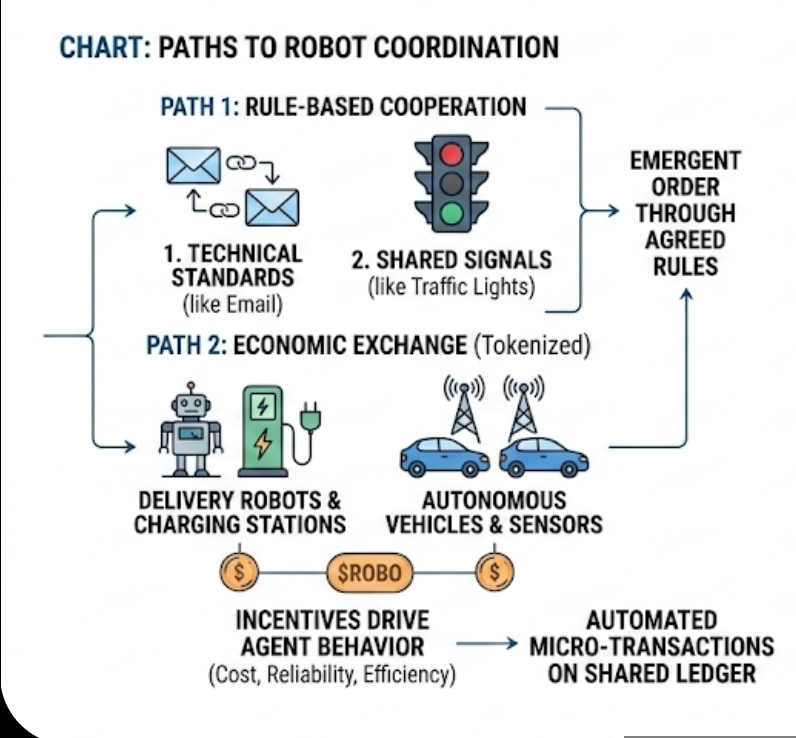
But imagine something looser. A delivery robot owned by one company needs to charge at a station run by another company. Or an autonomous vehicle requests data from a traffic sensor network maintained by a city. These interactions are small, quick, and frequent. Too frequent, probably, for humans to manually approve every transaction.
So the question slowly becomes practical: how do machines exchange value with each other?
That’s where tokens sometimes enter the discussion. A token like $ROBO is basically a digital unit recorded on a blockchain. Nothing mystical about it. A blockchain is just a shared ledger, meaning multiple computers maintain the same record of transactions instead of one central database.
Supporters of machine economies think this kind of system could give robots a simple way to settle payments automatically. A robot requests a service. The network verifies it. Payment moves instantly through the ledger. No human invoice. No delayed settlement.
On paper it sounds clean. Reality is usually messier.
I’ve spent enough time watching how digital platforms behave to know that systems rarely stay neutral once incentives are involved. Even small signals change behavior. On Binance Square, for instance, visibility metrics quietly shape how people write. Posts that attract engagement rise in rankings. Others disappear into the feed. Nobody tells creators what to say, yet the algorithm still nudges the ecosystem in certain directions.
Machines might experience something similar.
If robots start operating inside token-driven systems, the incentives embedded in those tokens will influence how they act. Not intentionally, of course. A robot isn’t thinking about profits or strategy. It simply follows the logic its designers gave it. But those instructions will likely revolve around cost, efficiency, reliability.
Imagine a delivery drone that must choose between two charging stations. One charges slightly less in tokens but is known to be less reliable. The other costs more but almost never fails. Which one does the drone pick? That decision depends entirely on the incentive rules written into its software.
Tokens become a kind of quiet pressure.
Some projects exploring this idea suggest staking mechanisms as well. Staking just means locking tokens as a form of guarantee. If a machine promises to complete a task, it temporarily deposits tokens into the system. If it fails or behaves incorrectly, some of that deposit can be lost. It’s a way of enforcing accountability without direct supervision.
Interesting concept. But again, things rarely stay simple once real systems appear.
One concern people rarely mention openly is volatility. Crypto tokens can swing wildly in value. That may be fine for speculative trading, but machines usually prefer stability. A robot planning operational costs cannot easily adapt to a payment system that changes value dramatically overnight.
Engineers might eventually solve that with stable pricing layers or hybrid systems. Or maybe tokens become more stable over time. Hard to know.
There is another angle that fascinates me more, though.
Not every coordination problem requires a financial layer.
Sometimes I remind myself that a lot of the systems we rely on every day don’t involve money at all. The internet is a good example. Email works because everyone follows the same technical rules. No tokens, no tiny payments moving around in the background. Just shared standards that people agreed to use.
Even something like traffic lights shows the same idea. Drivers stop at red lights and move on green ones, not because they’re paying a fee each time they pass an intersection, but because the system only works if everyone follows the same signals. It’s simple coordination. No micro-transactions needed.Cooperation sometimes emerges simply from shared rules.
So when I hear people say robot economies will definitely need tokens, I hesitate a little. Maybe they will. Maybe they won’t.
Still, markets have a strange way of appearing wherever resources become scarce. Electricity markets formed when power grids expanded. Something similar happened with cloud computing. In the early days companies mostly ran their own servers, so the question of pricing shared capacity didn’t really come up. But once cloud providers started renting computing power to others, server capacity quietly turned into something you could measure, allocate, and sell.
The same shift happened with internet bandwidth over time. At first it was mostly infrastructure people used without thinking about its cost per unit. Later, as demand grew and networks expanded, bandwidth started to carry its own pricing models. What began as a technical resource gradually became part of an economic layer.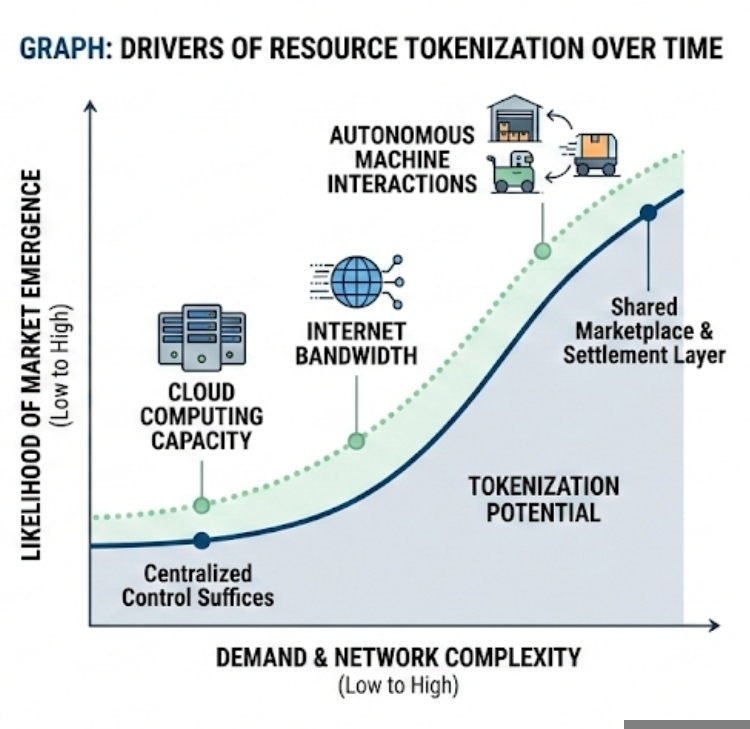
If robots from different owners begin competing for resources that charging stations, computing power, sensor data and some form of marketplace may naturally emerge. And marketplaces almost always require a settlement layer.
Tokens like $ROBO are essentially experiments around that idea.
They are attempts to answer a question we don’t fully understand yet: what happens when machines begin interacting economically without humans sitting in the middle of every transaction?
Maybe the whole concept turns out to be unnecessary. Centralized systems could remain more efficient. Or reputation networks might work better than token payments. It’s entirely possible that many of today’s token experiments fade away once practical engineering challenges appear.
But it is also possible that small machine-to-machine payments quietly become normal infrastructure someday, the same way APIs and cloud services did.
What I find interesting is not the token itself. Tokens come and go all the time.
The interesting part is the shift in thinking. For decades machines were tools controlled directly by humans. Now people are starting to imagine systems where machines coordinate with each other through shared rules and incentives.
Whether tokens like ROBO become part of that future is still uncertain.
But the moment machines begin negotiating resources among themselves with even in tiny ways to the conversation about value exchange will probably return again. And that’s when ideas like this stop sounding theoretical and start becoming engineering problems.

Artículo
Why Robot Economies May Need Tokens Like $ROBO
Aviso legal: Contiene opiniones de terceros. Esto no constituye asesoramiento financiero. Es posible que incluya contenido patrocinado. Consultar Términos y condiciones.
0
1
167
Descubre las últimas noticias sobre criptomonedas
⚡️ Participa en los debates más recientes sobre criptomonedas
💬 Interactúa con tus creadores favoritos
👍 Disfruta del contenido que te interesa
Correo electrónico/número de teléfono