
Agent-native infrastructure is emerging as one of the most important missing pieces for the coming robotic economy, and Fabric Protocol is positioning itself as a global coordination layer for that world.
From financial blockchains to machine coordination
Most existing blockchains were designed for financial coordination: moving tokens, settling trades, and reaching consensus on balances. Over time, people stretched these systems to handle identity, governance, and storage, but their core architecture is still transaction centric. That works well for DeFi, but it breaks down when we try to coordinate fleets of robots operating in the physical world, where latency, safety, and real-time decision-making matter more than just transferring value.
Autonomous systems introduce a different category of requirements. A delivery robot or autonomous drone must sense its environment, make decisions, and act in real time, often while interacting with humans and other machines. Their behavior needs to be auditable and constrained by rules, because mistakes can damage property or even hurt people. This is where a dedicated, agent-native infrastructure like Fabric becomes relevant.
What “agent-native” really means
“Agent-native” means the protocol is built from the ground up for autonomous agents—robots, AI agents, and machine systems—rather than retrofitting a financial chain. In Fabric’s case, the network is designed so that each agent can have an identity, a verifiable decision-making trail, and a way to coordinate with others under shared rules.
Supported by the non-profit Fabric Foundation, Fabric Protocol is described as a global, open network to build, govern, own, and evolve general-purpose robots. Instead of one company controlling the system, Fabric relies on a decentralized coordination framework where data, computation, and regulatory oversight meet on public infrastructure. The goal is simple but ambitious: create a shared foundation where robots operate transparently, safely, and in alignment with human interests.
Fabric as a global coordination layer
At the core of this design is the idea of a global coordination layer. Fabric coordinates three fundamental elements: data, computation, and regulation.
Data: Sensor streams, training data, and operational logs from robots and AI systems.
Computation: The decision-making logic that governs navigation, task execution, and interaction with the environment.
Regulation: Encoded safety standards, compliance policies, and governance rules that define what is acceptable behavior.
By anchoring all three to a public ledger, Fabric makes robotic actions and updates traceable and auditable. This verifiability is crucial in a world where thousands of autonomous agents may be operating around humans every day. Instead of trusting a black-box robot, participants can rely on cryptographic proofs and on-chain records of how decisions were made.
Importantly, Fabric does not try to dictate how any single robot operates internally. The protocol defines how robots interoperate—how they share data, coordinate tasks, and comply with global rules—rather than prescribing their internal control algorithms. That makes it a neutral platform that different manufacturers and developers can plug into.
Modular architecture for autonomous systems
Fabric’s agent-native architecture is intentionally modular to handle the complexity and diversity of real-world robotics. Several core components stand out:
Data storage layers optimized for high-volume, high-frequency sensor and environment data, which traditional financial chains are not built to handle efficiently.
Computation verification mechanisms that generate cryptographic proofs of decision integrity, allowing others to verify that an agent followed its declared logic.
Governance frameworks that encode safety constraints, behavioral parameters, and update processes for the protocol itself.
Reputation systems tracking each agent’s operational history, such as reliability, compliance, and safety record, across the network.
This modular design lets different industries—transportation, logistics, manufacturing, healthcare—integrate the pieces they need while still sharing a common coordination layer. A drone network and a surgical robot fleet might use different hardware and control software, but both can rely on the same primitives for identity, verification, and governance.
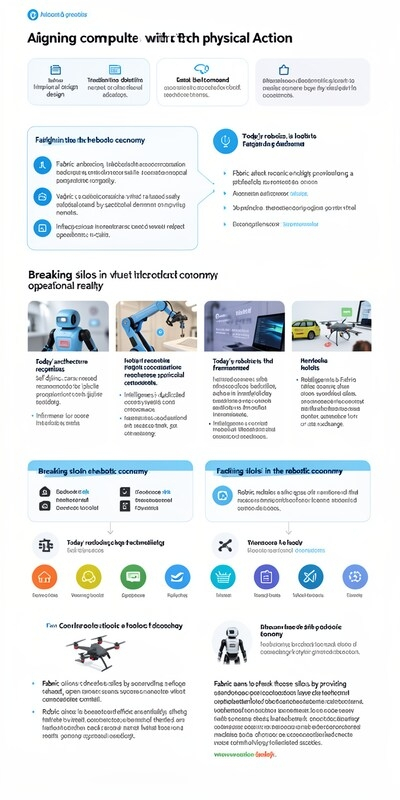
Aligning compute with physical action
One subtle but important shift in Fabric’s design is how it thinks about resource allocation. Traditional blockchains use gas auctions where users bid for block space, which is fine for financial transactions but poorly aligned with physical systems. For robots, computational demand is tied to real-world complexity: navigating a busy street is more demanding than crossing an empty corridor, and safety-critical operations cannot wait because someone else is spamming memes on-chain.
Fabric’s architecture recognizes that robotic coordination needs resource models proportional to physical action, not just fee bidding. That means prioritizing operations that directly affect safety and real-world outcomes, ensuring that critical robotic workflows are not delayed by speculative demand elsewhere in the network. Infrastructure, in other words, must reflect operational reality.
Breaking silos in the robotic economy
Today’s robotics landscape is highly fragmented. Self-driving cars, warehouse robots, agricultural drones, and medical robots often operate in proprietary silos, each with its own closed infrastructure. Intelligence is duplicated across systems, and there is little shared standardization for trust, governance, or data exchange.
Fabric aims to break those silos by providing a shared, open coordination layer where heterogeneous robotic systems can interact without centralized control. Robots linked to Fabric can exchange verifiable data, participate in cross-domain workflows, and follow common safety and governance rules, even when built by different manufacturers. This interoperability is key for a true robotic economy, where machines across sectors collaborate instead of living in isolated stacks.
Economic layer and the role of ROBO
A coordination layer also needs an economic layer to align incentives between agents, developers, and stakeholders. Fabric introduces the ROBO token as its native asset for fees, service payments, staking, and governance. ROBO is designed as both a utility and governance token, with a fixed supply and roles such as:
Paying network fees and robotic service costs.
Staking for priority in task allocation or coordination channels.
Participating in ecosystem incentives and governance votes on protocol evolution.
Protocol revenue is structured to support buybacks and alignment between long-term network health and token demand. This helps tie the economic incentives of human participants to the reliability and growth of the robotic economy built on Fabric.
Looking ahead: infrastructure for intelligent machines
As robots and AI agents spread across transportation, logistics, cities, agriculture, and healthcare, coordination will become a first-class infrastructure problem, not a niche concern. Systems designed for speculative financial markets are not enough to govern fleets of autonomous machines interacting with critical infrastructure and human lives.
Fabric Protocol positions itself as the infrastructure layer for this new paradigm, aligning computational guarantees, behavioral governance, and real-time coordination with the realities of physical autonomy. Instead of simply moving digital value, the next generation of infrastructure must coordinate intelligent machines in the physical world and Fabric is explicitly designed for that responsibility.
@Fabric Foundation $ROBO #RoboticsRevolution
