If you just glance at Fabric Protocol, it’s incredibly easy to get the wrong idea. Most people see "robots" and "blockchain" in the same sentence and assume it’s just another project trying to put hardware on-chain. But if you dig a little deeper, that description feels pretty thin. Fabric isn't actually trying to build the next humanoid robot or warehouse arm; it’s trying to build the economic brain that tells those robots how to behave and interact in a real-world market.
The real shift here is moving away from the obsession with hardware and focusing on coordination. While most people imagine fleets of drones or automated delivery systems, Fabric is more interested in the "boring" but vital infrastructure behind them. They are tackling the questions that actually matter: Who defines the task? How do we verify the robot actually did the work? How does payment settle instantly without a middleman, and who handles the disputes when something goes wrong? In essence, Fabric is building the "operating logic" for a world where machines aren't just tools we own, but independent economic actors.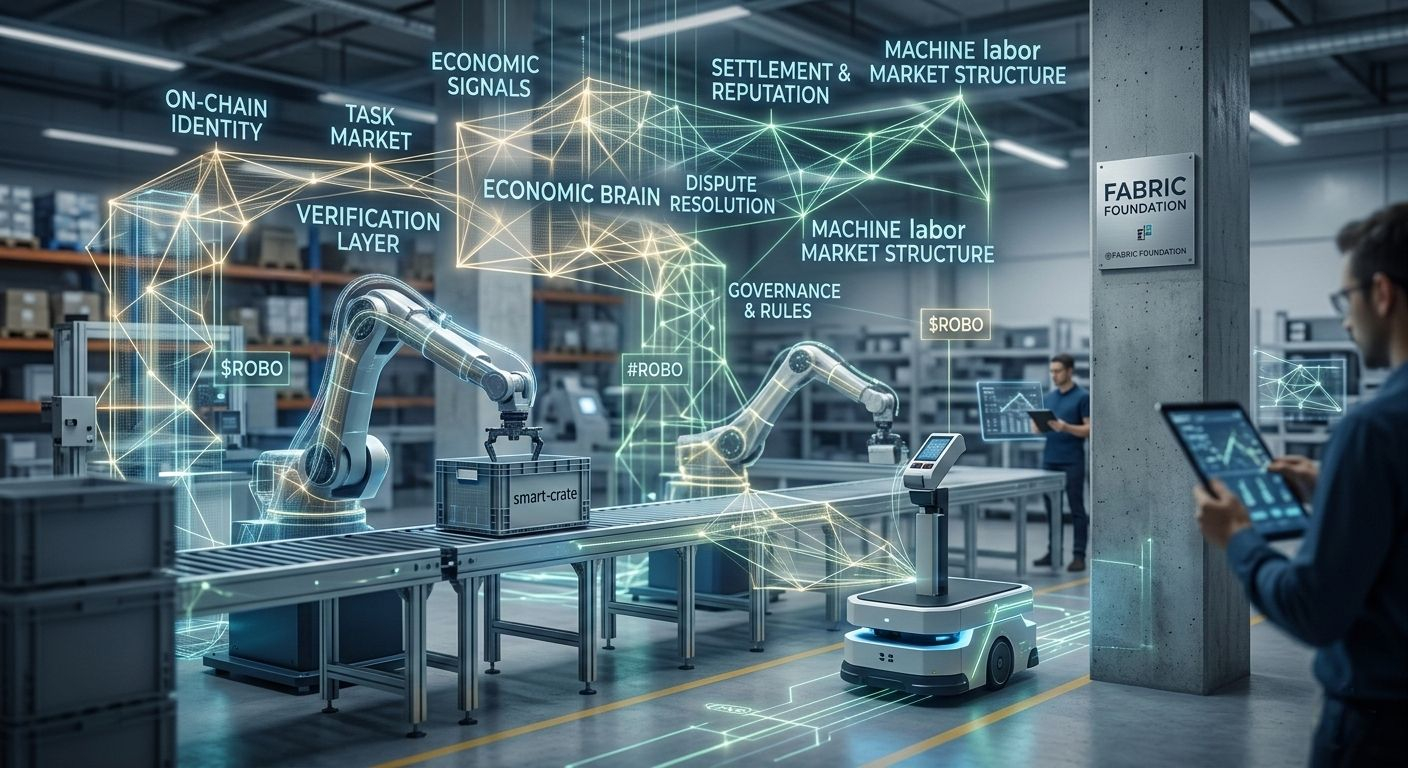
This approach is a direct challenge to the status quo. Currently, when a company automates its workflow, everything stays behind closed doors—the data, the profits, and the rules are all trapped in private corporate databases. Fabric is pushing a much bigger "what if." They are asking if the systems organizing machine labor can become public infrastructure instead. It’s a deliberate move away from just chasing "AI" hype. By focusing on on-chain identity and reputation, they’re envisioning a world where a robot has its own ID, enters a marketplace, performs a task, and builds a "career" based on its performance, all governed by shared code rather than a corporate HR department.
Of course, we have to be realistic—there is still a gap between this vision and the current reality. If you’re looking for a token that gives you a direct legal claim over a fleet of hardware, this isn't it. The value here lies entirely in the coordination layer. If Fabric successfully becomes the place where machine work is routed, verified, and managed, then having influence within that system becomes a massive deal. It’s still early days, and much of the project's value currently rests on its architectural logic rather than massive real-world scale, but that doesn't make it any less serious.
Ultimately, Fabric is an attempt to figure out who controls the rules of machine participation as automation scales. It’s a mix of robotics, market design, and protocol economics that actually feels like it has a point. Whether it succeeds will depend on execution—proving that these shared, decentralized rules are actually more efficient than the closed systems Big Tech is already building. It’s a high-stakes challenge, but by shifting the conversation from the spectacle of robots to the structure of their labor, Fabric has carved out a category of its own.
#ROBO @Fabric Foundation $ROBO