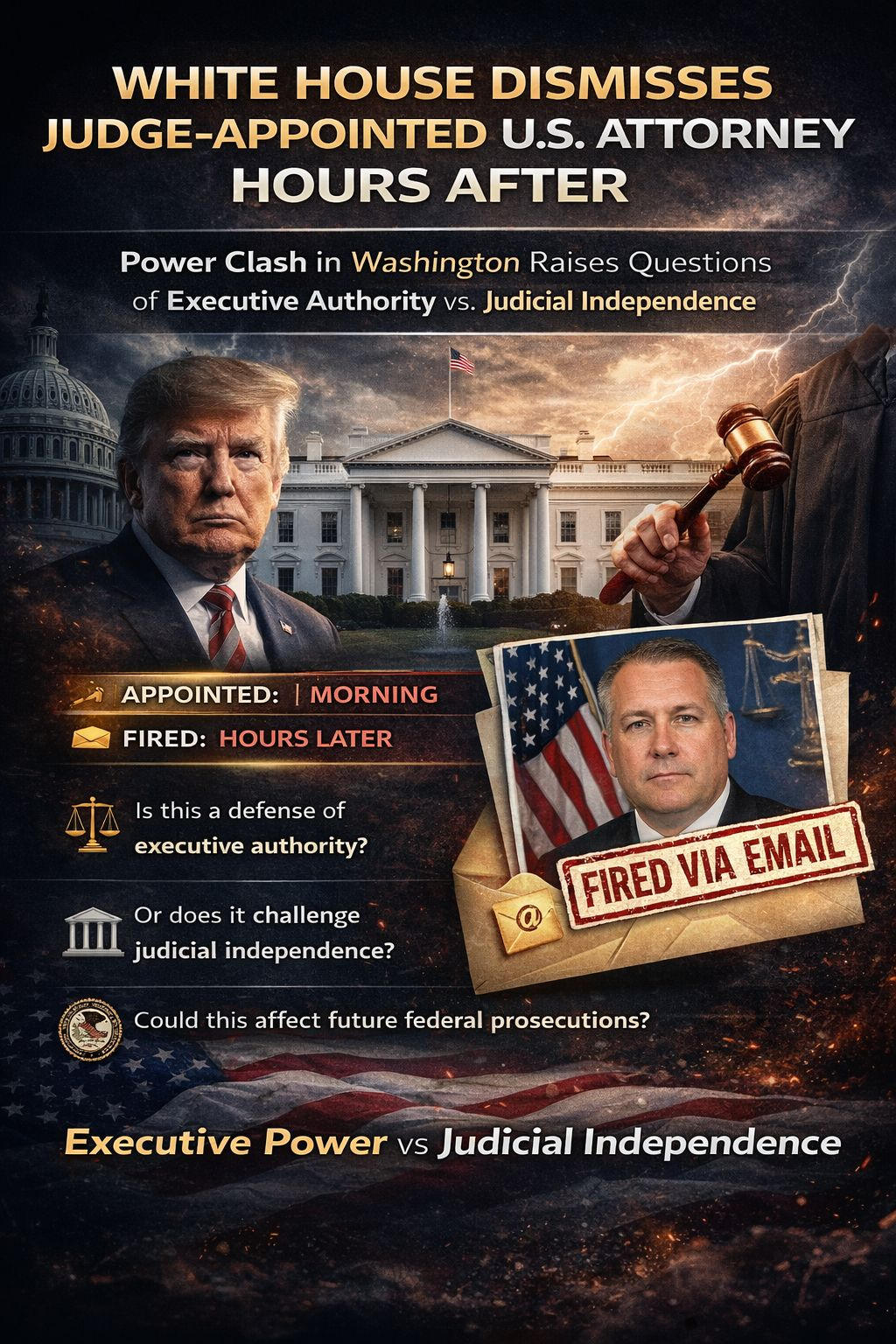
political storm erupted in Washington after the White House dismissed Donald T. Kinsella just hours after federal judges appointed him as U.S. Attorney for the Northern District of New York.
The timeline raised eyebrows. He was appointed in the morning. By later that same day, he was reportedly removed via email.
Federal judges had used their legal authority to fill a vacancy in Albany — a process permitted under certain circumstances when a position remains unfilled. The administration quickly pushed back, maintaining that the power to appoint U.S. Attorneys ultimately rests with the President.
What followed wasn’t just a personnel change — it became a broader institutional clash.
At the center of the debate is a constitutional question: Is this a defense of executive authority? Or does it risk being seen as friction with judicial independence?
Legal experts note that disputes over appointment authority are rare but significant because they shape how branches of government interact. U.S. Attorneys play a critical role in federal prosecutions, and leadership uncertainty can carry implications for ongoing and future cases.
This moment goes beyond one office in New York. It touches on separation of powers — the balance between the executive and judicial branches — and how precedent may guide future appointments.
Power. Authority. Institutional boundaries.
Washington is watching closely.