Gold never really leaves the conversation. It just waits for the right moment.
Now it’s back in focus, but with a twist. More than $6 billion worth of gold is currently tokenized on blockchain networks. Over 1.2 million ounces of physical gold sit in vaults, represented by digital tokens that trade 24/7. Roughly $2 billion of that value has been added this year alone.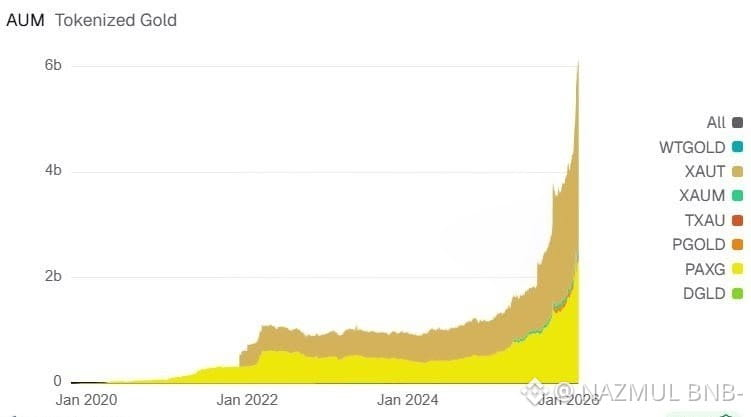
This isn’t a meme trend. It’s capital moving with intent.
Two names dominate the space: Tether with its token XAUT, and Paxos with PAXG. Together, they control about 96.7% of the entire tokenized gold market. That level of concentration tells you something important. This isn’t a fragmented experiment. It’s a small, tightly controlled segment of the crypto economy.
So what’s actually happening here?
At its core, tokenized gold is simple. Each token represents a claim on real, physical gold stored in professional vaults. Instead of holding a gold bar or buying shares of a gold ETF, investors can hold a token in a crypto wallet. The price tracks gold. The settlement is instant. The market never sleeps.
That’s the structural shift.
Gold used to move through banks, brokers, and metal dealers. Now it moves through wallets and exchanges. You can trade it on a Sunday night. You can send it across borders in minutes. You can use it as collateral in certain crypto platforms. Physical gold doesn’t do that on its own.
From a trader’s perspective, this changes behavior.
When macro uncertainty rises and investors look for safety, gold typically benefits. Now there’s a version of gold that sits inside the same ecosystem as Bitcoin and stablecoins. That makes capital rotation faster. Instead of exiting crypto completely, some traders rotate into tokenized gold. It becomes a defensive position without leaving the digital market structure.
That flow matters.
The $2 billion added this year suggests demand is not theoretical. It’s real capital seeking exposure. In risk-off environments, that trend can accelerate. But here’s the nuance: this is still gold. It’s not designed to 10x. It’s designed to preserve value and reduce volatility in a portfolio.
That’s why the growth is interesting.
This isn’t hype-driven growth. It’s infrastructure growth. Over 1.2 million ounces locked on-chain signals trust in the custody model, at least at a functional level. But traders should stay clear-eyed. These tokens rely on centralized issuers and custodians. The gold is real, but it’s stored by institutions. Transparency reports and audits matter. Redemption terms matter. Concentration risk matters.
When two issuers control nearly the entire market, counterparty awareness becomes part of the strategy.
Still, the bigger concept goes beyond just gold.
Tokenized gold is a live example of real-world assets moving onto blockchain rails. It shows how traditional value can be wrapped in digital form without changing the underlying asset. The metal hasn’t changed. The access has.
That’s powerful.
Imagine explaining this five years ago. A gold bar in a vault, represented by a token you can trade instantly from a phone in Bangladesh or Brazil. No shipping. No storage at home. No bank middle layer for every transfer.
For everyday investors, the appeal is practical. You don’t need to understand derivatives or commodities trading. You just buy a token that follows gold’s price. Simple. Familiar. Digital.
For traders, it adds flexibility. Gold exposure without leaving crypto liquidity. A hedge inside the same account. Faster rotation between risk-on and risk-off positions.
For the market as a whole, it signals maturity.
Crypto isn’t just building new assets anymore. It’s absorbing old ones. And gold is one of the oldest stores of value in history.
The $6 billion milestone doesn’t mean tokenized gold will replace physical gold or ETFs. It doesn’t need to. What it shows is that there is demand for programmable, portable, and continuously tradable exposure to something traditional and trusted.
The next phase will likely depend on three things: transparency from issuers, regulatory clarity, and broader integration into financial platforms. If those strengthen, adoption can expand steadily. If trust weakens, growth slows. Simple as that.
Right now, the data tells a clear story. Capital is flowing. The structure is forming. And digital gold is no longer a niche experiment.
It’s becoming part of the market’s core toolkit.