
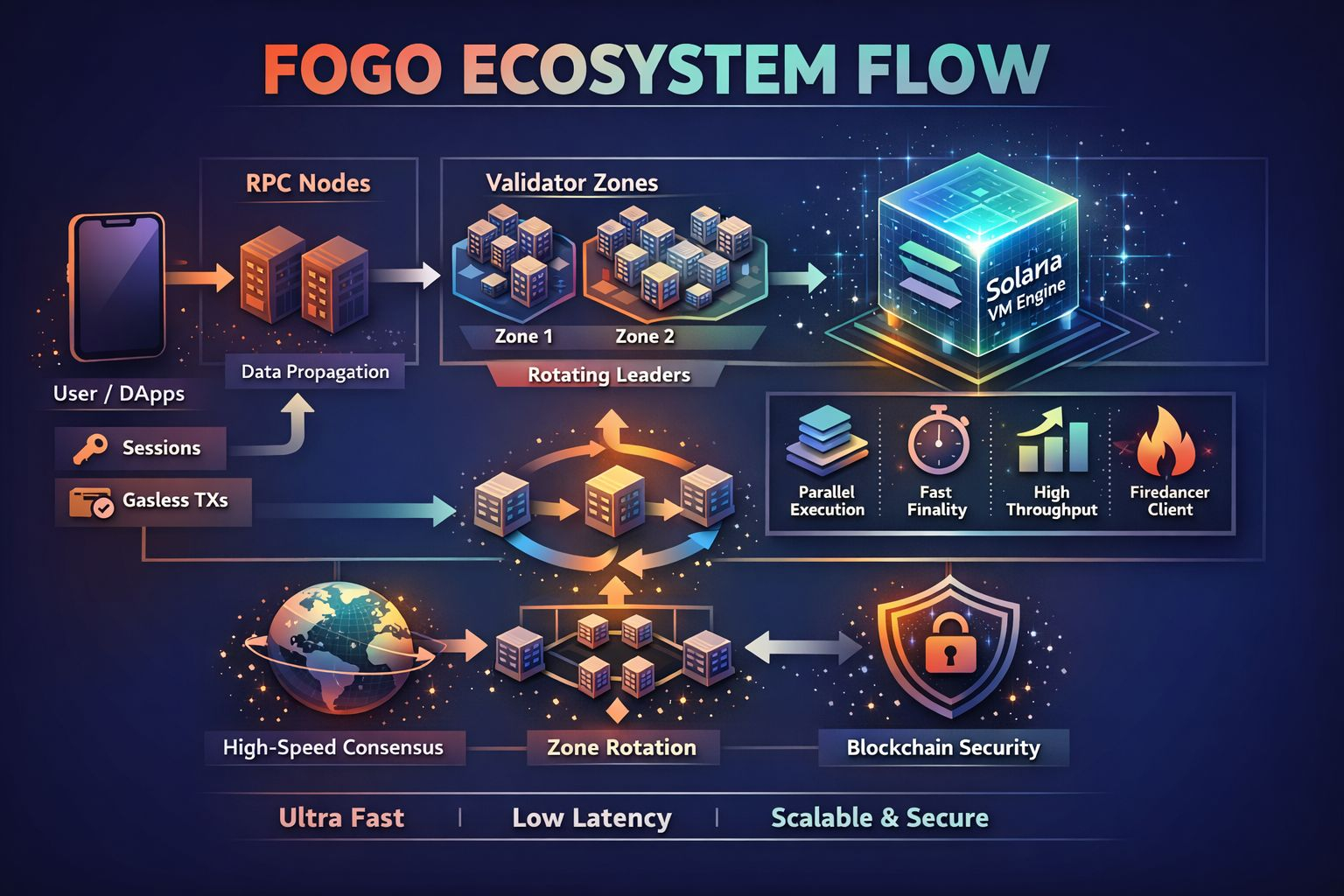
I’m going to describe Fogo the way it feels when you zoom out and then slowly move closer, because what they’re doing is not just “another Layer 1,” it’s a very specific promise that on chain trading and real time apps should stop feeling like a compromise, and it should start feeling like something you can trust under pressure, when the market is moving fast and the stakes are real and you do not want to wonder if your transaction will land in time or if the network will suddenly turn into a crowded hallway where everyone is pushing and nobody is sure what happened first. Fogo presents itself as a high performance Layer 1 built around the Solana Virtual Machine, and the emotional heart of that choice is simple: they want the speed and parallel execution style that the SVM ecosystem is known for, but they also want to rebuild parts of the network experience that usually get hand waved away, like unpredictable latency, validator performance variance, and the way congestion can turn the user experience into a guessing game.
To understand why the SVM matters here, it helps to picture how this runtime thinks about work, because in an SVM style chain, a transaction does not arrive as a vague command that the network must interpret later, it arrives with clear instructions about which accounts it will read and which accounts it will write, and that one constraint creates a powerful benefit because the runtime can run many non conflicting transactions in parallel rather than forcing everything into a single line. The result is not only more throughput, but a more practical kind of throughput where the network can keep moving even when one crowded application is busy, because unrelated activity can continue without being blocked by the same shared hotspots, and this is where people start caring about the chain again, because the difference between “fast in theory” and “fast when everyone is actually using it” is what separates a nice demo from a usable financial system.
Now let’s walk through what happens step by step when you submit a transaction, in a way that matches the system as Fogo describes it. First, your wallet or application creates an SVM formatted transaction that declares the account set it plans to touch, then it signs the message and sends it into the network through an RPC path, and from there the network needs two things to happen quickly and consistently, it needs to decide which block producer is currently responsible for ordering the next chunk of transactions, and it needs to propagate data across validators with as little wasted time as possible, because every extra millisecond of uncertainty can snowball into worse user outcomes, especially for trading apps where timing is the product. In a leader based system, a scheduled leader collects incoming transactions, filters duplicates, decides how to pack them efficiently, and then executes them against the current state, producing a block that the rest of the validator set can verify and vote on so the chain can converge on a single history.
This is where Fogo’s main personality shows up, because they do not treat geography and validator placement as background noise, they treat it like a core design input, and they describe a zone based approach where validators are grouped into zones and only one zone is actively driving consensus during an epoch, with the active zone rotating over time. The human reason behind this is almost painfully obvious once you say it out loud: distance is expensive, and the speed of light plus real world network routing is not going to negotiate with your roadmap, so if the set of machines that must rapidly agree with each other is physically closer together, the critical path of message propagation shrinks and the time to reach confident finality can drop, which is exactly what real time finance wants. They’re not pretending this is a free win, because the minute you say “co location” or “tight proximity,” you also invite hard questions about decentralization shape and operational concentration, but the argument is that rotation, threshold rules, and on chain assignment logic can preserve resilience while still allowing the network to operate at a latency level that feels closer to high frequency systems than to traditional blockchains.
The second choice that matters is about software uniformity and performance consistency, because Fogo leans into a high performance client strategy using a Firedancer based approach and a hybrid structure that they describe as a practical bridge between mature validator code and a performance specialized pipeline. The key idea is not magical optimization, it is engineering discipline: break the validator into a pipeline of dedicated components that each do one job extremely well, run them in tight loops pinned to CPU cores, reduce memory copying, reduce unnecessary serialization, reduce context switching jitter, and treat networking, signature verification, deduplication, packing, execution, and block dissemination like a carefully tuned factory line rather than a single large program that occasionally pauses to think. If you’ve ever watched a system fall apart in the worst five percent of conditions, you know why they’re obsessed with this, because average performance is a vanity metric, but tail latency is the thing that actually decides whether users feel safe.
When this pipeline is working the way it is meant to work, the story of a block is clean and fast: transactions arrive, they’re streamed and reassembled, signatures are verified in parallel, duplicates are removed, account references are resolved, a leader packs transactions into a structure that can be executed efficiently, execution updates account state, and then the block is committed into the chain’s history structure and propagated to other validators so they can verify and vote. The dream is that the system spends most of its time moving forward and almost none of its time waiting for slow components, which is how you get from “we can handle a lot of transactions” to “we can handle a lot of transactions without the user experience changing when the network gets busy.”
There is also a user experience layer here that is easy to underestimate until you watch real people use crypto, and this is where Sessions comes in as Fogo describes it, because the project aims to reduce the constant friction of gas management and repetitive signing by letting users grant scoped, time limited permissions that applications can use to perform actions on their behalf in a controlled way, often with a paymaster style mechanism that can cover fees so users are not forced to hold a specific gas token just to click around. They’re trying to make on chain life feel normal, like the app can pay the cost of doing business while the user stays focused on what they are trying to achieve, and if it becomes widely adopted, this is the kind of shift that can quietly change who is willing to participate, because it lowers the mental burden without removing self custody as the foundation.
If you’re evaluating Fogo seriously, you want to watch the metrics that reveal truth rather than hype, and the most important ones are the ones that describe time and stability, not just raw volume. You want to watch block time behavior as it behaves in the real world, not only the target but the variance, because jitter is what users feel, and you want to watch confirmation and finality timing in both typical conditions and stressed conditions, because a chain that is fast until it is popular is not actually fast, it is simply underused. You also want to watch fork rate and reorganization behavior, because any design that pushes the edge of latency has to prove it can keep safety and convergence tight. Then you want to watch fee dynamics during congestion, especially whether fees stay local to hotspots or spill into global pain, because the difference between localized contention and global bidding wars is the difference between a network that can host many apps and a network where one popular app drags everyone into the same traffic jam. Finally, you want to watch validator participation reality, meaning how many validators actually matter for consensus, how stake and influence distribute, what hardware requirements effectively gate participation, and whether zone rotation stays healthy over time rather than becoming a fragile ritual that only works on quiet days.
The risks are real, and they’re not the kind you can hide behind branding, because the same choices that unlock performance can create sharp edges that the market will test. Zone based operation and co located consensus can concentrate operational and jurisdictional exposure, and rotation helps but rotation itself can introduce complexity and new failure modes, so the project has to prove not only that it can run fast, but that it can rotate safely, recover gracefully, and keep the chain coherent when something unexpected happens in a single region. A curated validator approach can keep performance consistent, but it also raises governance pressure, because you have to answer who decides participation, how decisions are made, and what protections exist against censorship or unfair exclusion, and the only way people trust this over time is through transparency, clear rules, and a track record that survives stressful events. A high performance client pipeline can reduce latency, but hybrid systems can inherit complexity from both sides, and complexity is where rare bugs live, so the engineering bar is extremely high. Sessions and paymasters can make onboarding smoother, but they also add new trust surfaces and abuse vectors, so permission scoping, limits, domain binding, and monitoring matter, and the first major exploit in any abstraction layer tends to hurt not just one app but the entire narrative of safety.
What makes the future interesting is that it does not depend on one miracle, it depends on steady proof, and I’m watching for a very specific evolution path that feels realistic. We’re seeing the concept of real time on chain finance become less of a slogan and more of an engineering race, and Fogo’s direction suggests a world where more SVM compatible applications can move across without rewriting everything, where the chain’s performance profile becomes predictable enough for serious on chain order books and timing sensitive liquidation systems, and where user experience can feel closer to modern apps because the chain stops demanding constant gas handling and constant signature fatigue. If it becomes clear that the performance gains come with acceptable decentralization and safety tradeoffs, the ecosystem can grow around the idea that latency is not just a nice to have, it is a core product feature. If the tradeoffs bite harder than expected, the chain may still find a strong niche as a specialized venue for certain kinds of trading and execution, but the wider market will ask for proof that speed does not quietly weaken resilience.
In the end, what I appreciate about this kind of project is not that it claims perfection, but that it picks a clear problem and refuses to treat it as “someone else’s issue,” because speed, predictability, and usability are not separate concerns when you’re building a financial system, they are one connected promise. They’re betting that if the base layer feels steady and fast even when emotions run high and markets move fast, builders will stop designing around limits and start designing around possibilities, and users will stop feeling like they are wrestling the chain and start feeling like the chain is simply there, dependable, almost invisible, doing its job while they do theirs. If Fogo keeps building with that kind of discipline, then even small improvements can stack into something that feels surprisingly human: a system that does not demand your attention every second, and still gives you the quiet confidence that your actions matter, your time matters, and the future can be built a little closer to the way we always hoped it would feel.
