

Most Layer-1 conversations still revolve around spectacle. Throughput numbers. Transaction speed claims. Buzzwords layered on buzzwords. The narrative often treats blockchains like performance machines faster is better, louder is stronger.
But when you talk to builders not marketers, not speculators, but teams shipping products a different reality appears. They do not ask how flashy a chain sounds. They ask whether it works reliably, whether they can connect in minutes, whether they can deploy without friction, whether it breaks under load.
That is where Vanar’s advantage becomes visible.
@Vanarchain is not quietly winning because it sounds futuristic. It is positioning itself to win because it behaves like infrastructure. And infrastructure, not hype, is what scales.
When builders evaluate a network, they start with the basics. What is the RPC endpoint? Is WebSocket available for live updates? What is the chain ID? Is the explorer reliable? Does the testnet mirror production? Can we onboard our team in less than a week?
These questions sound boring — but they determine survival.
Vanar provides clearly defined mainnet RPC endpoints, WebSocket connectivity, a documented chain ID, token configuration, and an official explorer. This removes ambiguity. Builders do not need to reverse-engineer connection details or search community threads for configuration steps.
In practice, that reduces integration time dramatically. If a team can connect to the network within minutes instead of days, experimentation costs fall. Lower experimentation cost means more projects attempt deployment. More attempts mean higher probability of durable ecosystem growth.
This is not theory. In software ecosystems, friction reduction directly correlates with adoption velocity.
Vanar’s EVM compatibility also plays a deeper role than convenience. Many chains advertise compatibility as a feature. In reality, compatibility reduces operational risk.
Businesses do not fear writing code. They fear maintenance, audits, hiring constraints, and unknown integration edge cases. When a network adheres to familiar EVM standards, teams reuse existing tooling, workflows, wallet integrations, and auditing practices.
Vanar’s compatibility — including straightforward MetaMask onboarding and support across developer platforms like thirdweb — lowers the perceived risk of adoption.
Risk reduction is often more powerful than speed improvement.
A 10% performance improvement rarely changes a roadmap. A 50% reduction in deployment uncertainty does.
Testnet readiness is another overlooked differentiator. Many chains emphasize mainnet headlines but neglect their test environment. Yet serious builders live in testnet during product development.
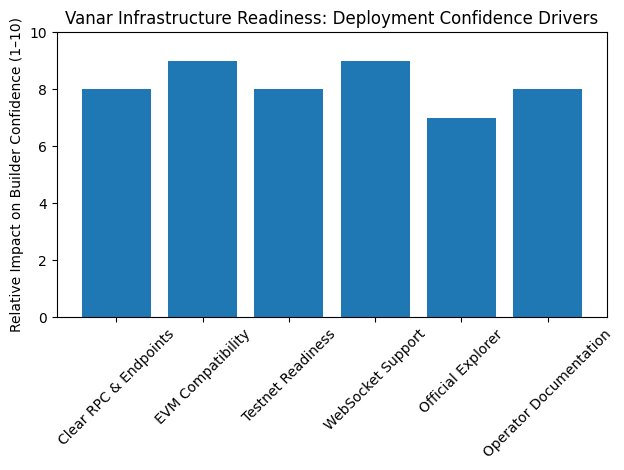
Vanar provides clearly separated testnet endpoints and configuration documentation. That signals maturity. Teams building AI-driven applications, automation layers, and always-on services require stable environments for iteration.
Without reliable test infrastructure, production quality collapses.
Vanar’s broader AI-native positioning only works because the plumbing exists underneath. AI agents and autonomous systems require continuous, reliable connectivity. WebSocket endpoints are not optional — they are foundational for real-time feedback loops, live state monitoring, and automated transaction execution.
An AI infrastructure chain without dependable always-on connectivity is narrative without foundation.
Vanar’s WebSocket support and endpoint clarity demonstrate that the AI thesis is operationally grounded rather than abstract.
The block explorer may seem trivial, but in reality it acts as a network’s trust interface. When transactions fail, when payments stall, when contracts misbehave, users do not consult whitepapers. They check the explorer.
Developers debug with it. Exchanges verify activity with it. Support teams rely on it.
Vanar’s emphasis on providing an official explorer as part of its core documentation reinforces a business-grade posture. Enterprises prefer visible, auditable environments. Transparency reduces friction during incidents.
And incidents always happen.
Node and operator documentation further strengthen this infrastructure identity. Sustainable chains support not only end-users but service providers, RPC operators, analytics dashboards, compliance tools, and monitoring platforms.
Vanar’s documentation provides guidance for infrastructure operators. This positions the chain not merely as an app platform but as a base layer that secondary services can confidently build upon.
Ecosystems become durable when service providers integrate deeply.
That integration requires predictable architecture and accessible documentation — not marketing campaigns.
Another subtle but critical advantage lies in compatibility across developer directories and infrastructure ecosystems. Vanar’s presence in thirdweb and other EVM tooling platforms signals integration readiness.
This matters because adoption rarely begins from scratch. Developers already use standardized frameworks. A chain that inserts itself seamlessly into existing stacks accelerates growth organically.
All these factors combine into a single emerging identity: Vanar is becoming infrastructure that can actually be deployed.
Its broader narrative around AI agents, memory layers, PayFi, tokenized assets, and multi-industry applications gains credibility precisely because the underlying network fundamentals are operationally sound.
Infrastructure wins by being predictable.
Predictability builds retention.
Retention builds compounding growth.
In crowded Layer-1 markets, many projects chase differentiation through features. Vanar appears to be pursuing differentiation through deployability.
Builders do not choose chains because they are the fastest on paper. They choose chains that let them ship before runway expires.
When onboarding is frictionless, when test environments mirror production, when monitoring tools are stable, when wallets connect instantly, and when infrastructure behaves consistently, the chain becomes the default choice — not because it is loud, but because it works.
This is incremental advantage. It does not produce viral spikes. It produces steady ecosystem density.
And steady density is what ultimately determines which chains endure beyond narrative cycles.
Vanar’s scaling advantage is not dramatic. It is systematic.
It is the quiet discipline of building plumbing that does not leak.
Over time, the chains that feel the most boring in the best sense reliable, connectable, predictable often become the default platforms for builders who simply want to ship.
@Vanarchain opportunity lies there.
Not in being the loudest chain.
But in being the chain that builders can trust to behave like infrastructure.
And infrastructure, when it works, rarely needs to shout.
