
Over the past few years I’ve noticed something interesting about how the crypto market talks about privacy. Most people assume privacy is either a philosophical debate or a regulatory headache. It’s often framed as something ideological rather than something structural. But when I look closely at how real blockchain systems evolve, privacy tends to appear not as a rebellion against transparency, but as a technical correction to it. That is the lens through which I’ve been watching @MidnightNetwork and the broader idea behind #NIGHT .
Midnight Network sits in the Layer 1 category, but it doesn’t feel like a typical L1 narrative. Most Layer 1 projects compete on speed, throughput, or developer ecosystems. Midnight seems to approach the market from a different angle. It treats privacy as missing infrastructure rather than an optional feature. That difference sounds subtle, but in practice it changes how the system is designed and how users interact with it.
What interests me most is timing. The market today is not the same as it was during the early DeFi cycle or the NFT wave. Back then the priority was experimentation. Protocols rushed to prove that decentralized systems could replicate traditional financial tools. Privacy was rarely part of the equation because transparency made debugging and trust easier. Now the environment is shifting. Institutions are exploring blockchain infrastructure, regulators are paying closer attention, and real-world assets are starting to interact with public networks. In that context, full transparency becomes less practical.
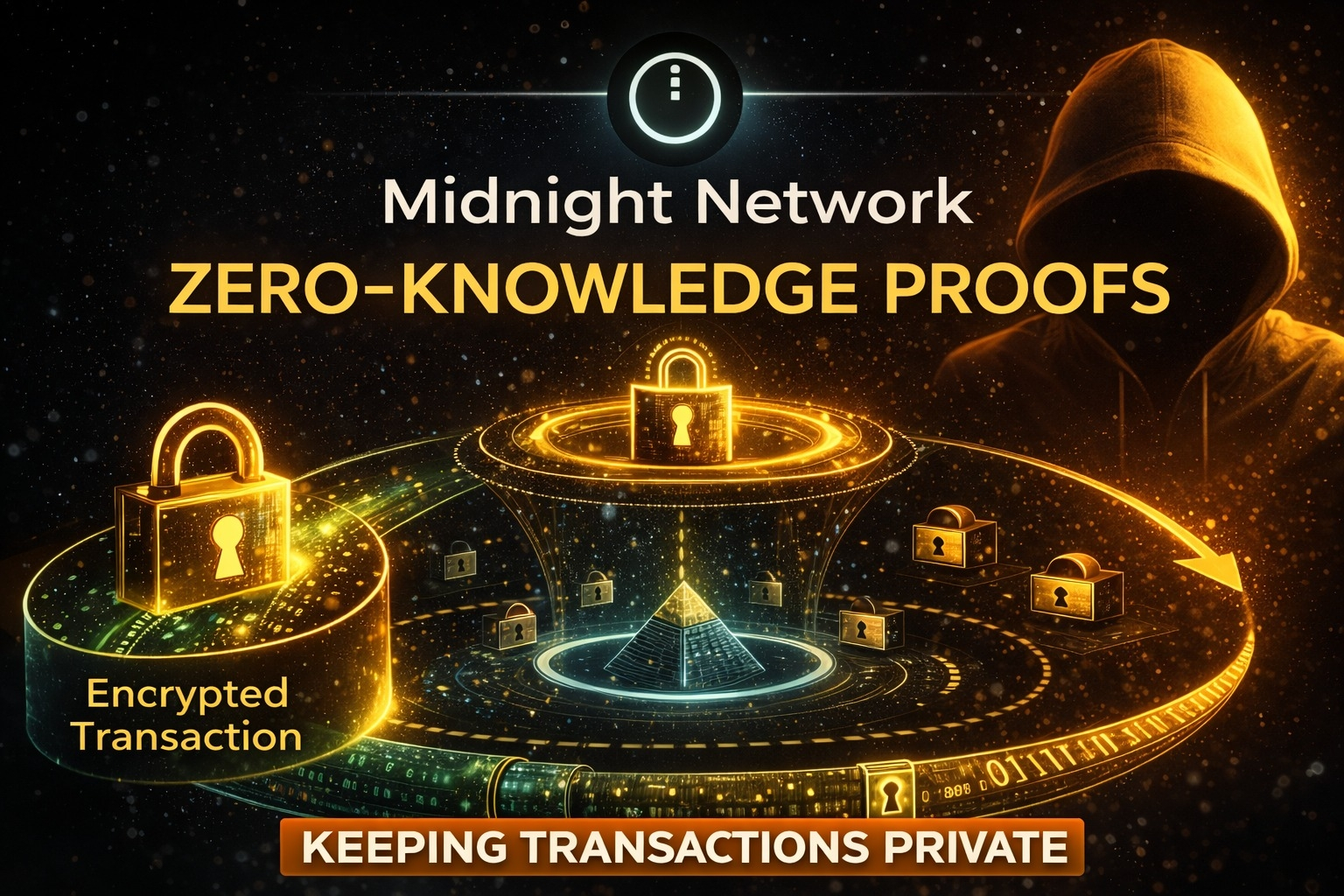
Midnight Network appears to be responding to that shift. Instead of forcing every transaction and data point into a public ledger visible to everyone, the architecture introduces zero-knowledge proofs as a way to separate verification from exposure. In simple terms, the network can confirm that a transaction is valid without revealing the underlying data behind it.
I tend to think of it like a sealed envelope with a cryptographic stamp. The network can check that the envelope hasn’t been tampered with and that the sender has the right to send it, but it doesn’t need to open the envelope to verify those facts. That basic idea has existed for years in cryptography, but integrating it directly into a Layer 1 architecture changes how developers design applications.
One thing I’ve noticed while following the space is that privacy solutions often struggle with usability. Many privacy tools exist in isolation from the broader ecosystem. They require specialized wallets, separate networks, or complicated user flows. Midnight’s approach seems more focused on embedding privacy capabilities directly into programmable infrastructure. Developers can build applications that selectively reveal information when necessary while keeping other parts confidential.
From a user perspective, that creates interesting possibilities. A trader or participant interacting with a Midnight-based application might prove they meet certain conditions without exposing personal data. For example, proving compliance requirements, ownership thresholds, or transaction validity without broadcasting full financial histories. In traditional finance, this type of selective disclosure is normal. On most blockchains today, it is almost impossible.
Of course, the trade-offs are real. Zero-knowledge systems add complexity. Proof generation requires computational work, and verifying those proofs across a decentralized network introduces additional design challenges. Privacy layers can also create friction for analytics, auditing, and transparency, which are important for many DeFi participants. In other words, privacy doesn’t eliminate problems; it simply redistributes them.
Another dimension worth watching is the role of the NIGHT token. Tokens tied to infrastructure networks often serve multiple functions at once. They can act as economic incentives for validators, payment for computational resources, or coordination mechanisms for governance. In a privacy-focused network like Midnight, the token may also play a role in securing proof verification and maintaining the economic balance of the system.
When I observe token behavior in networks like this, I tend to look less at short-term price movement and more at network activity patterns. If Midnight gains traction, on-chain data would likely show increasing proof verification activity, application deployments, and transaction volume tied to private computation rather than simple transfers. Price movements often lag behind those structural signals.
What makes Midnight interesting right now is the broader direction of the market cycle. For several years the crypto ecosystem has been obsessed with scaling. Rollups, modular architectures, and data availability layers dominate technical conversations. But as those scaling solutions mature, attention gradually shifts toward what applications actually need once performance stops being the bottleneck.
Privacy becomes much harder to ignore at that stage. Real businesses, financial institutions, and enterprise participants rarely want their entire operational data visible on a public ledger. Yet they still want the security guarantees that blockchains provide. Midnight appears to position itself precisely at that intersection.
Recent discussions around confidential smart contracts and selective disclosure suggest that the industry is beginning to take these ideas more seriously. Whether Midnight becomes a major player or simply contributes to the broader evolution of privacy infrastructure remains uncertain. Crypto history is full of technically elegant systems that struggled to gain adoption.
Still, I find it difficult to dismiss the underlying premise. Public blockchains solved the problem of trustless verification, but they created another issue in the process: radical transparency. For early experiments that transparency was useful. For mature financial and data systems, it may become a limitation.
When I step back and look at Midnight Network from that perspective, I see less of a hype-driven project and more of an attempt to address an architectural imbalance in the ecosystem. It is trying to reconcile two things that normally conflict in distributed systems: verification and confidentiality.
Whether the market values that balance right now is another question entirely. Crypto cycles often reward narratives long before infrastructure proves itself. But sometimes the quieter projects — the ones focused on solving structural problems rather than chasing trends — end up shaping the next phase of the industry.
I’m not certain yet where Midnight will land in that story. What I do know is that the conversation around privacy is gradually shifting from ideology to practicality. And once that shift becomes obvious to the market, networks designed around that reality may start to matter more than people expect.
