
@Mira - Trust Layer of AI $MIRA #Mira #AI
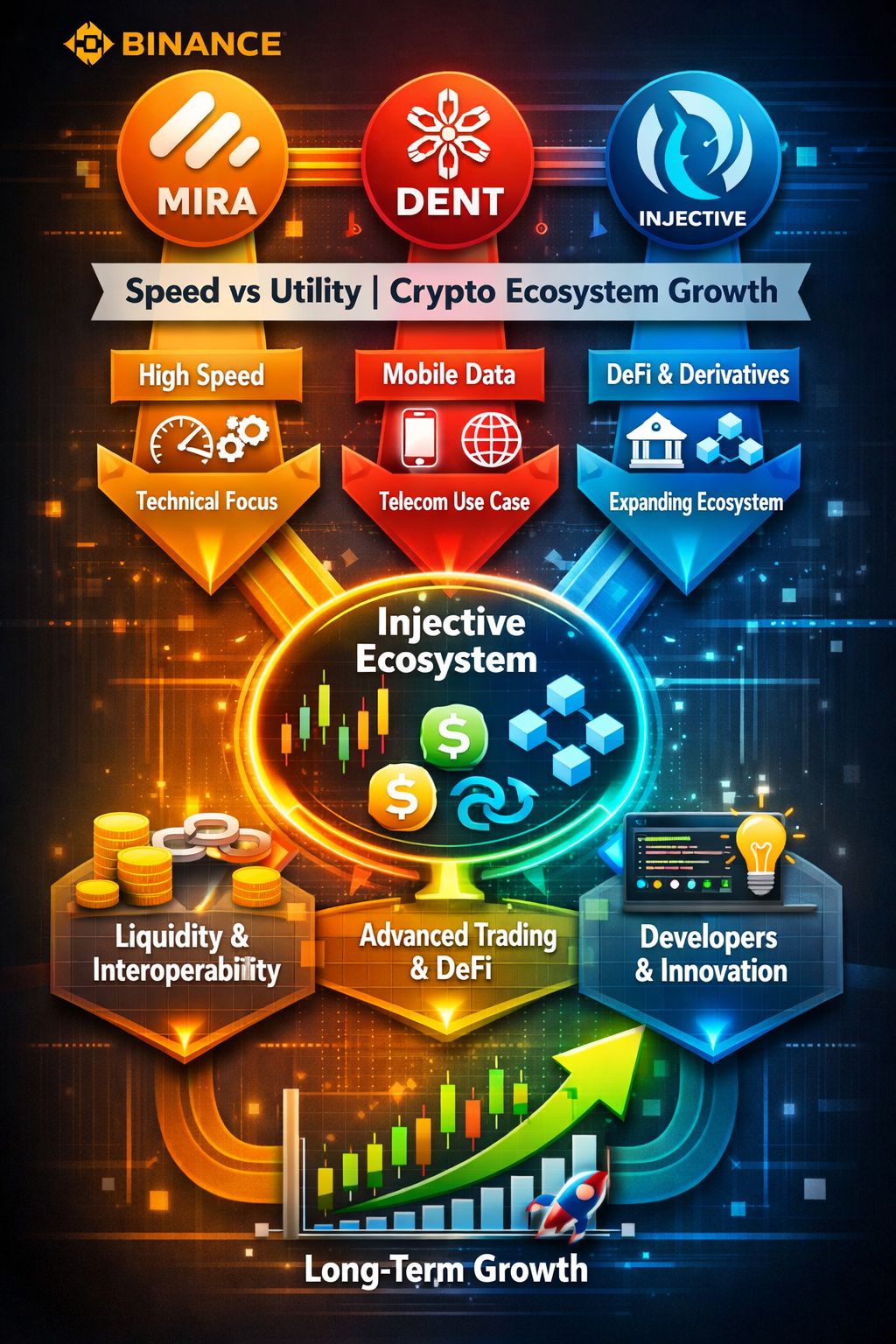
In the fast-moving world of cryptocurrency trading, narratives change almost overnight. A few years ago, the conversation was simple: whichever blockchain processed transactions the fastest would win the market. Traders chased raw speed numbers, networks advertised thousands of transactions per second, and investors believed that performance metrics alone would determine the future. But today the market has evolved. Speed still matters, but it is no longer the ultimate deciding factor. In the growing competition between MIRA, $DENT , and Injective ($INJ ), the deeper story lies far beyond raw transaction speed.
For professional traders watching the Binance ecosystem, the shift is impossible to ignore. The market has matured, infrastructure has improved, and traders now evaluate networks based on utility, ecosystem strength, and real adoption rather than simple benchmarks. And in this evolving landscape, Injective has begun to emerge as one of the most strategically positioned platforms in the entire crypto sector.
The reason is simple: markets reward systems that solve real problems. Speed alone does not build financial ecosystems. Liquidity, interoperability, developer activity, and institutional readiness do.
MIRA entered the conversation as a technically promising project designed to offer efficient blockchain interactions. Its architecture highlights optimization and streamlined processing, which naturally places transaction speed at the center of its narrative. For early adopters who still view performance as the primary metric, MIRA appears attractive. But the deeper question professional traders ask is this: what is the real-world demand driving the network? Without an expanding ecosystem of applications, liquidity layers, and financial instruments, even the fastest chain can struggle to maintain long-term relevance.
DENT, on the other hand, carries a completely different story. The project was built around the idea of decentralizing mobile data markets and creating a global telecom ecosystem powered by blockchain. For a time, this vision attracted enormous excitement. The concept of buying, selling, and trading mobile data globally felt revolutionary, and early market cycles pushed DENT into major exchange listings including Binance. However, over the years, traders have realized that innovation alone is not enough; execution, scalability, and continuous ecosystem development determine whether a token maintains momentum in competitive markets. While DENT still maintains a recognizable brand and loyal community, its market narrative has gradually cooled compared to the explosive infrastructure developments seen in newer blockchain ecosystems.
This is where Injective begins to rewrite the rules.
Injective is not just another blockchain focused on speed. It was engineered as a complete financial infrastructure layer for decentralized markets. Instead of competing purely on transaction throughput, Injective focuses on building a powerful decentralized trading environment where derivatives, spot markets, prediction markets, and structured financial products can operate seamlessly on-chain.
From a professional trading perspective, this design philosophy changes everything.
Markets care about liquidity. Markets care about accessibility. Markets care about composability between protocols. Injective’s architecture directly targets these priorities, creating a network optimized for real financial activity rather than simple transactional metrics.
Speed certainly exists within Injective’s framework — the network processes transactions with extremely low latency and near-instant finality. But the critical difference is that speed is not the headline feature. It is simply the foundation supporting a far larger financial ecosystem.
This distinction is what sophisticated Binance traders increasingly recognize.
Injective’s deep integration with the Cosmos ecosystem, its interoperability layers, and its ability to support complex financial instruments have transformed it into a platform that feels closer to a decentralized Wall Street than a standard blockchain network. Traders are no longer limited to simple token swaps; they can interact with advanced market structures that mirror traditional finance while maintaining the transparency and openness of decentralized infrastructure.
When comparing this to MIRA and DENT, the contrast becomes clear.
MIRA competes primarily on technical performance. DENT competes on a niche telecom use case. Injective competes on financial dominance.
And financial markets ultimately gravitate toward platforms where capital can move efficiently, products can evolve rapidly, and liquidity attracts more liquidity.
Another powerful factor driving Injective’s growing influence is its developer ecosystem. Over the past cycles, a surge of decentralized applications, trading protocols, and financial tools have begun building directly on the Injective network. This expanding environment creates what traders call a network effect. Each new project strengthens the platform, draws new users, and increases demand for the underlying token.
Markets rarely reward isolated innovation. They reward ecosystems.
From a price-action perspective, this ecosystem growth creates something every trader looks for: sustainable narrative momentum. Instead of relying on short-term hype cycles, Injective’s value proposition continues to deepen as new applications integrate with its infrastructure.
This structural strength explains why many analysts now view Injective not simply as a high-performance blockchain, but as a core financial layer for the future of decentralized trading.
In contrast, projects that focus purely on speed face a long-term challenge. As blockchain technology evolves, speed improvements become easier to replicate. What cannot be replicated easily is a thriving ecosystem filled with active developers, liquidity providers, institutional integrations, and real financial products.
Speed can be copied.
Ecosystems cannot.
That reality is reshaping how professional traders analyze Binance-listed assets. Instead of asking “Which network is the fastest?” they now ask deeper questions.
Which platform attracts capital?
Which ecosystem builds real markets?
Which infrastructure will still matter five years from now?
Increasingly, Injective appears in the answer to those questions.
This does not mean MIRA or DENT disappear from the conversation. Both projects still represent interesting experiments within the broader blockchain landscape, and crypto history has repeatedly shown that unexpected innovations can reignite dormant narratives. But when evaluating long-term strategic positioning, Injective’s alignment with decentralized finance, derivatives trading, and cross-chain liquidity gives it a significantly broader growth runway.
In many ways, the comparison between MIRA, DENT, and Injective reflects the larger transformation happening across the entire crypto industry.
The market is moving beyond raw performance numbers.
The next generation of winners will be defined by economic gravity — platforms capable of attracting capital, enabling complex financial activity, and sustaining innovation across entire ecosystems.
Speed started the blockchain revolution.
But infrastructure will define its future.
And right now, among Binance-listed projects competing for market relevance, Injective is quietly building the kind of financial foundation that could shape the next era of decentralized trading.