On Friday morning in Asia, global assets exhibited severe volatility once again.
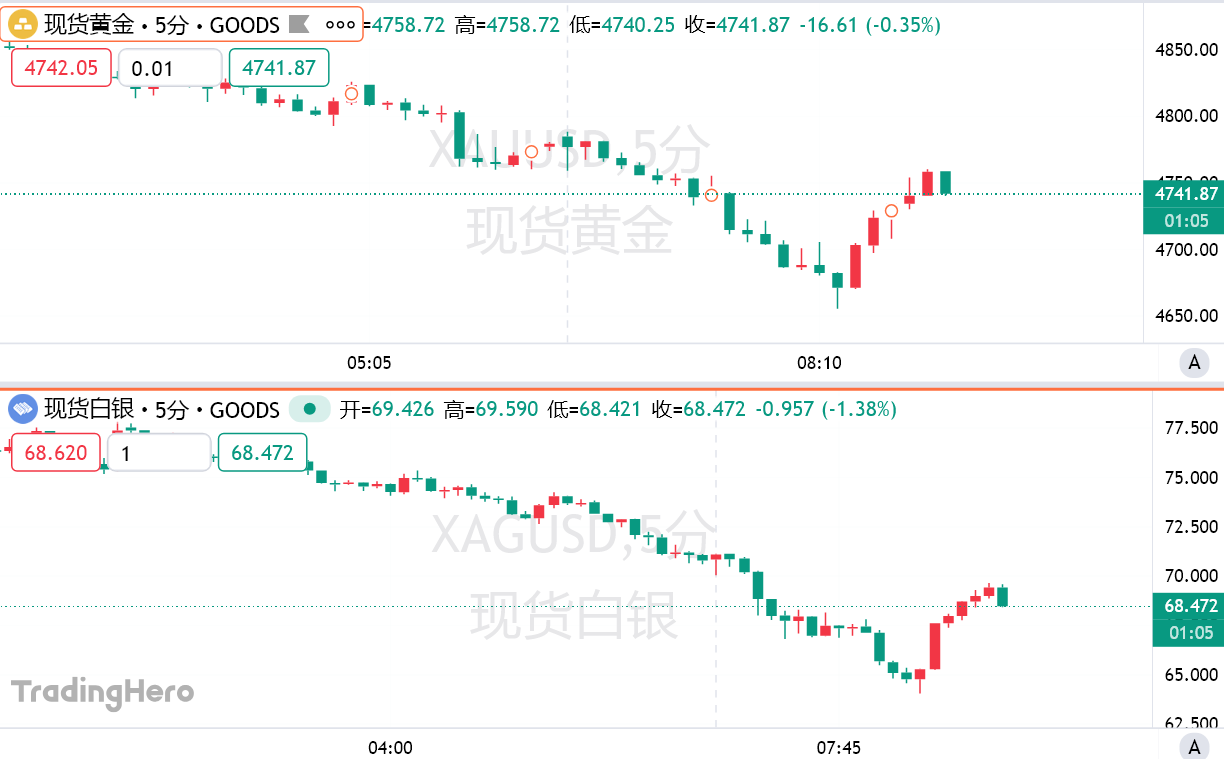
The severe volatility in precious metals remains the most noteworthy. During the session, spot gold touched down to $4660/ounce, declining 2.51% for the day; spot silver plummeted 9% for the day, reporting $64.38/ounce. As of Thursday's close, silver has given back all of this year's gains, with the market caught in a turmoil unseen since 1980. Spot palladium experienced a decline of 4% during the session, reporting $1574.96/ounce. Spot platinum briefly fell below $1900/ounce, dropping $1000 from its recent historical high.
As of the time of writing, spot gold and silver have significantly rebounded, with the decline in spot gold narrowing to within 1%, and the decline in spot silver narrowing to 2%, even briefly turning positive.
The oil market is also in decline. WTI crude oil fell by as much as 1% during the day, narrowing the decline to 0.29% as of the time of publication.
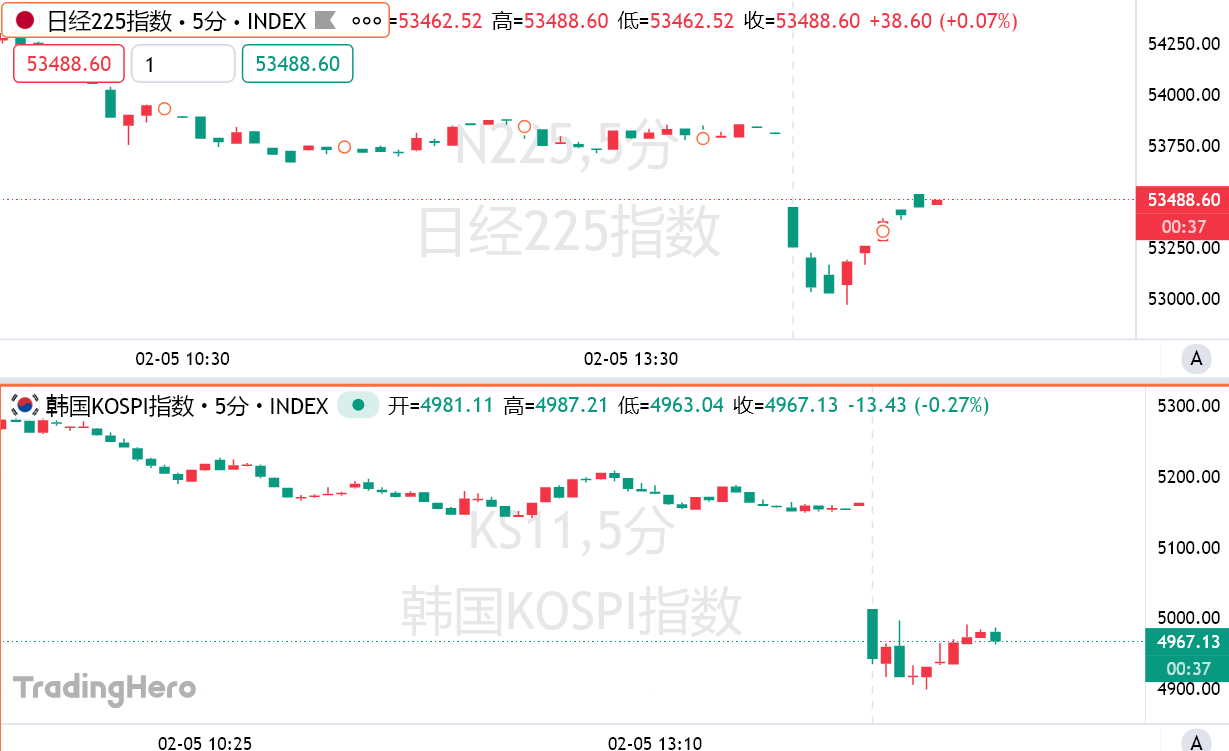
After a sharp decline in U.S. tech stocks hit risk appetite, the downturn in global stock markets spread to the Asian trading session. During the day, the Nikkei 225 index fell below 53000 points, down 1.57% for the day. The KOSPI index opened down 3.35%, and the KOSPI 200 index futures dropped by as much as 5%, with program trading paused for 5 minutes. As of the time of publication, the decline had somewhat eased.
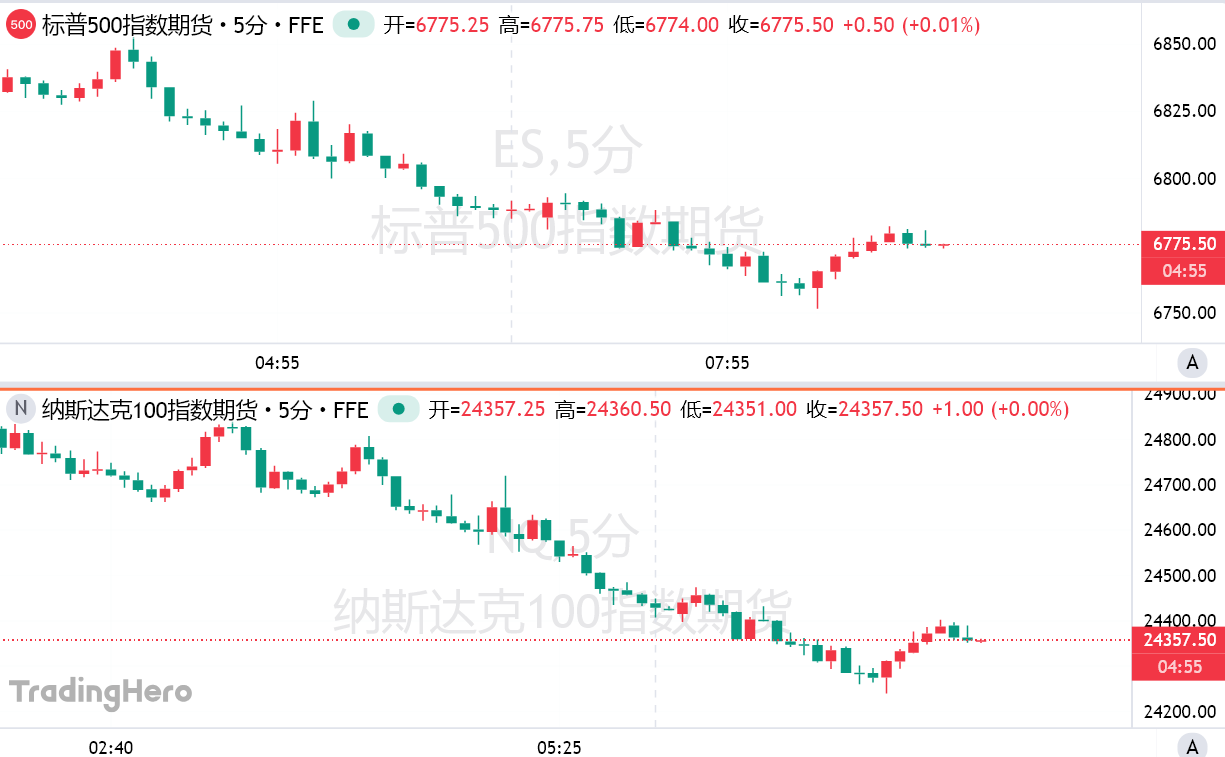
U.S. stock index futures opened sharply lower, signaling more losses to come. During the day, the three major stock index futures expanded their declines, with S&P 500 futures down 1%, Nasdaq futures down 1.6%, and Dow futures down nearly 0.6%. The Nasdaq 100 index faced its worst three-day drop since the market crash last April. Since Federal Reserve policymakers hinted last week that they do not intend to cut rates again soon, the benchmark index has seen over $1 trillion in market value evaporate. Further impacting market sentiment, Amazon's stock plummeted 10% in after-hours trading after the company announced plans to invest $200 billion in AI this year. As of the time of publication, U.S. stock index futures have rebounded somewhat.
This weak sentiment has driven investors towards U.S. Treasury bonds, causing the yield on two-year U.S. Treasury bonds to fall to its lowest level in nearly a month during Thursday's New York trading session, with the downward trend continuing in Friday's Asian session.
Mona Mahajan of Edward Jones stated: "It's been a tough week for investors heavily betting on the leading sectors of the market. The tech and AI sectors are at the forefront, but we have also seen gold and other precious metals sold off recently."
Unlike the panic spiral decline triggered by Trump's trade war last April, there wasn't a single triggering factor this time. Instead, a series of slowly accumulating messages sparked market anxiety over valuations—many investors already suspected that valuations were too high, leading to simultaneous withdrawals.
IG Australia market analyst Tony Sycamore wrote in a report: "Investors are questioning their faith in the three pillars that have supported the market over the past six months: AI, cryptocurrencies, and precious metals. This increases the likelihood of a deep market correction."
The number of job openings in the U.S. hit its lowest level since 2020, while initial jobless claims rose, and the announced layoffs for January were the largest since 2009, all of which intensified the market's low mood.
Bret Kenwell of eToro stated: "The latest labor data again indicates that the U.S. job market has not strengthened comprehensively. If the situation worsens, the Federal Reserve and investors will have to take this risk seriously. Volatility may persist, especially given the recent increase in uncertainty."
Those short-term futures traders in precious metals who attempted to buy the dip early this week, playing the role of "potential bargain hunters," may have already been "burned" by the end of this week.
On February 5, the Chicago Mercantile Exchange (CME) announced adjustments to the margins (Outright Rates) for certain futures contracts including gold, silver, and aluminum. The document shows that the new margin ratio for gold has been raised to 9%, and the margin level for silver has been raised to 18%. The new standards will take effect after the close on February 6.
Margin is a risk control leverage used by clearing houses designed to ensure sufficient collateral coverage when price volatility expands. CME described the recent adjustment of margins as part of a routine risk management review linked to market volatility, and recent reports have also emphasized that margin increases have exacerbated market pressure during the recent sell-off.
For the market, its direct impact is usually mechanical: higher margins increase the cost of holding positions, which may suppress speculative participation and prompt some holders to reduce their positions. If traders are forced to sell to meet higher collateral requirements, especially in thin liquidity conditions, this dynamic could destabilize the market in a very short time.
As margin requirements have now increased significantly, traders will closely monitor whether the risk of liquidation will diminish as leverage is squeezed out of the market—or whether higher funding costs will continue to suppress the precious metals sector until market volatility normalizes.
Kitco reported that technically, the price action of April gold futures last week formed a huge and bearish 'key reversal' downward pattern on the daily chart, which is a chart signal suggesting that a market top may have formed. The next upside price target for bulls is to stabilize the closing price above the strong resistance level of 5250 dollars. The next downside price target for bears is to push futures prices below the solid technical support level of this week's low of 4423.20 dollars. Initial resistance is seen at 5000 dollars, followed by a high of 5045 dollars. Initial support is seen at 4805 dollars (which has already been breached as of the time of publication), followed by 4700 dollars.
In March silver futures, a bearish triangular flag pattern has formed on the daily chart. The next upside price target is to close above the strong technical resistance level of 92 dollars, the high of this week. The next downside price target for bears is a close below the strong support level of 70 dollars. Initial resistance is seen at 80 dollars, followed by 82.50 dollars.
Those who don't know how to time their entry can seek guidance from Hui Ge, who will provide real-time analysis 25 hours a day and give the current best entry points. Daily insights and in-depth analysis.