

This morning at 8:00, the price hit around $60,000, and many people's first reaction was to poke the needle, thinking 'finally, it has bottomed out'. But those who truly understand the cycle see not 'cheapness', but a more glaring signal: the price has fallen back below the 2021 bull market peak of 69,000. This drop does not just break through a support level, but directly shatters a market belief—'the bottom of a bear market is always higher than the peak of the previous bull market'. In 2022, this iron rule was broken for the first time; today, it has been publicly mocked for the second time.
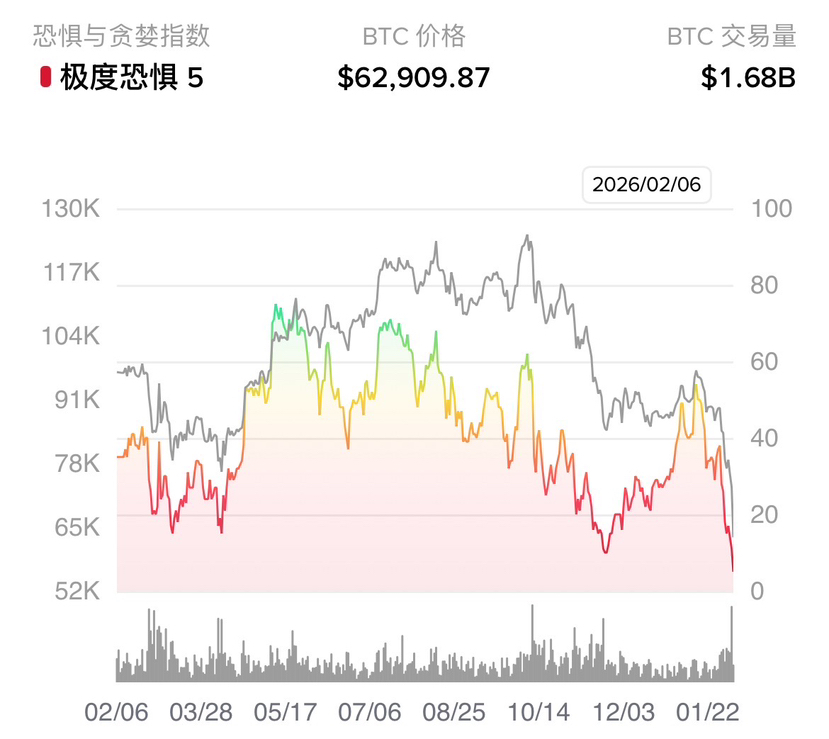
What's worse is that this time it's not just a collapse of cryptocurrencies, but a 'full asset panic': a series of liquidations in crypto, ETF outflows, miners' profits plummeting to the limit, and precious metals also diving simultaneously. At the moment when the fear and greed index drops to single digits, the market has actually made it clear to you: this is not an ordinary pullback, but a repricing after the simultaneous bankruptcy of 'systemic dividends + liquidity expectations'.
What you want is not a simple 'to bottom fish or not,' but to see through this narrative: breaking a level does not equal finding a bottom; breaking means the 'new downward phase' has just begun.
First, why is breaking 69k so critical? Because it is not just a price; it is a memory.
For many, 69k is not just a number; it represents the 'end' and 'dignity' of the previous bull market. It carries an illusion: as long as previous highs are defended, the cycle remains dignified; once it breaks, the market will force everyone to acknowledge two things:
First, those who bought and held at the last bull market peak also begin to feel the overall loss; second, the belief that 'the four-year cycle will surely lift you' will be reexamined by reality. What happened after it broke 20k in 2022? It wasn't an immediate bottoming, but a more brutal process: initial panic breaking through, followed by failed rebounds, and finally a credit shock washed out the chips clean.
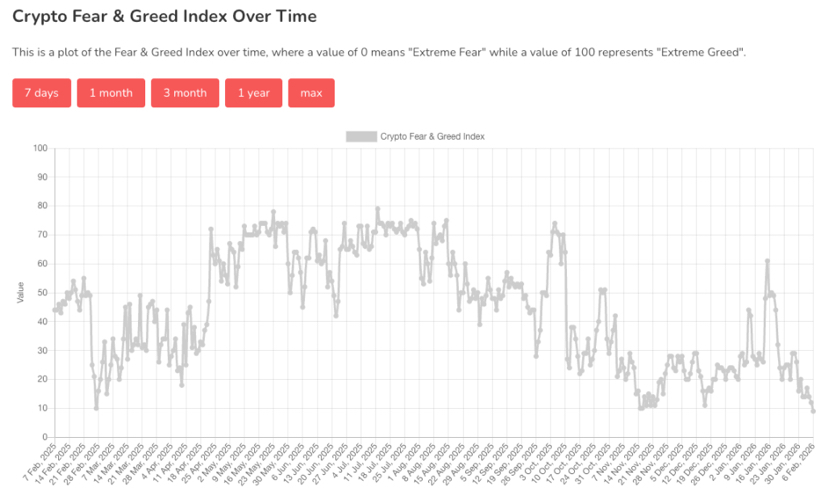
The structure of today's downturn is eerily similar to 2022: when a key price level is first breached, the market enters 'panic release,' then 'rebound illusion,' and finally a 'deeper second dip.' Many die in the second phase because they mistake rebounds for reversals.
Second, looking back at the path of 2022, you will find that 'the most terrifying part' never occurs in the first wave.
In June 2022, when it broke 20k, the monthly decline was nearly 43%, and some thought 'it couldn't drop any further.' What happened next? The market oscillated for a long time, with failed rebounds until a credit shock of FTX's magnitude delivered the final blow, clearing out most of the industry's leverage and illusions. What truly matters is not how much FTX caused the market to drop, but the feeling of 'a fatal bad news comes out but cannot push it down' — that is when the bottom starts to form.
So remember a counterintuitive phrase: the bottom does not appear when bad news is at its peak, but when bad news comes out and still cannot push prices down. This is why trying to bottom fish the moment it breaks previous highs often leads you straight into the next phase of bloodshed.
Third, why is this time more severe? Because 'institutionalization' makes liquidation feel more like an avalanche rather than a retail stampede.
Two key points are very dangerous:
One is the massive turnover of ETFs — record trading volume, but funds are fleeing. Many mistakenly believe that 'high trading volume = bottom fishing funds,' but it actually resembles 'institutions retreating and hedging through turnover.' Institutions excel at one thing: transferring risk to the most anxious during periods of high volatility.
The other is that the strategy (MSTR) treasury model is entering a 'life and death test.' When its average holding price is around 76k, and the price drops to the 60k level, the market will begin to imagine the financial pressure it faces. You don't need it to truly explode; you just need the market to start believing that 'something might go wrong,' and the price will be repeatedly crushed by such expectations.
Adding to this, miner revenues (hash price) hitting extremely low levels will create a very ugly but real pressure: miners are not bearish; they are forced to sell. Forced selling usually does not end with the first wave.
So today's crash feels 'catastrophic,' not because everyone suddenly became foolish, but because the market structure has changed to: more leverage, more institutions, more automation; once it breaks, the stampede resembles an out-of-control escalator.
Fourth, can you bottom fish? The answer is simple: yes, but don't bottom fish with an 'hero mode.'
Here you can refer to a very useful framework: VIX layering. It’s not a magic indicator, but it reminds you of one thing — truly high-probability buying does not occur when 'panic just starts,' but rather when 'panic reaches extremes and begins to feel numb.'
You now see the fear and greed index drop to single digits; this is called emotional extremity, but it does not equal structural reversal. A reversal requires 'price action' to cooperate, with typical signals including: not being able to drop further, reduced volume sideways, no new lows after bad news comes out, and rebounds being able to hold key moving averages.
If you must operate, the correct way is not to 'bet on the price points,' but to 'bet on the process,' pulling yourself out of a one-time life-and-death game:
You can participate through dollar-cost averaging or in batches, but assume this is not the last drop; you can test the waters with small positions during extreme panic, but save bullets for the next dip; what you should focus on is not 'whether it has risen,' but 'whether the rebound has failed.' The most common killer move in a bear market is to use a decent rebound to deceive everyone back into the market, and then deliver another blow.
In short: you can buy, but don’t rush to be a savior.
Fifth, to be clear: the most critical conclusion of this round is not 'how low it drops,' but 'the bottom is definitely a period of time.'
From the moment it broke the previous high in 2022 to the true bottom formation, it underwent a long period of oscillation, failed rebounds, and further dips, finally completing the chip turnover. The bottom is not a point, but a prolonged grinding time. The atmosphere at the true bottom is often: people no longer discuss getting rich, nor do they talk about bottom fishing, and even become too lazy to complain; the market is quiet as if it has died.
Clearly, we are not yet at that 'dead silence' period. It feels more like the 'first chapter of extreme fear.'
Sixth, just to mention XPL: when Bitcoin jumps, it also flips over.
The most authentic lesson from this round of stampede is — you think you are making asset allocations, but in reality, you are struggling against liquidity. Whether the direction is correct is no longer the priority; having an exit strategy is.
The last sentence is for those who still want to 'prove themselves by bottom fishing.'
When 69000 breaks, it's not a signal of opportunity; it's the opening whistle for the second half.
You don't need to be the first to rush in; what you need is to remain at the table during the toughest times. The bear market rewards not those who guess the lowest point, but those who endure until the structure stabilizes and can still act.
The market will not praise your bravery; it will only punish your anxiety.


