
There is a moment that comes after you have been in crypto long enough. Usually somewhere between your second deep drawdown and your fifth confident narrative that did not survive the market. Your relationship with this space changes. You stop refreshing charts every few minutes. You stop believing that every new idea will reshape finance by next quarter. What replaces that urgency is not boredom. It is clarity. You start watching what people actually use when things feel uncertain and fragile.
Right now the market feels like it is holding its breath. Volatility appears and fades. Liquidity drifts instead of committing. Most participants sense that something important is changing even if they cannot name it yet. In moments like this speculation tends to quiet down and utility steps forward. Once again stablecoins are carrying the system forward.
Not because they are exciting. Because they are trusted.
Stablecoins have become the emotional anchor of crypto. Traders rotate into them when risk feels mispriced. Businesses rely on them because banks do not move at internet speed. Families in high adoption regions depend on them because local currencies can lose value faster than wages can keep up. Stablecoins are no longer a narrative. They are a behavior. Yet for all their importance they have spent years running on infrastructure that was never designed with them at the center.
Plasma feels like it was built by people who noticed that mismatch and could not ignore it anymore.
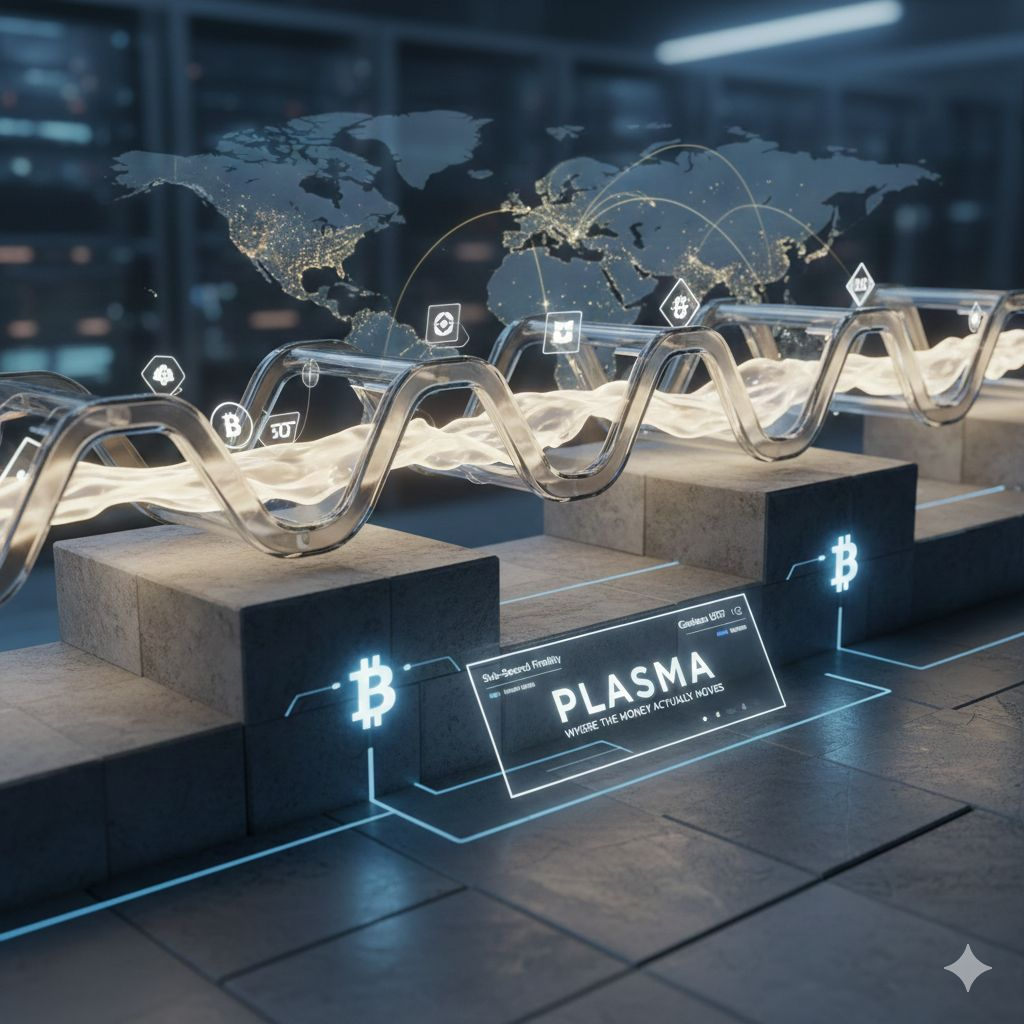
At its core Plasma is not trying to redefine what a blockchain can be. It is asking a simpler and more honest question. If stablecoins are the most widely used assets in crypto why do they not have a base layer designed specifically for them. Not adapted later. Not tolerated as a side effect. Designed from the start.
That question feels obvious once you sit with it. Which is usually a sign that it matters.
Most Layer One networks begin with abstraction. General computation. Maximum flexibility. Endless possibility. They assume real world use cases will eventually settle in. Plasma moves in the opposite direction. It begins with settlement. With the assumption that real money in meaningful size will move across this chain every day. That people will depend on it not because it is interesting but because it is dependable. Everything else flows from that assumption.
There is a quiet maturity in that way of thinking.
Plasma stays fully EVM compatible through Reth and that choice says more than any slogan could. It does not force developers or institutions to relearn everything they already know. The ecosystem already understands this environment. Tooling audits and workflows already exist. When real capital is involved familiarity is not a weakness. It is a requirement. Plasma respects that reality.
But familiarity alone is not enough. Where Plasma begins to feel different is in how it treats time and certainty. PlasmaBFT delivers sub second finality and while that sounds technical it changes the emotional experience of using the network. Transactions do not linger. Settlement does not feel tentative. The chain feels decisive. When you are moving money especially during volatile conditions that decisiveness builds trust faster than any marketing ever could.
People often underestimate how much confidence is created by speed that never fails.
Then there is gasless USDT transfers and stablecoin first gas. This might be the most human design choice Plasma makes. For years users have accepted that to move stable money they first need to hold a volatile asset just to pay fees. It never felt natural and Plasma does not pretend that it is. By letting stablecoins handle their own movement costs Plasma removes a layer of friction that most users felt but could not name.
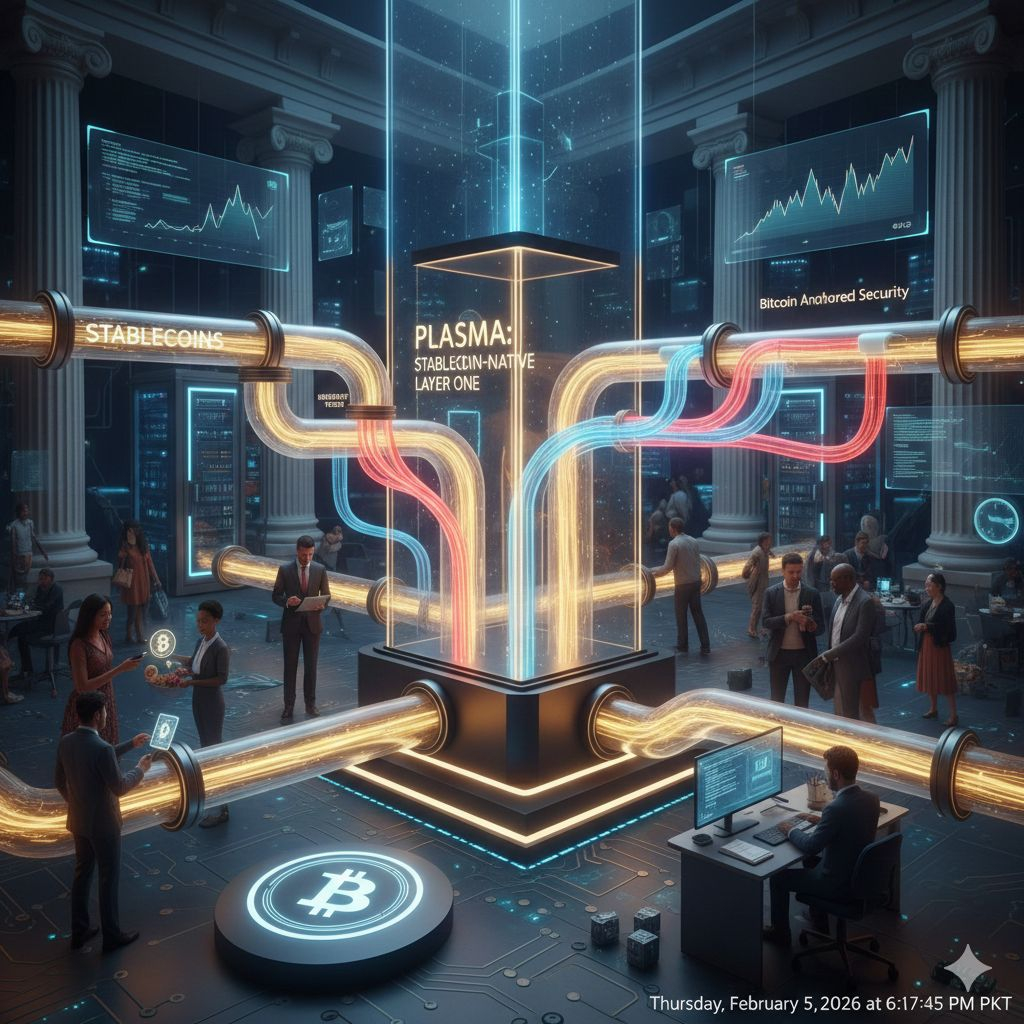
This is the point where Plasma starts to feel less like crypto infrastructure and more like financial plumbing. The kind you barely notice when it works. The kind you cannot live without when it breaks.
Security follows the same grounded philosophy. Bitcoin anchored security is not presented as a flex. It feels more like a statement of intent. Bitcoin represents neutrality resilience and time tested credibility. By anchoring to that security model Plasma signals that it is building for longevity rather than short term advantage. In a world where censorship resistance is moving from theory to practice that choice carries real weight.
What stands out is how calmly Plasma has evolved. There is no sense of panic in its progress. Updates feel like refinement rather than reinvention. Ecosystem growth feels intentional rather than explosive. Payment flows settlement tools and integrations are being shaped with the assumption that people will use them daily. Not just once for a demo.
From a trader perspective that patience is noticeable. Markets love spectacle in the short term but they punish infrastructure that overpromises. Plasma does not try to dominate every category. It focuses on doing one thing extremely well in an area where demand already exists.
Its attention to high adoption regions feels especially grounded. In these markets stablecoins are not an experiment. They are a practical necessity. People do not care about narratives. They care about reliability. Plasma is not trying to change behavior. It is supporting behavior that already exists at scale.
Institutions approach the same system from a different angle. They see fast finality predictable settlement familiar tooling and a security posture anchored in something globally recognized. Plasma does not shout about being institutional grade. It does not need to. Its design choices speak clearly to anyone who has moved serious capital before.
When Plasma touches tokenomics incentives and governance the tone remains consistent. These elements are not treated as speculative engines. They are treated as tools for long term alignment. Incentives reward commitment. Governance appears designed to function rather than perform. The underlying belief is simple. Trust compounds when systems are stable understandable and resistant to capture.
That belief feels increasingly relevant in this phase of the market. Traders are tired of complexity that does not earn its keep. Users are tired of being early. Capital is becoming more selective and more patient. In that environment specialization is not a limitation. It is a strength.

Looking forward the impact of a stablecoin native Layer One is easy to underestimate precisely because it is so practical. Faster settlement reduces risk. Gas abstraction lowers onboarding friction. Neutral security increases confidence. These are not features that dominate headlines. They are advantages that quietly reshape behavior over time.
Plasma does not need to win the entire market. It only needs to become indispensable where it is used. A place where payment providers settle. A chain institutions trust. A network that fades into the background because it works exactly as expected.
There is also a broader cultural signal here. Crypto is slowly growing out of its adolescence. The industry is learning that not every innovation needs to be loud and not every breakthrough needs a new vocabulary. Plasma feels aligned with that maturity. It does not ask users to believe. It asks them to transact.
For those who have been around long enough to recognize patterns this kind of project feels familiar. The ones that last rarely dominate attention early. They earn relevance through consistency. They survive multiple market moods. By the time everyone agrees they matter they are already woven into the system.
Plasma feels built for that timeline.
Not as a bet on hype but as a bet on behavior. On the idea that when uncertainty rises people choose systems that feel calm predictable and honest. In markets like these reliability is not boring. It is rare.
Sometimes the most forward looking move in crypto is not chasing the next story. It is paying attention to where the money is already moving and asking which systems are quietly making that movement possible. @Plasma #plasma $XPL
