
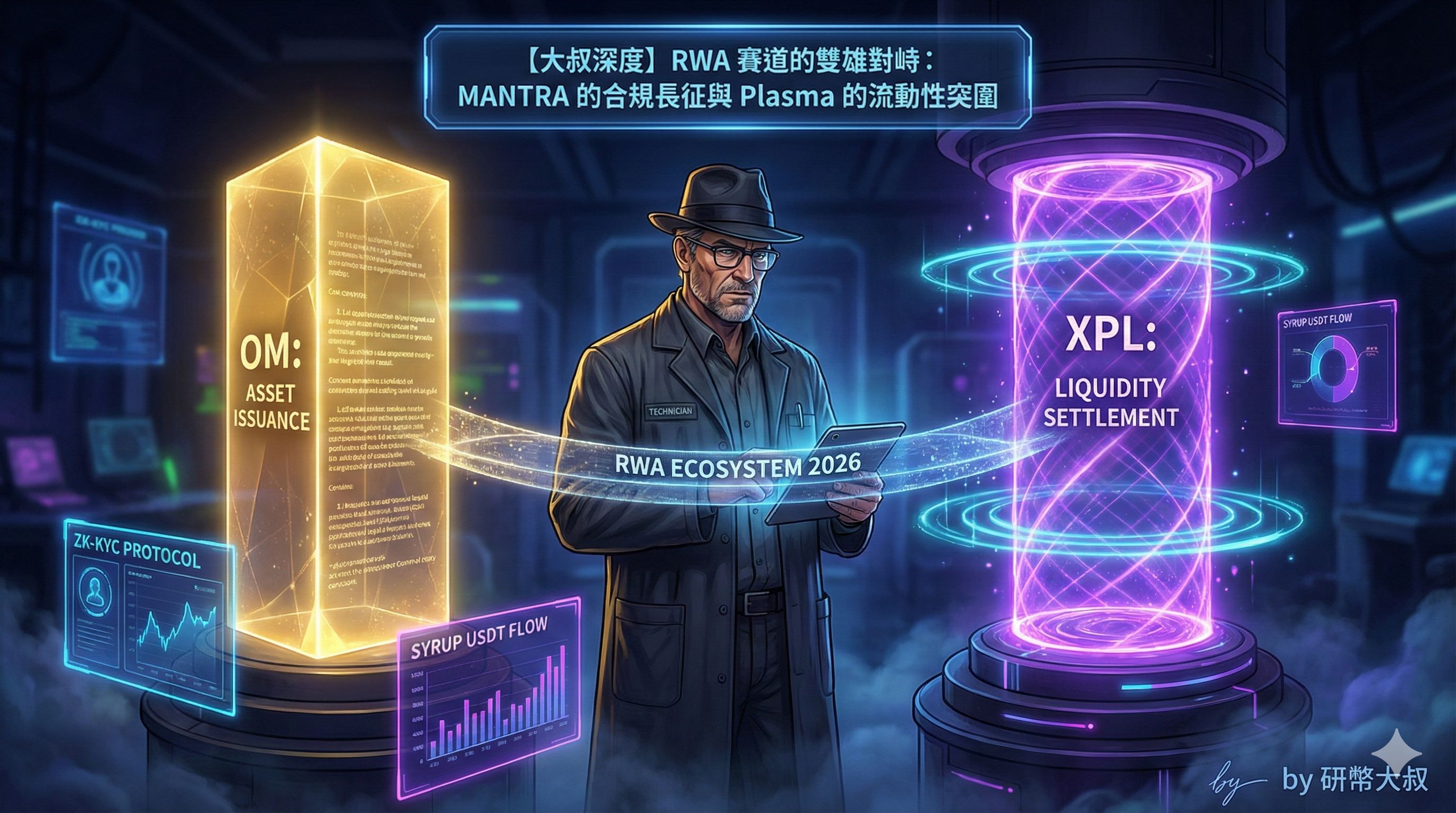
Everyone, the uncle detective is not here to catch conspiracies today; we are going straight to the lab to break down the fundamentals. In the 2026 RWA (Real World Assets) technological landscape, it is currently recognized that a tripartite balance has formed: the 'Confidential Privacy Faction' led by Dusk ($DUSK), the 'Regulatory Issuance Faction' led by MANTRA ($OM), and the 'Liquidity Settlement Faction' led by @Plasma .
Regarding the privacy technology details of Dusk, the uncle has already discussed it thoroughly in previous articles, so I won't repeat it here. Today, we will focus on the two most contentious paths in the RWA track: OM's 'top-down' approach and XPL's 'bottom-up' approach, to see what essential differences exist between them in terms of code and logic.
🔍 Chapter 1: MANTRA ($OM) — Locking in Sovereign-Level Compliance 'Reinforced Tank'
The uncle observes that MANTRA's technical logic has always been very clear. Its goal is not the wild territory of decentralized finance, but those traditional institutions holding hundreds of billions of dollars but hesitant to enter the market.
* Native ZK-KYC Module: MANTRA has embedded an identity verification layer at the base layer of the Cosmos SDK chain. This is different from typical projects that perform KYC at the contract layer; it is 'system-level compliance.' This means that when institutions issue assets, the contract can automatically identify whether both parties in the transfer meet the legal requirements of specific jurisdictions, significantly reducing regulatory costs technically.
* The strategic game of the March 1:4 split: Many people only look at prices when it comes to splits, but the uncle focuses on 'liquidity restoration.' Along with a $25 million buyback plan, MANTRA is artificially creating a stable price range with the aim of attracting fractionalized assets (Fractionalized Real Estate) from regions like the UAE. For these types of assets, stable and precise numerical settlements are far more important than wild price fluctuations.
🔍 Chapter 2: Plasma — Targeting High-Frequency Payments 'Liquidity Highway'
In contrast to the logic of OM, which states 'assets only exist with compliance,' Plasma follows the path of 'only with traffic can there be revenue.' Its RWA properties are hidden behind the product SyrupUSDT.
* ZK-Plasma's Data Availability (DA) Advantage: Why does XPL dare to claim it is the settlement network for RWA? Because it has pushed transaction costs to the extreme at the code level. Through ZK technology that only puts the 'state root fingerprint' on-chain, its DA costs are 85% lower than its competitors. This is the only technically optimal solution for scenarios that require frequent settlement of RWA returns (such as private credit interest).
* ERC-4337 and RWA Retailization: The uncle believes that Plasma's strongest weapon is Account Abstraction (AA). Through the built-in Paymaster payment contract, retail investors can seamlessly deposit USDT into the Syrup vault, which is connected to institutional credit from Maple Finance. This essentially retailizes professional 'private credit RWA,' which is more accessible in technical thresholds than OM's institutional services.
🔍 Chapter 3: Summary of Technical Differentiation — Building Houses vs. Laying Pipes
The uncle summarizes for everyone, although both are in the RWA track, the dimensions are completely different:
* MANTRA ($OM) is about 'building houses.' It is responsible for legally transferring real-world assets (properties, government bonds) onto the chain, focusing on asset 'certification' and 'issuance.'
* Plasma is about 'laying pipes.' It is responsible for efficiently distributing the returns (profits, interests) generated by these assets to everyone's wallets, focusing on asset 'liquidity' and 'settlement.'
🕵️♂️ The uncle detective's closing statement
The technological heights of 2026 are no longer about solo efforts. MANTRA solves the problem of whether assets can be put on-chain, while Plasma addresses the usability of assets once they are on-chain. The uncle believes that value investors should keep a close eye on the data intersection of these two: when the issuance volume of OM's assets increases, it often drives an increase in XPL's settlement volume.
This is not competition; it is a technical complementarity about the upstream and downstream of the RWA industry chain. Understanding this relationship, the uncle believes you have truly solidified your footing in this wave of RWA.

