
Making money from trading cryptocurrencies, 90% of people are going in the wrong direction.
Everyone is chasing trends, studying K-lines, and inquiring about insider information every day, but they overlook the most crucial point: in this market, making big money relies not on trading, but on sitting still.
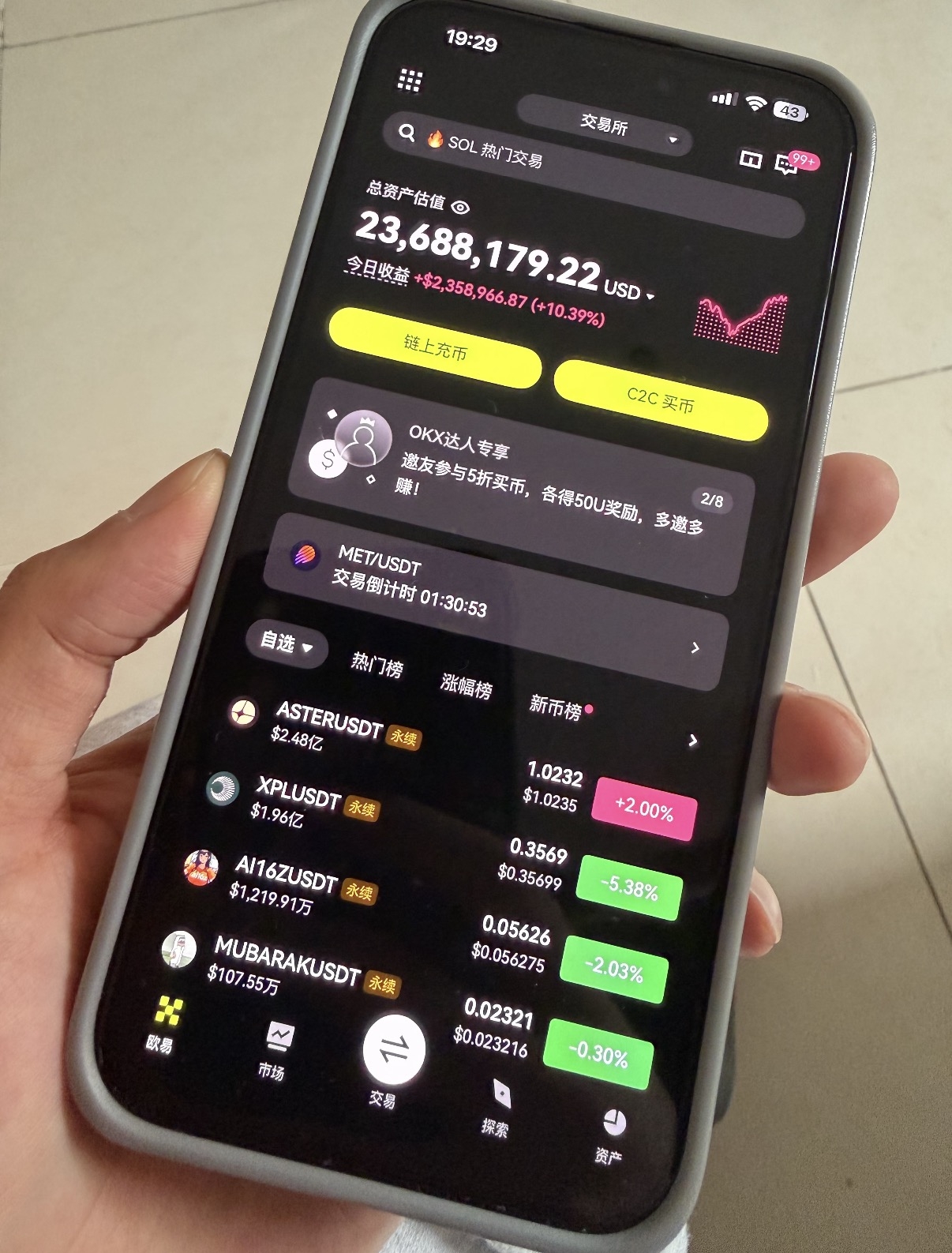
Who am I? An old investor who has been in the cryptocurrency market for eleven years, and an ordinary person who made 80 million with a strategy of 'non-action'.
Today, I want to completely overturn your understanding of 'trading cryptocurrencies'.
I will share three core concepts that seem simple, yet very few people can achieve.
Only by understanding them can you possibly navigate through the future bull and bear markets and become one of the 10% winners.
In addition to the exciting techniques, I also strictly adhere to the following seven iron rules:
1. Position Syndrome: This is a common ailment among investors. The 'symptoms' manifest as: when there are no positions, the hands itch and one cannot sit still, feeling compelled to place an order; when there are positions, panic arises, and if the market moves in the opposite direction, one doesn't know what to do; believing that opportunities are continuous, always wanting to operate continuously, resulting in greater losses the more one trades.
2. Frequent 'all-weather' operations: Many investors want to be all-rounders, 'going long' after 'going short', but this contradicts the importance of following the market trend. When no force breaks another force, do not entertain thoughts of going against the trend; in a bull market, just keep buying long, and in a bear market, persist in going short.
3. Counter-trend rebounds: Can you grab a rebound? If the method is right, of course, you can. Otherwise, it's like licking blood on a knife's edge. If a knife falls from the sky, when should you catch it? Undoubtedly, it must be when it has fallen to the ground and is motionless; otherwise, you will surely be injured. Grabbing a rebound requires skill; those without experience should not take risks, just go with the trend, and pay attention to capital management when participating in rebounds.
4. Hesitating when placing orders: Fear of deception when going long, fear of false breaks when going short, leading to opportunities vanishing before your eyes. Understand the principle of inertia after a train starts moving — when the trend takes its first step, we follow in at one and a half steps until the balance is broken.
When the trend is established, adopt an 'accept all orders' operational strategy; when signs of false breaks appear, the chance of success in the opposite direction is very high.
5. The mindset of watching the main force: Many investors must have had this experience: when you go long, it falls; when you go short, it rises; when you cut your long position, it still rises; when you cut your short position, it falls. Trading BTC can sometimes depend heavily on luck; the main force does not lack your hand. Immediately turn off the computer, take a break, and come back to trade calmly.
6. Full position: Full position trading may rapidly increase your wealth, but it is more likely to lead to a rapid margin call. There are no absolutes; even funds cannot completely control unexpected events and the effects of policies or news. Never go full position, limit each opening to no more than 30% of total capital, at most 50%, to guard against margin calls or other situations.
7. Never admit defeat: Many investors are stubborn; when they make a mistake, they never admit it, failing to resolve the erroneous position at the first opportunity, leading to the perpetuation of mistakes and the consequences are evident. 'I just don't believe it won't rise, I just don't believe it won't fall...' This mindset is utterly harmful.

Time freedom and the ability to make money at any time is the ultimate goal of every trader. However, many people struggle for years without making money, the core reason is that they have not avoided these four key pitfalls. Today, I am sharing four trading lessons (which can also be called 'iron rules') that I have summarized from years of practical experience, helping you break free from the cycle of losses and elevate your trading level.
Lesson 1:
Most people do not lose because of strategy, but because of execution.
Many traders have the illusion: 'as long as I find a perfect trading strategy, I can stabilize my profits.' Thus, they frequently change indicators, patterns, and time frames, thinking 'the current strategy is no longer effective', yet never reflecting on 'whether they have executed properly.'
In backtesting or simulated trading, everything is perfect — entering according to rules, setting stop losses and take profits, without emotional interference; but once entering real trading, the pressure of real money comes, human greed and fear will be infinitely magnified, and execution will instantly deform.
Fear of stop losses and arbitrary movement of stop loss points: When the price approaches the stop loss, one always thinks 'wait a little longer, it might reverse', moving the stop loss backward, resulting in losses turning from controllable to massive losses.
Prematurely taking profit wastes potential profit space: as soon as a trade has unrealized profit, anxiety sets in, fearing profit drawdown, and leaving the market before reaching the take-profit point, turning a 2:1 profit-loss ratio into 1:1, destroying the strategy's positive expected value;
Self-justification, adding positions to hold (the most fatal): treating stop losses as 'failure', treating the market as 'the opponent'. Once the price reaches the stop loss, unwilling to admit mistakes, adding positions to hold, trying to prove oneself right — at this point, trading is no longer a probability game but an emotional gamble, and the account risk is completely controlled by emotions.
These execution issues are more fatal than the strategy itself — they will 'magnify losses and shrink profits'. Even if you have a 58% win rate and a 2:1 profit-loss ratio, as long as you frequently move stop losses and take profits too early, you will inevitably lose in the long run.
A truly mature trader does not rely on willpower to 'resist making mistakes', but rather reduces execution freedom through 'systematization': setting stop-loss, take-profit, and risk control rules before entering the market, and mechanically executing without on-the-spot thinking after entry. You must treat losses as 'operational costs' — just like paying rent and utilities when opening a store, trading losses are inevitable; accept it to prevail in the long-term probability game.
Remember: strategy determines whether you have an 'advantage', execution determines whether you can turn that 'advantage' into profit. No matter how good the strategy is, without execution, it's all in vain.
Lesson 2:
You must master 'market structure', trading along the trend is the way to go.
Market structure is the 'basic skill' of profitable traders — without understanding market structure, you cannot understand trends, and the trading direction can easily go wrong. No matter what strategy you use, it ultimately has to return to 'trend'; trading with the trend will yield a higher win rate.
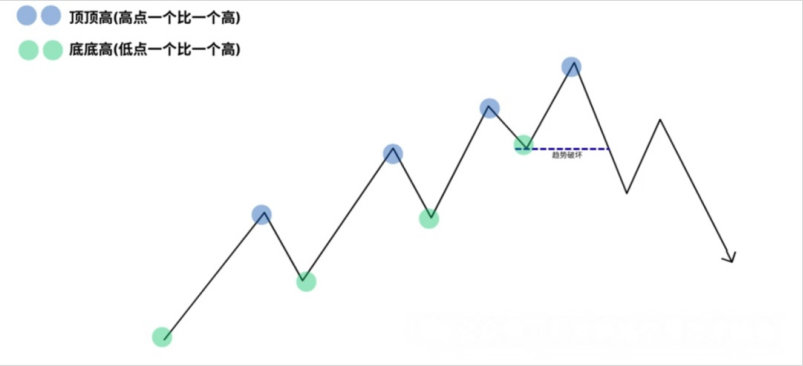
The core of market structure is very simple, just look at two 'highs and lows':
Uptrend: prices form 'higher highs (higher highs)' + 'higher lows (higher lows)';
Downtrend: prices form 'higher highs (lower highs)' + 'lower lows (lower lows)'.
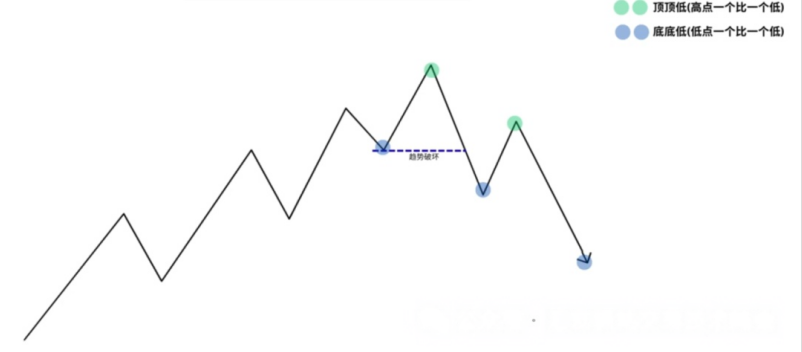
Another key signal is called 'trend destruction': for example, in an uptrend, if the price breaks below a previous low, forming 'lower lows', it indicates that the uptrend is likely to end, and one must be alert for a reversal.
For example: If the market structure is an uptrend, you should prioritize going long and avoid going short; if it is a downtrend, prioritize going short and do not easily catch the bottom. Trading along the major trend is like 'borrowing strength', even if the signal is slightly off, it's easier to be led towards profit; trading against the trend is like rowing upstream, no matter how hard you try, it's easy to incur losses.
Thus, before any trade, first look at the market structure to determine the trend, then find opportunities — this is the most basic and effective method to improve win rates.
Lesson 3: Price action analysis.
The order is always 'first structure, then price, finally candles.'
Many beginners learn candle patterns (like bullish engulfing, bearish engulfing) and think they can make money — as soon as they see the pattern, they enter, resulting in increasing losses.
In fact, a single candle shape has no meaning! Prices will randomly form various candle shapes on the chart. If not 'filtered', the entries are all low-quality, low-win-rate orders. The correct order for price action analysis must be 'first structure, then price, finally candles':
First look at the structure: determine the trend (upward/downward) through market structure, set the trading direction;
Then find key price levels: in the trend direction, find support, resistance, supply and demand zones, etc., high-quality price levels;
Finally, look at the candle signals: only when the price appears as a candle shape at the key price level do you enter — the candle shape is just a 'trigger button', not the only basis for entering.
Using practical cases to break down:
Step 1: Set the structure (direction): prices form higher highs and higher lows, clearly indicating an uptrend, prioritize going long;
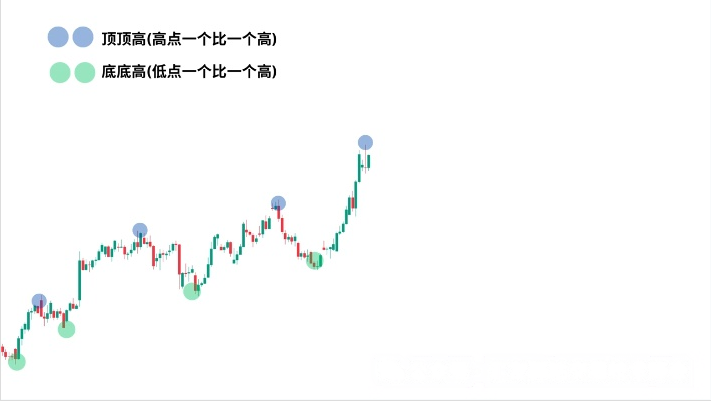
Step 2: Find key price levels: filter out two high-quality support levels — ① previous resistance converted into support after a breakout; ② support formed by previous lows;
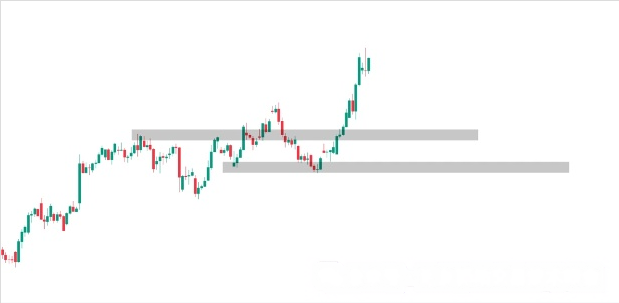
Step 3: Wait for candle signals (entry): When the price pulls back to a resistance level turning into support, a strong buying candle appears first.
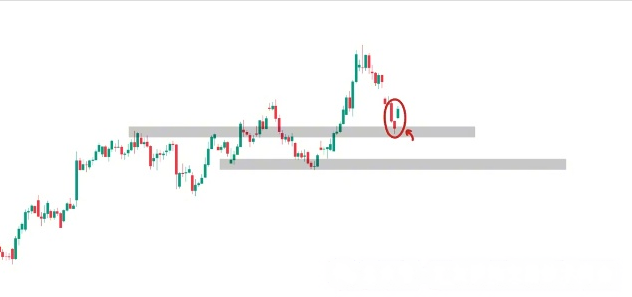
Then form a 'double bottom pattern', ultimately breaking through the double bottom neckline with a large bullish candle (confirming the pattern is valid);
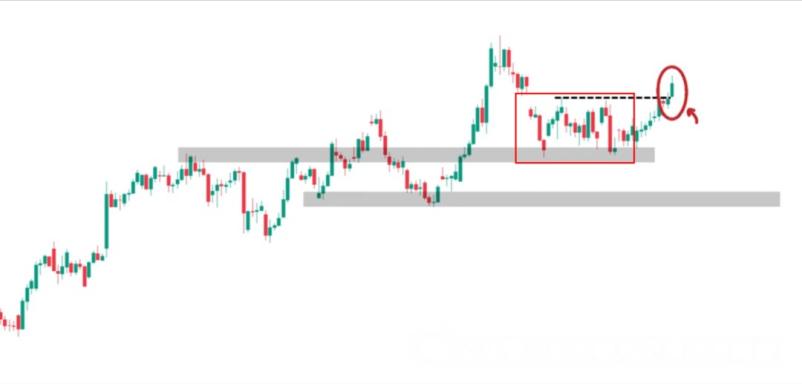
Entry + risk control: After a large bullish candle is fully formed, go long, with the stop loss set below the double bottom low (leave the market if the pattern fails) and take profit set according to a 2:1 profit-loss ratio, finally successfully taking profit.
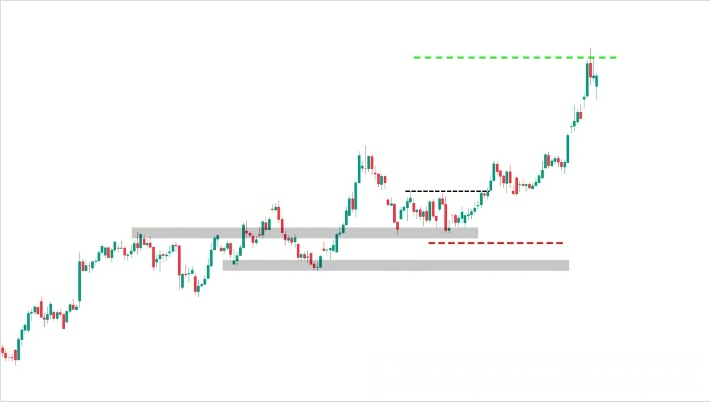
The core of this logic is 'high probability stacking': correct trend direction (structure) + price has support (key level) + momentum confirmation (candle shape), when these three combine, the win rate will significantly increase, avoiding being deceived by false signals.
Lesson 4: Understand 'expected value'.
Only then does one understand that the essence of trading is 'long-term repetition'.
Many traders only focus on 'whether a single trade is profitable', but ignore the core of trading — expected value. Expected value is 'over the long term, how much can you average per trade', it determines whether your trading system can be profitable in the long run.
Let me give you a core formula first:
Expected value = (win rate × average profit) - (loss rate × average loss).
As long as expected value > 0, over a sufficient number of trading samples, you will definitely make money. For example:
Win rate 50%, profit-loss ratio 2:1, single risk 10 yuan;
Average profit = 20 yuan, average loss = 10 yuan;
Expected value = (50% × 20) - (50% × 10) = 5 yuan — over the long term, each trade can average a profit of 5 yuan, which is an excellent trading system.
But in reality, many people turn a positive expected value system into a negative one: holding positions during losses (amplifying average losses), taking profits too early during gains (shrinking average profits), causing both win rates and profit-loss ratios to change, and as a result, the expected value naturally becomes negative.
Here are three pieces of advice for you, remember them well:
A trade with no positive expected value is essentially gambling;
Emotion is the greatest enemy of expected value — all execution problems will ultimately destroy expected value;
You cannot earn money beyond your understanding — if you do not comprehend expected value, you will not understand 'why consistency in execution is necessary', always pursuing 'single profit' while neglecting 'long-term repetition'.
The essence of trading is not 'whether this time is profitable', but 'what happens when this system is repeated 100 times, 1000 times'. When you start trading with the mindset of 'expected value + sample size', you will no longer be anxious about single losses or ecstatic about single profits, but will focus on 'consistent execution' — this is the core of stable profitability.

Summary:
The core of trading profit is to 'do the things that are most likely to be right.'
These four lessons actually revolve around one core: trading is a 'long-term probability game', not a 'single win-lose game'. You don't need to profit on every trade, just focus on these four points:
Choose a strategy with positive expected value, focus on execution, and do not arbitrarily change the rules;
Understand market structure, trade along the trend, do not go against it;
Find opportunities in the order of 'structure-price-candles', only engage in high-quality trades;
View trading through the lens of expected value, adhere to long-term repetition, and accumulate sample sizes.
Many people lose money precisely because they focus their energy on 'finding better strategies' and 'guessing single market movements', neglecting these most basic and core principles. Integrate these four lessons into your trading, and you will find that profit is actually the natural result of 'consistent execution'.
That concludes the trading experience shared by Yan An today. Many times, your doubts lead to missed opportunities for profit; if you do not dare to boldly try, engage, and understand, how can you know the pros and cons? You only know what to do next after taking the first step. A warm cup of tea, a piece of advice, I am both a teacher and a friend you can talk to.
Meeting is fate, knowing each other is parting. I firmly believe that fate will lead to encounters across a thousand miles, while parting is destined. The road of investment is long, and the gains and losses at one moment are merely the tip of the iceberg along the way. Remember, even the wisest can have their moments of failure, and the foolish can have their moments of success. No matter what emotions arise, time will not stop for you. Pick up your worries and stand up again to continue your journey.
The martial arts secrets have been given to you; whether you can become famous in the world depends on yourself.
These methods everyone must save, those who find them useful can share them with more crypto traders around them. Follow me for more cryptocurrency insights. After the rain, I am willing to hold an umbrella for the retail investors! Follow me, and let's walk together on the road of cryptocurrencies!



