
Deeply engaged in the crypto world for a full eleven years. From entering the market in 2014 with 100,000 savings, clueless and losing 80% in half a year, to now having account funds exceeding 80 million, purchasing 3 properties in Changsha, and driving a big G and a Porsche — over these ten years, I have encountered more pitfalls than profits, and the core that supported me to climb out of the loss mire and achieve stable profits is only two words: system.
Many people treat cryptocurrency trading as a “gamble,” relying on feelings, listening to news, and chasing trends, ultimately becoming “chives” in the market. I have spent ten years validating: the crypto world is not a casino, but a trading battlefield that requires “rules + execution.” Today, I am sharing this trading system and practical strategies that have enabled me to achieve wealth with no reservations, hoping to help more fellow traders avoid detours and truly make money in this market.

In addition to strong technical skills, I strictly follow these trading rules, which I recommend you to save and learn!
1. Trading rules.
Buy horizontally, buy dips, do not buy vertically; sell at the peak of excitement.
This means: Buy when the cryptocurrency price is stable or slightly pulling back, avoiding blind chasing when the price rises sharply. When market enthusiasm reaches its peak, it is often a good time to sell.
2. Continuous small rises are real rises; continuous large rises require exiting.
If the cryptocurrency price rises continuously in small increments, it is likely a genuine upward trend. But if it rises continuously in large increments, be cautious; it may signal an impending bubble burst, and it’s best to exit and observe.
3. A significant rise requires a pullback; do not dig deep or buy large.
When the cryptocurrency price suddenly rises sharply, there is often a demand for a pullback. If this pullback is not deep, do not buy easily. The real buying opportunity often occurs after prices undergo a significant pullback.
4. The main rise accelerates to reach the peak; sell quickly on sharp drops and sell slowly on gradual rises.
When the price of cryptocurrency accelerates in the main rising phase, it often indicates that a peak is imminent. If the price falls rapidly at this time, sell quickly; if the price is only rising slowly, you can sell gradually.
5. A sharp drop without volume is intimidation; a slow drop with volume requires quick withdrawal.
If the cryptocurrency price suddenly drops sharply but the trading volume is not large, this may indicate market intimidation. However, if the price drops slowly but the trading volume is increasing, then be alert; this may signal capital flight, and you should evacuate as soon as possible.#币圈资讯
6. When prices break through the lifeline, do not hesitate to make short-term trades.
The lifeline usually refers to some important technical indicator lines or moving averages. If the cryptocurrency price breaks through these lifelines and continues to rise, do not hesitate and decisively make short-term trades.
7. Pay attention to daily and monthly charts; build positions with the main force.
Daily and monthly charts are important tools for observing market trends. By carefully analyzing these charts, you can better grasp the market's main forces and trends, thus establishing your own positions.
8. When the cryptocurrency price is rallying without volume, the main force is inducing buying—do not stand guard.
If the price of the cryptocurrency rises but the trading volume does not significantly increase, this may indicate that the main force is inducing buying. At this time, do not blindly follow the trend to buy to avoid becoming 'chopped leeks.' A shrinking new low indicates a bottom; an increasing volume recovery signals entry when the price reaches a new low after a decrease in volume.
2. Ways to make money.
There are many ways to make money in the cryptocurrency world; here are nine common methods:
Trading coins: Earn profit by buying and selling cryptocurrencies.
Hoarding valuable coins: Hold potential cryptocurrencies for a long time to wait for their value to rise.
Exchange arbitrage (IEO): Utilize exchange promotions or new coin issuance opportunities for arbitrage.
Airdrop collection: Participate in project airdrops to obtain free tokens and wait for their appreciation.
DeFi mining: Earn mining rewards by participating in decentralized finance projects.
Physical mining machine mining: Purchase physical mining machines to obtain rewards.
GameFi gold mining: Earn in-game currency or tokens by participating in game finance projects.
Participate in the primary market: Directly participate in the private placement or crowdfunding stage of projects to obtain tokens at a low price. Donations to early projects: Support early projects through donations to obtain project tokens or rights.
If you can't even distinguish between bull markets, bear markets, and sideways trends, then profitability is simply out of the question—the trend is the 'root' of trading. Following the trend leads to naturally doubling your success rate; going against the trend, no matter how skilled you are, it’s easy to incur losses. Today, I will publicly share the methods for identifying the three types of trends and the logic of profitability, using the simplest technical analysis to help you find money-making opportunities in any market.
1. Bull market:
Only go long, do not go short, earn by following the upward momentum.
The core of a bull market is 'prices are overall pulling up'; the only correct operation at this time is to 'go long.'
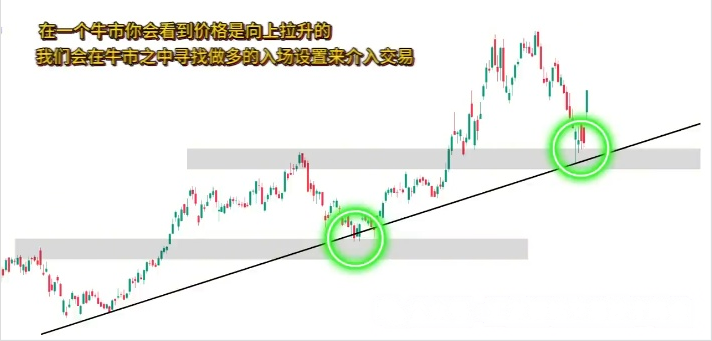
Going short in a bull market is risky because pullbacks tend to be very short-lived; they are just normal adjustments, and after the adjustments, prices will continue to rise.
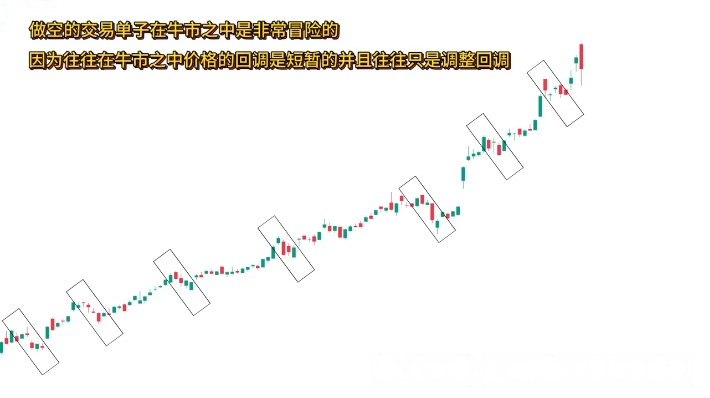
You can imagine the momentum of a bull market as a 'river flowing downstream': even if your entry timing is slightly off, as long as you follow the trend and go long, you will most likely profit in the end—the trend will help you 'correct' small mistakes. From the stock market's definition, an index rising 20% from a low point can be recognized as a bull market.
5 technical signals to accurately identify a bull market.
Trend structure: Higher highs + higher lows: This is the most core signal—prices are making higher highs (higher highs), and lows are also making higher lows (higher lows).
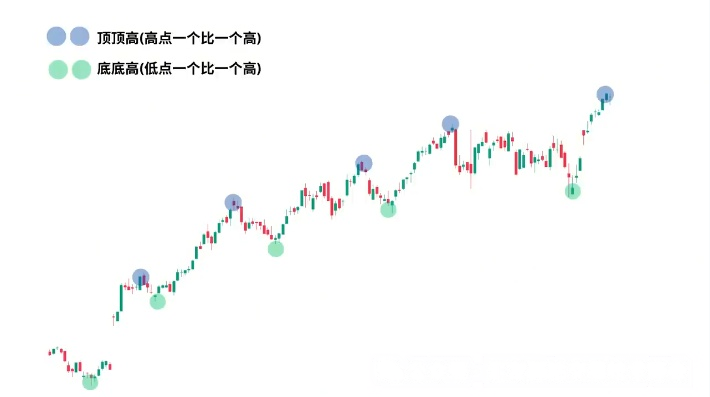
At this time, as long as prices pull back to support levels or key price levels, it is a good opportunity to go long;
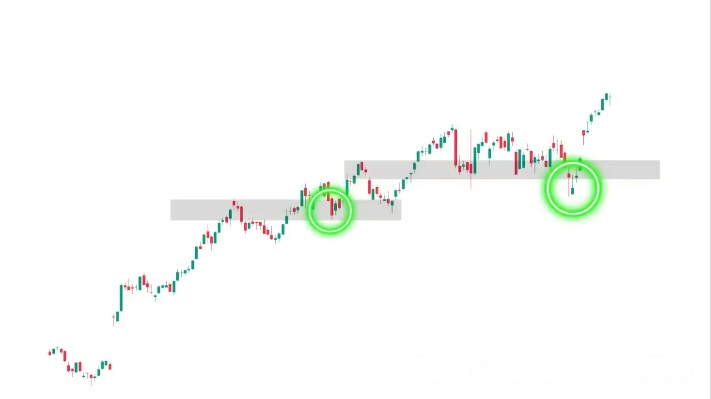
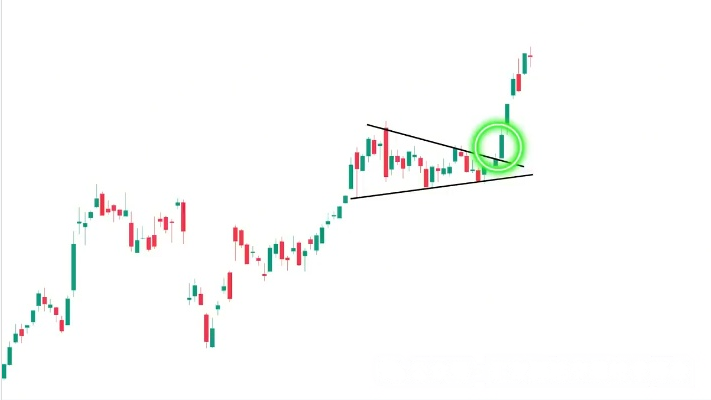
Consolidation pattern + upward break: Prices first rise, then enter consolidation (which can be any shape like flags, triangles, channels, etc.), followed by an upward break from the consolidation range—this indicates the end of the pullback, new buyers enter, the bull market continues, and go long directly;
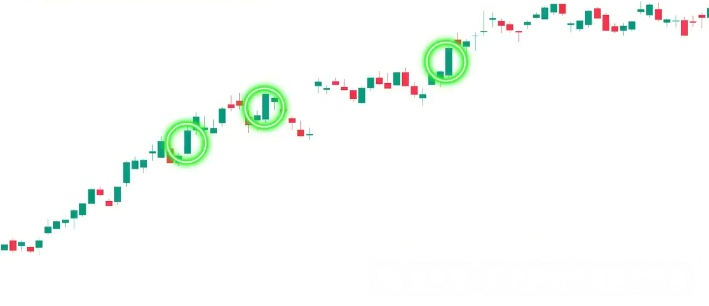
Frequent appearance of large bullish candles: A large bullish candle appears in the chart frequently, and its body is much larger than the surrounding candlesticks—this indicates strong buying power, sufficient bullish momentum, and the price will continue to rise;
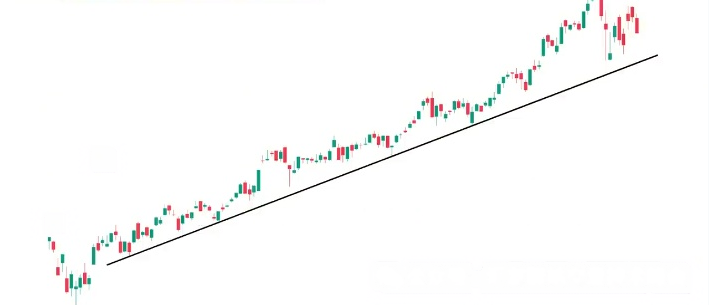
Can draw a clear upward trend line: Connect the price lows to form a smooth upward trend line. When prices pull back to near the trend line, combined with other technical signals (like bullish candlestick patterns), you can go long;
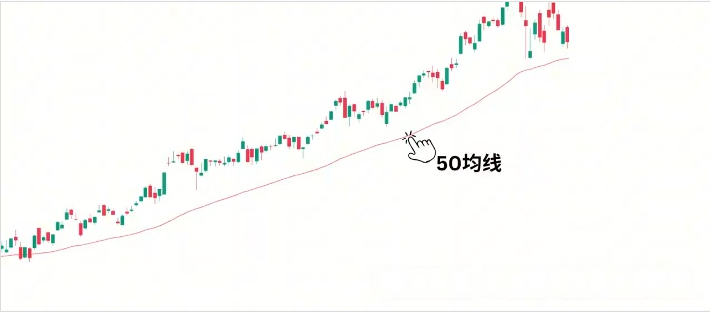
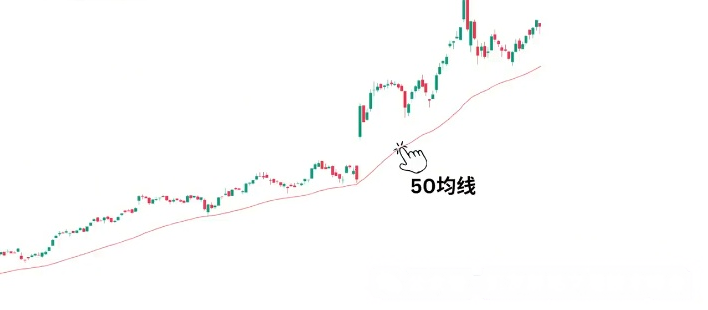
Prices consistently stay above the moving average: I often use the 50-period moving average (you can choose parameters that suit your strategy); if prices consistently run clearly above the 50-period moving average, it indicates a strong bull market, focusing on going long.
7 signals to determine the end of a bull market (transition to bear market).
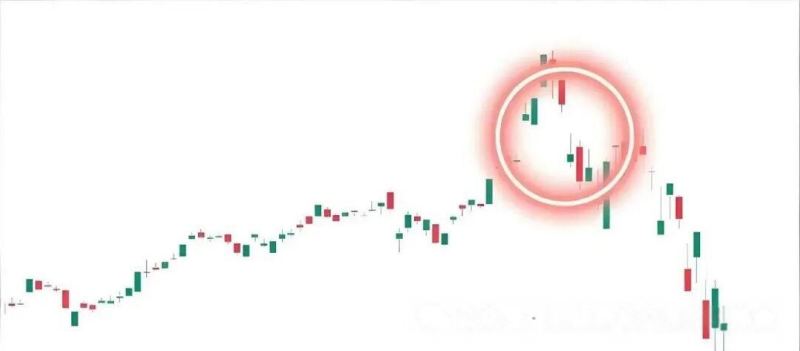
A bull market does not rise forever; when these signals appear, be alert, quickly reduce positions or exit:
Trend structure has changed: from 'higher highs + higher lows' to 'lower highs,' indicating the upward momentum is gone;
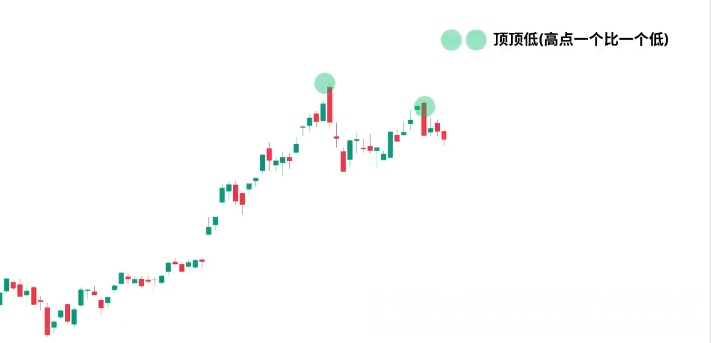
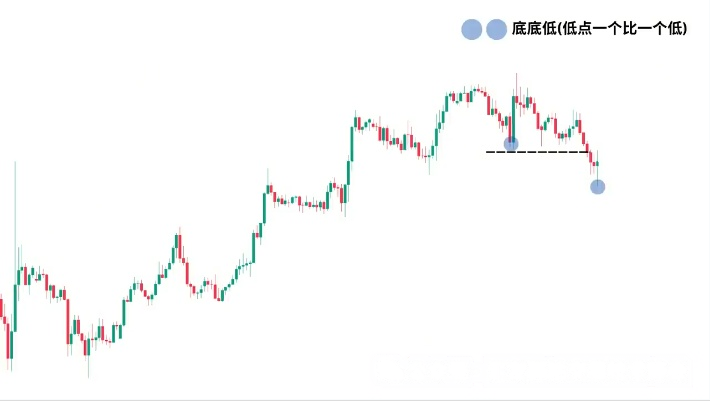
Breaking below previous lows: Forming a downward structure of 'lower lows,' completely destroying the bull market;
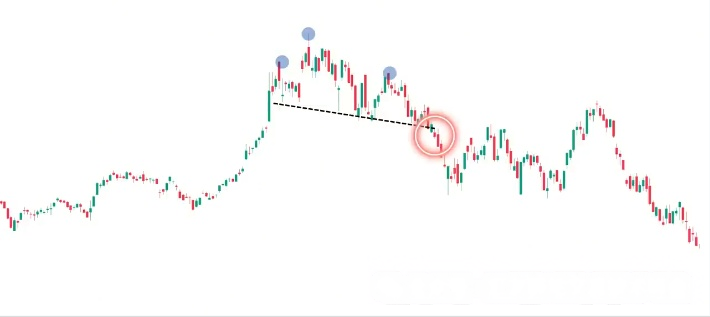
Consolidation pattern broken: After price consolidation, a large bearish candle breaks downward, indicating explosive selling pressure;
Appearance of a large bearish candle: A large bearish candle’s body is much larger than previous candlesticks, indicating that bulls are exiting for arbitrage, strong selling pressure;
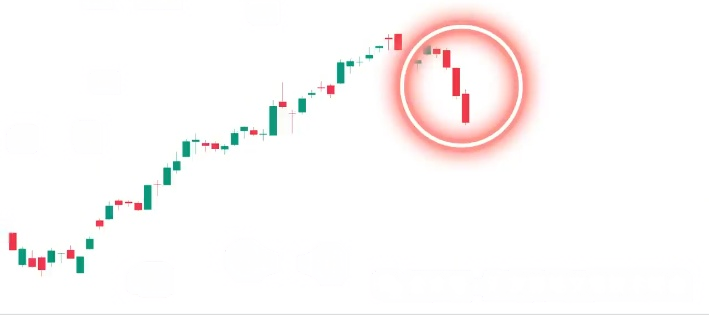
Huge gap down: Prices drop sharply, leaving a gap, indicating a reversal in market sentiment and panic selling occurs;
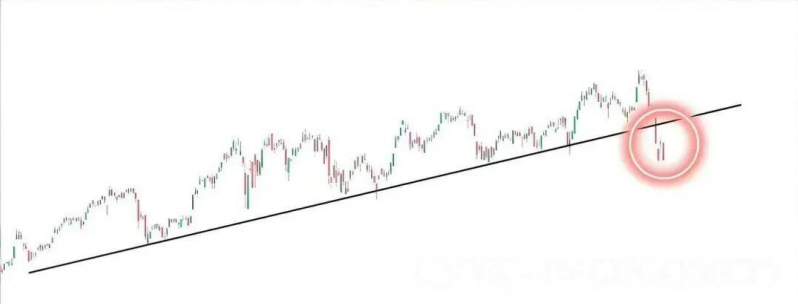
Breaking below the upward trend line: Prices break down through the previously drawn upward trend line, invalidating trend support;
Breaking below the moving average: Prices fall from above the moving average to below, breaking the strong pattern of the bull market.
2. Bear market:
Only short, do not bottom fish, earn by following the downward momentum.
Bear markets and bull markets are exactly the opposite—prices are overall declining, so you should follow the trend and 'go short'; going long is just seeking your own demise.
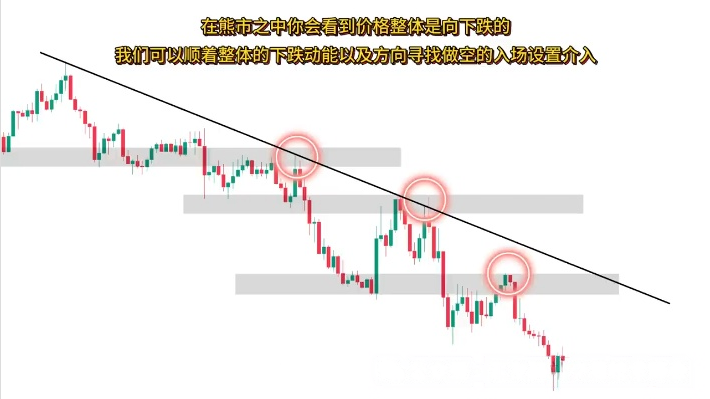
Rebounds in bear markets are all temporary adjustments, and after the pullback, prices will continue to fall. Don't think about 'bottom fishing,' as it’s easy to get trapped.
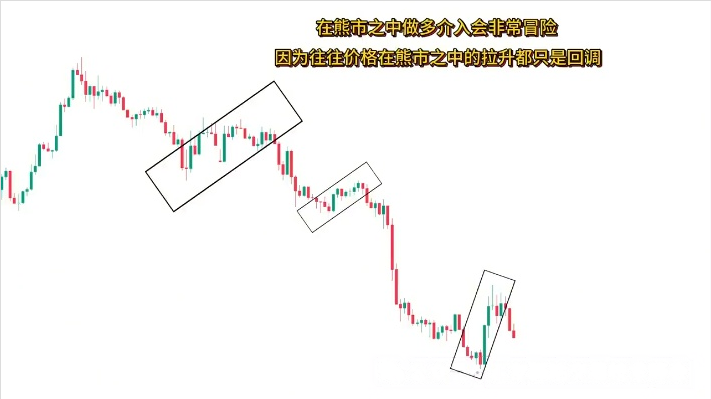
In the market, if the index falls 20% or more from a high point, it is considered a bear market. The momentum of a bear market is like 'swimming upstream'; going long against the trend will only be severely suppressed by the trend.
5 technical signals to accurately identify a bear market.
Trend structure: lower highs + lower lows: Prices are making lower highs (lower highs), and lows are also making lower lows (lower lows). When prices pull back to resistance levels or key price levels, it is an opportunity to go short.
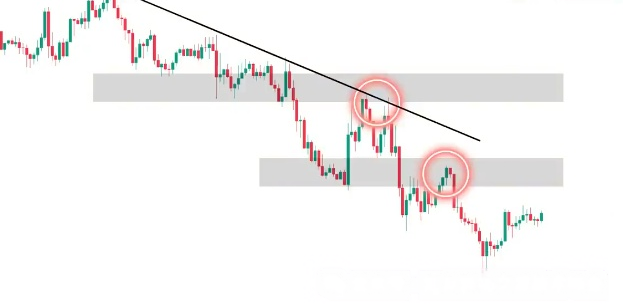
Consolidation pattern + downward break: Prices first decline, then enter consolidation, followed by a large bearish candle breaking the consolidation range—indicating the end of the pullback, new sellers entering, and the bear market continuing, go short directly;
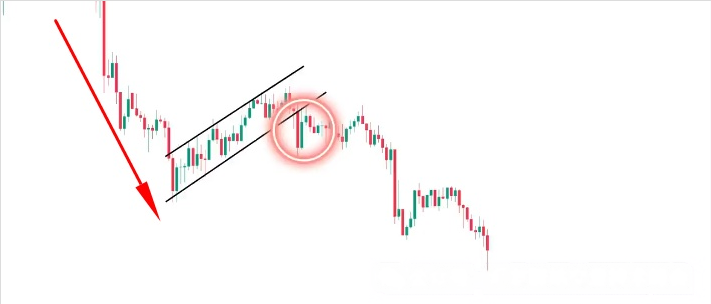
Frequent appearance of large bearish candles: Large bearish candles often appear in the chart, with bodies much larger than surrounding candlesticks—indicating strong selling pressure, sufficient bearish momentum, and prices will continue to fall;
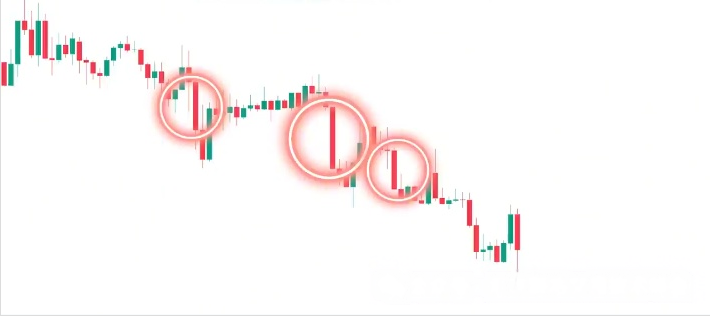
Can draw a clear downward trend line: Connect the price peaks to form a smooth downward trend line. When prices pull back to near the trend line, combined with bearish candlestick patterns, you can go short;
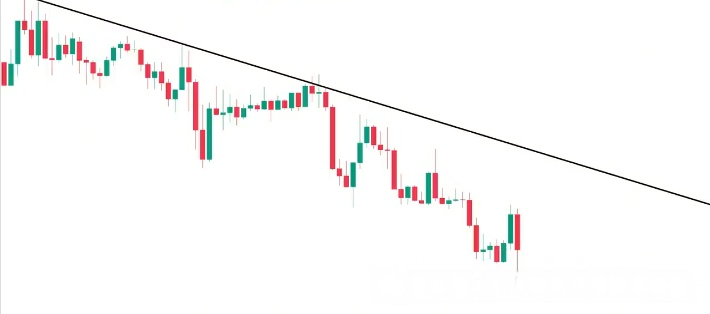
Prices consistently stay below the moving average: Prices consistently run clearly below the 50-period moving average (or your commonly used moving averages), indicating a weak bear market, focusing on going short.
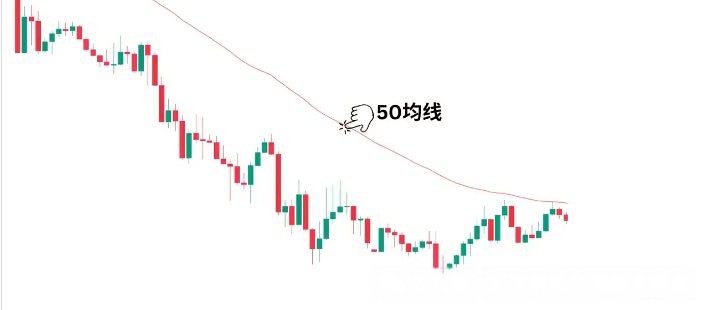
7 signals to determine the end of the bear market (transition to bull market).
The bear market will also end; when these signals appear, prepare to go long:
Trend structure has changed: from 'lower highs + lower lows' to 'higher highs,' indicating the downward momentum has weakened;
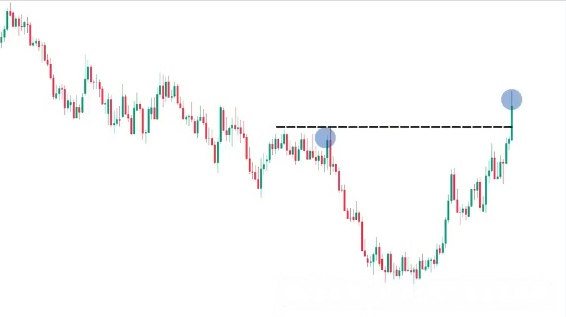
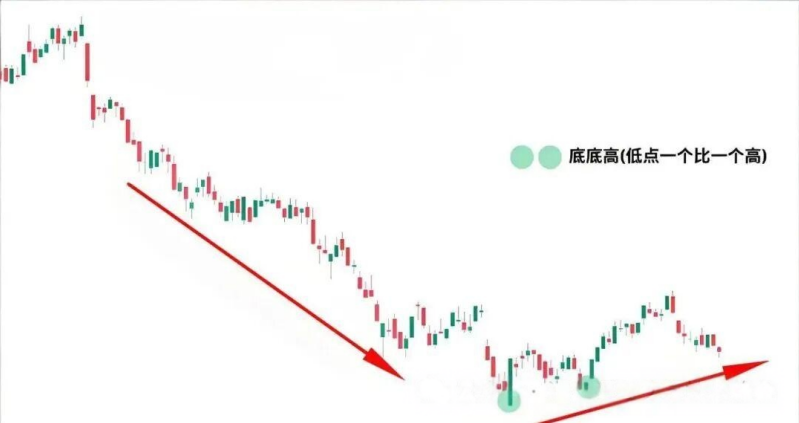
Forming higher lows: Prices no longer create new lows, with each low being higher than the last, indicating a bull market is about to start;
Consolidation pattern broken upward: After price consolidation, it breaks upward and forms higher highs, indicating the end of the bear market;
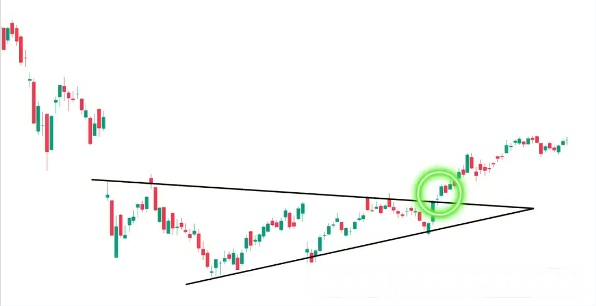
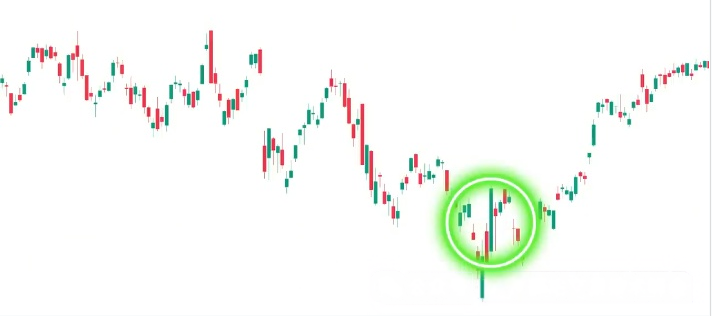
Appearance of a large bullish candle: A large bullish candle’s body is much larger than previous candlesticks, indicating explosive buying power, sellers exit for arbitrage;
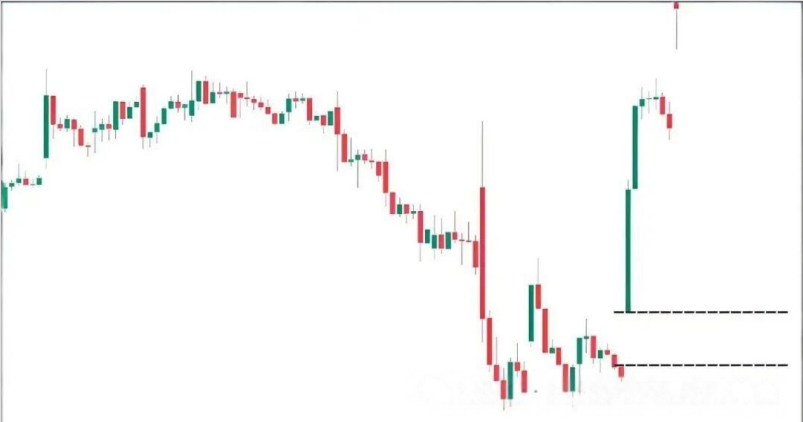
Huge gap up: Prices jump sharply and open high, leaving a gap, indicating a reversal in market sentiment and funds are scrambling to buy;
Breaking through the downward trend line: Prices break upwards through the downward trend line, transforming trend support into resistance, ending the bear market;
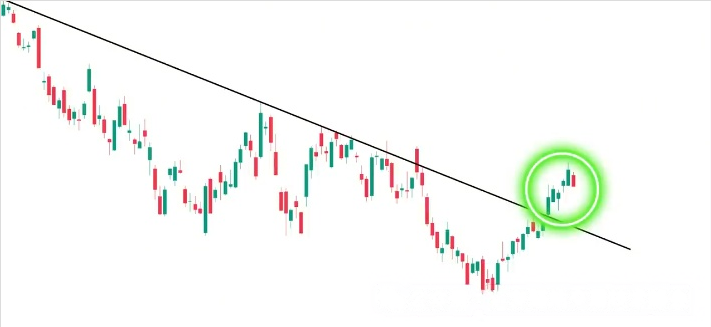
Breaking through the moving average: Prices rise from below the moving average to above, breaking the weak pattern of the bear market.
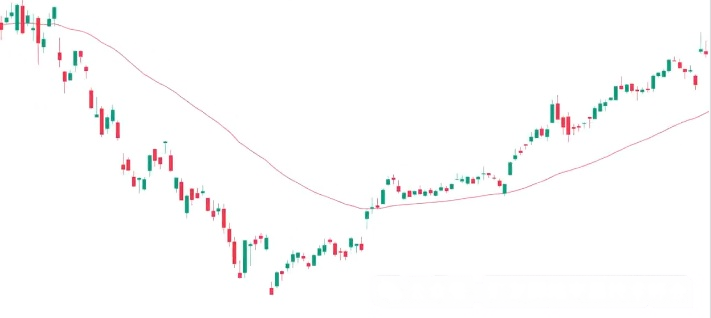
3. Sideways trend:
Buy high and sell low, earn the difference within the range.
The core of a sideways trend is 'prices move to the right'; there is no clear upward or downward direction, and the forces of supply and demand are balanced. At this time, the highs and lows of prices are roughly the same, and we can easily draw support levels (connecting the lows) and resistance levels (connecting the highs).
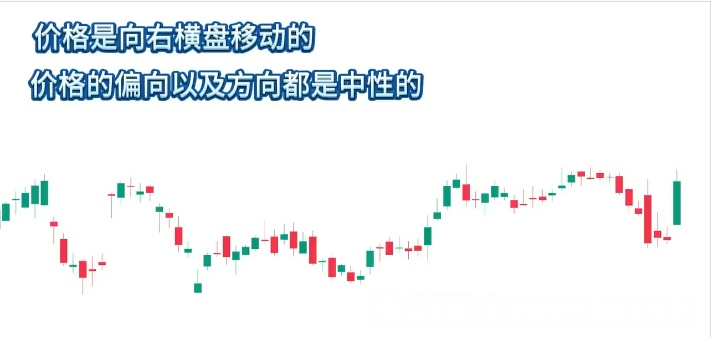
In a sideways trend, there is no need to be obsessed with going long or going short; the core strategy is 'buy high and sell low':
When prices drop to support levels, and bullish candlestick patterns appear (like hammer lines, bullish engulfing), go long;
When prices rise to resistance levels, and bearish candlestick patterns appear (like shooting stars, bearish engulfing), go short;
Set stop-loss points below support levels (when going long) or above resistance levels (when going short) to avoid being trapped by breakouts.
The key to a sideways trend is 'not being greedy' because prices lack trending momentum, and the range of price fluctuations is limited. Just set take profits at a fixed risk-reward ratio (like 1:1 or 1:2), and don’t expect to make big money in one go.
Summary:
The core of trading is 'first recognize the trend, then look for opportunities.'
Regardless of whether it is a bull market, bear market, or sideways market, remember this: 'Trend is king, go with the trend.'
Bull market: Look for support levels to go long, avoid going short;
Bear market: Look for resistance levels to go short, do not bottom fish;
Sideways: Go long at support levels, go short at resistance levels, buy high and sell low.
The method to recognize trends is actually very simple; it’s those core signals—trend structure, candlestick patterns, trend lines, moving averages. Master these signals, and in 3 minutes, you can distinguish what type of market it is, then find opportunities along the trend, naturally increasing your success rate compared to blind trading.
This concludes the trading experience shared by Yan An today. Many times, you lose many opportunities to make money because of your doubts. If you don’t dare to try boldly, to approach, to understand, how can you know the pros and cons? You only know how to take the next step after taking the first step. A warm cup of tea, a piece of advice, I am both a teacher and your talkative friend.
Fate is a connection; knowing each other is a parting. I firmly believe that fate will bring us together after a thousand miles, and parting is destiny. The journey of investing is very long; gains and losses are just the tip of the iceberg. Remember, even the wisest can make mistakes, and even the most foolish can have gains. Regardless of emotions, time will not stand still for you. Pick up your frustrations and stand up to move forward.
The martial arts secrets have been given to you; whether you can become famous in the world depends on yourself.
These methods should be saved by everyone; if you find them useful, feel free to share them with more cryptocurrency traders around you. Follow me for more valuable insights in the crypto world. After getting soaked in the rain, I wish to hold up an umbrella for the leeks! Follow me, and let's walk hand in hand on the road of cryptocurrency!


