Introduction: Why must we pay attention to Google's $180 billion now?
Release Background: On February 4, 2026, based on Google's strongest financial report and management guidance in history.
Core Focus: Google announced that capital expenditures could reach up to $175 billion to $185 billion in the coming year, with almost all directed towards AI infrastructure.
Strategic Interpretation:
This is not just business expansion, but a strategic declaration with a 'clearing the field' implication.
While the market is still competing on model technology, Google has already started the qualification rounds for the second half of AI with real money—determining who can stay at the table.
Briefing objective: Based on the true financial numbers, management information, and practical progress (infrastructure and autonomous driving), answer a real question: Is this $180 billion a gamble on the future, or an early end to the game?
Executive Summary
This report aims to analyze Google's latest financial performance and its strategic deployment in the AI field. Although Google has delivered its strongest earnings report in history, the $175 billion to $185 billion capital expenditure (Capex) revealed by its CFO for 2026 has raised concerns on Wall Street. Through deep data mining, this report points out that Google is trying to achieve a "clearing" in the AI field with its strong cash flow and ecological advantages. Meanwhile, Waymo, under Google, has already outpaced Tesla in the commercialization of autonomous driving.
-----------------------------------------------------------------------
1. Financial performance: AI-driven growth peak
Google's latest financial report shows that the company not only maintains stability in its traditional business but has also begun to see results in its AI transformation.
Resilience of search business: Fourth-quarter search revenue reached $63.1 billion, a year-on-year increase of 17%. AI Overview has covered over 100 countries, serving 2 billion users daily. Data shows that users using AI Overview search more frequently.
Cloud business profit explosion: Google Cloud's fourth-quarter revenue reached $17.7 billion, with profit margin soaring from 17.5% in the same period last year to 30.1%, with a profit amount of $5.3 billion. This indicates that enterprise customers have shifted from "trial" to "large-scale payment."
Gemini ecosystem expansion: Gemini applications have reached 750 million monthly active users; the number of developers has reached 13 million, processing requests over 10 billion times per minute via API.
Order backlog: Google Cloud's backlog of orders reached $240 billion, a year-on-year increase of 100%, mostly driven by enterprise-level AI demand.
-----------------------------------------------------------------------
2. $180 billion capital expenditure: Clearing-style strategic layout
Wall Street's panic over Google's future huge investments mainly stems from concerns about diluted profit margins, but in the long run, this reflects Google's infrastructure moat strategy.
1. Breakdown of capital flows
Google plans to invest $175 billion to $185 billion in 2026, nearly three times the investment in 2024 ($69.1 billion).
60% for devices: About $105 billion will be used to procure NVIDIA's latest H200, Vera/Ruben GPUs, and deploy Google's self-developed seventh-generation TPU (Ironwood).
40% for infrastructure: About $70 billion will be used for global data center construction, covering land, buildings, cooling systems, and power infrastructure.
2. Wall Street's concerns: Depreciation pressure
Huge investments mean a surge in depreciation costs.
Depreciation expenses are expected to be $21.1 billion in 2025.
If capital expenditure doubles in 2026, depreciation costs could rise to $36 billion, which may directly consume most of the net profit, compress profit margins, and thus affect short-term stock performance.
3. "Clearing" logic
Google has raised the entry threshold for the AI track through this "superpower" competition:
Against OpenAI: Compared to OpenAI's funding chain pressure and financing difficulties, Google has a stable cash flow (Search business annual revenue exceeds $250 billion) to support long-term investments.
Supply certainty: Google, as one of the first vendors to deploy NVIDIA's latest platform, has a solid supply chain position.
-----------------------------------------------------------------------
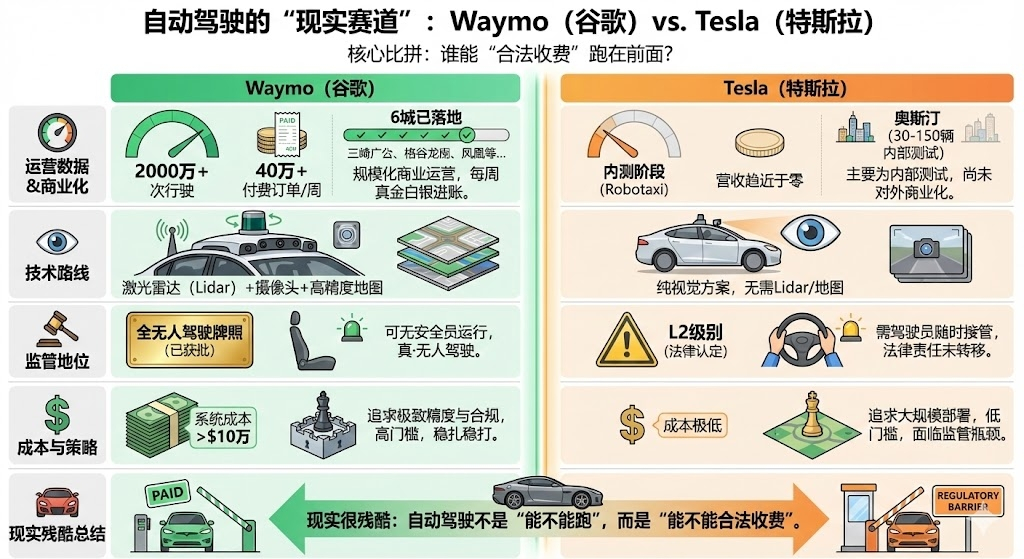
3. Autonomous driving practice: Waymo vs Tesla
The report indicates through comparative data that Waymo is currently significantly ahead in commercialization and regulatory compliance.
-----------------------------------------------------------------------
4. Competitive landscape and strategic insights
1. Platform companies vs tool-based companies
Google vs Microsoft: Both are platform companies, with a complete ecosystem (search, office software, cloud, YouTube, etc.) and self-sustaining capabilities.
OpenAI: A tool-based company. Despite its leading model (GPT), it lacks a cash cow. Last year, it spent $8.5 billion and lost $5 billion, facing severe financing pressure and the erosion from open-source models like Llama 4 and DeepSeek.
2. Investment style analysis
Conservative suggestion: Microsoft may be more stable, with a deep moat formed by Office 365 and Teams, resulting in low friction for AI integration.
Aggressive suggestion: Google has a larger growth space. Its cloud business profit margin is growing rapidly, Waymo has shown the ability to implement AI in high-difficulty scenarios, and its current valuation is relatively cheaper compared to Microsoft.
-----------------------------------------------------------------------
5. Core conclusions
The second half of AI is a capital battle: the technical lead is shrinking, and the future's victory or defeat depends on who has the money to buy "shovels" (chips) and build "warehouses" (data centers).
Cash flow is a golden ticket: Google dares to spend money because it is supported by huge profits from its search business, while companies relying on financing for survival will face huge risks when the tide goes out.
Long-term value looks at ecology: Google has a complete closed loop from underlying chips, models to end applications (Android/YouTube), and its $180 billion investment is not crazy but aims to use capital advantages to "dimensionality reduce" competitors.
Important point excerpts:
"Google spent $180 billion to hold itself down... using money to build walls, and those outside cannot come in."
"In the face of the $180 billion hammer, all technical tricks are futile."
"Banks are unwilling to lend money to the poor. Google spent $180 billion, and Wall Street knows this money is likely to be recovered."