
Friends who have been frequently farming MEME on-chain and running cross-chain arbitrage must deeply resonate: Web3 has been shouting for years about large-scale landing, yet the infrastructure is so fragmented that it makes it hard to breathe.
I just taught newcomers that to transfer USDT, they must first buy ETH/TRX to pay for Gas, and then turned around to be hit by frequent outages on Solana and the high congestion costs on Tron—it’s a painful and inhumane payment experience, which is a fatal flaw on the road to Mass Adoption.
I just withdrew some positions from the overcrowded Solana, and with the bias of 'looking at another stablecoin payment pioneer,' I dived deep into Plasma. After running the testnet and digesting the account model documentation, my perspective changed: this is not an ordinary payment chain, but a dimensional attack on the underlying logic of public chains.
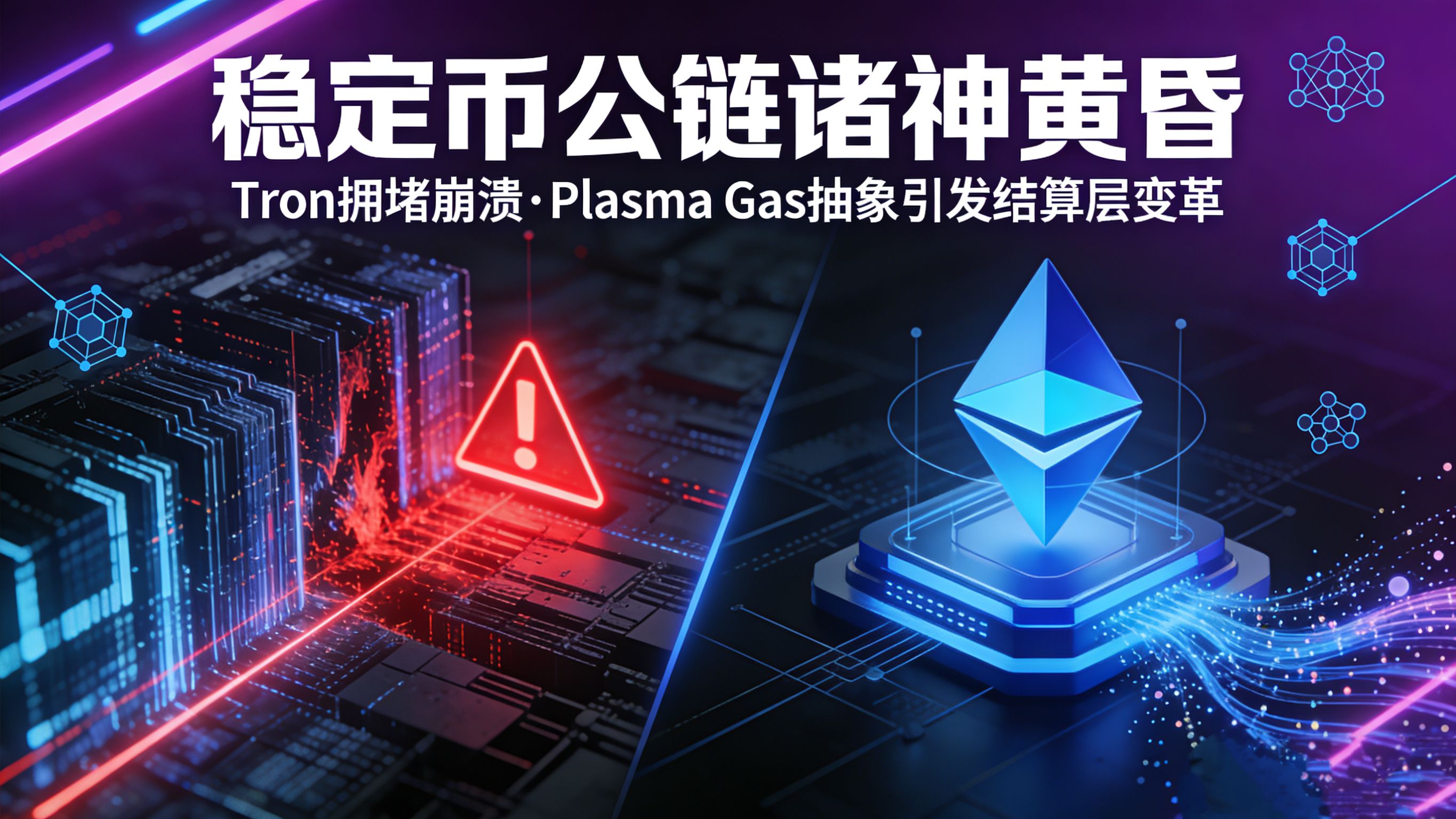
One, on the eve of Tron’s hegemony collapse: the cheap and fast trump card has already been played out.
Everyone acknowledges that Tron can capture half of the USDT market; it is not technology but its low Gas + fast confirmation that creates an exceptional settlement experience.
However, this core advantage is now crumbling: after a surge in on-chain transactions, Tron experiences full congestion during peak hours, Gas fees spike, and confirmation delays. The once 'retail transfer paradise' is losing its most critical competitive edge.
Plasma directly throws out the Paymaster native Gas abstraction kill shot, precisely targeting all public chains' experiential pain points—
This is not a secondary transformation of Ethereum ERC-4337 account abstraction; it is on-chain native integration: developers/third parties fully pay Gas, and users only perceive 'asset transfer' with no 'fuel consumption.'
Just as you don't need to care about how much power Tencent's servers consume when you send a red envelope via WeChat, this experience gap that flattens Web2 and Web3 is the only ticket for large-scale rollout.
Two, breaking away from L2 and competitors: L1 tailored for stablecoins, pure enough to have no rivals.
Compared to a variety of Layer 2 and payment public chains, Plasma's 'specialization' has become its biggest moat.
✅ Goodbye to ETH hostage: the DA costs of Optimism/Arb are ultimately passed on to users, while Plasma, as a native L1, has an economic model completely designed for high-concurrency stablecoin circulation, with asset settlements pure and without redundancy.
✅ Crushing Ton/Solana: Ton, backed by Telegram's massive traffic, is still not developer-friendly, and its asynchronous architecture kills DeFi Lego combinations; Solana may be fast, but its downtime curse + SOL's drastic volatility makes it unsuitable for a stable settlement layer.
✅ First-tier performance: cutting redundant public chain functions, focusing on stablecoin transfers, with consistent block stability and transaction confirmation speed at the top, and TPS performance is solidly effective.
The best part is its value capture logic, perfectly hitting the internet's 'the wool comes from the pig' principle.
$XPL is not a retail user's fuel payment but rather network 'equity'—validators stake XPL to secure the network and share MEV earnings; B-end merchants, DApps, and payment gateways need to stake/burn XPL to exchange for network bandwidth.
Shifting the fee side from ordinary users to B-end preserves a zero Gas experience for users while locking in value support for native tokens, which can be considered a new idea for public chain economic models.
Three, a fatal shortcoming: the 8-lane highway is currently desolate.
It's a cold splash of reality: Plasma's current ecosystem is so barren it is concerning.
The official wallet + simple Swap is all there is; without strong applications to retain funds and no mature DeFi ecosystem, a zero-fee, high-throughput 8-lane highway has neither gas stations nor service areas, and the TVL is too small to show.
This is also the core betting point of early layout.
Betting on large payment institutions and RWA real asset on-chain projects focusing on this dedicated stablecoin settlement public chain; betting on heavyweight B-end collaborations landing within six months.
Once the ecosystem's rollout fails to meet expectations, XPL staking inflation rewards will turn into massive selling pressure, and the risk of falling to zero is not merely alarmist.
Four, from the perspective of the secondary market: during a sideways consolidation period, it is actually a calm layout window.
Looking at the $XPL market, it has been trading narrowly around 0.1 for a long time; day traders avoid it, but it is a golden window for allocation players.
🔹 RSI shows no overbought conditions, fund heat is siphoned off by AI and MEME sectors, and chips have not been overly speculated.
🔹 Healthy chip structure, no irrational bubbles, belongs to a 'neglected' undervalued track.
My operational strategy is very clear: do not bet on short-term hundredfold myths, but enhance allocations in the stablecoin settlement track.
USDT's market capitalization continues to expand, and the demand for an efficient decentralized settlement layer is rigid. Once Plasma takes on the narrative of 'decentralized Alipay,' its current market value won't even cover the decimals.
Five, final complaint: the engineering approach to operations is both a strength and a weakness.
The project team's operation is too 'techie': Twitter is filled with code updates and technical parameters, neglecting emotional value and marketing hype.
In the era of cryptocurrency attention economy, no matter how good the technology is, it fears being too deep in the alley; without hackathons, without attracting developers, without ecosystem activities, even the best public chains are just empty showrooms.
But from another perspective: being untrendy is the value of early layout.
Cryptocurrency investment has never been about chasing highs and cutting losses; instead, it is about digging deep for value when no one cares and securing profits when voices are loud—this is the core logic for navigating bull and bear markets.
The twilight of stablecoin public chains has arrived. The pain points of Tron and Solana are laid bare, and Plasma's Gas abstraction revolution—who will it ultimately displace?
Watch the ecosystem rollout and B-end entry; this reshuffle of the settlement layer has just begun.


