

In finance in general and especially in the crypto market specifically, the two concepts of investment and speculation are frequently mentioned. Although both aim for profit, their approaches, levels of risk, and visions are completely different. Many newcomers to Crypto often confuse these two concepts, leading to misguided strategies and unnecessary risks.
1. What is speculation?
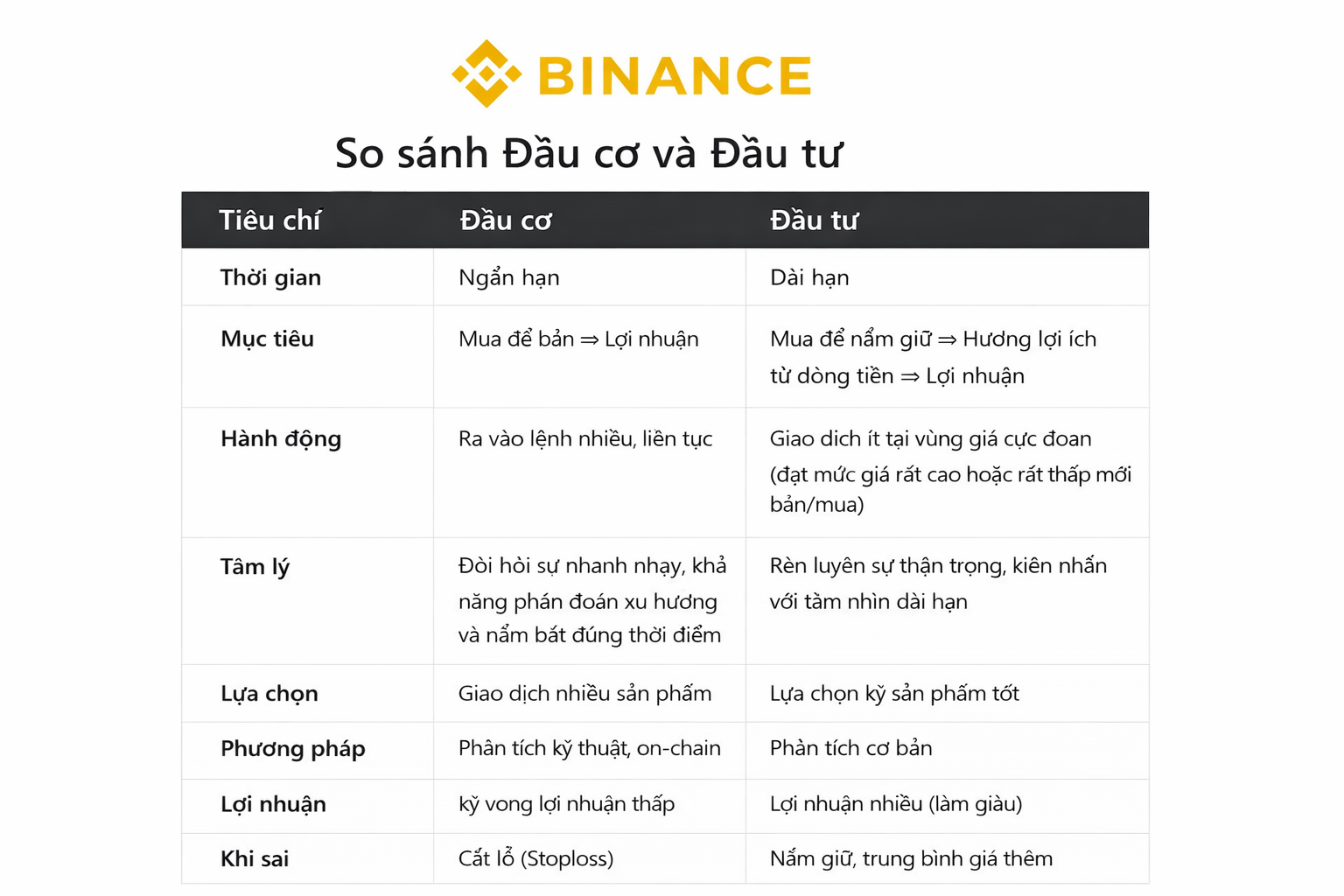
In the field of finance, speculation is understood as the act of buying and selling various assets such as stocks, foreign currencies, commodities, real estate, or Crypto with the main purpose of making a profit from short-term market fluctuations.
Speculators often do not pay much attention to the intrinsic value of assets. Instead of fundamental or technological analysis behind a coin, they mainly predict price trends to take advantage of opportunities to 'buy low - sell high' or vice versa.
Notable characteristics of speculation:
Short-term holding period: It can be just a few minutes, hours, or days.
Quick profit targets: Often expect a high return on investment in a short time.
Dependent on price fluctuations: Profits mainly come from price differences, not concerned with true value.
High risk: If the trend prediction is wrong or faces unusual fluctuations, losses can occur immediately.
For example in Crypto:
A speculator might buy Bitcoin at a price of 73,000 USD because they believe the price will bounce to 77,000 USD within a week. If correct, they quickly take profits. But if Bitcoin continues to drop, the losses will also come very quickly.
Because of the characteristic 'quick profit but high risk', speculation is often considered an 'attractive risk' in finance and particularly popular in Crypto – where coin/token prices can fluctuate by 10–20% in just one day.
2. What is investment?
Unlike speculation, investing is the process of using resources (capital, time, effort, knowledge) to generate long-term and sustainable profits.
Investors focus on the intrinsic value of assets. They analyze the projects, technologies, or platforms behind the projects, and then make decisions to hold for many years. Profits do not come from short-term price fluctuations but from stable growth and broad market acceptance.
Characteristics of investment:
Long-term vision: Hold from a few years to several decades.
Concerned about real value: Only invest in assets with potential for sustainable growth.
Stable profits: Do not expect to get rich quickly but focus on steady growth.
Lower risk: Compared to speculation, long-term investment is often less affected by short-term fluctuations.
For example in Crypto:
An investor who believes in the potential of BNB Coin will buy BNB and hold it for 5–10 years, as analysis suggests that Binance will continue to maintain its position as the leading crypto exchange in the market, and the value of BNB will grow in the long term. They do not care whether BNB increases or decreases by 5% tomorrow, but look at the long-term trend.
3. Distinguish between investment and speculation – Who are you?
To clearly distinguish between investment and speculation, the legend Warren Buffett once proposed a 'simple test':
Do you care whether the market opens tomorrow?
Are you concerned whether the market goes up or down tomorrow?
If the answer is 'Yes', you lean towards speculation. If you only care about the essence of the project, the intrinsic value of the asset, and the ability to generate profit in the future, you are an investor.
However, in the Crypto market, the line between investment and speculation is quite blurred. Most crypto projects are still young, the lifecycle of a project is quite short compared to traditional financial entities, most coins have not proven their real value, while price fluctuations are extremely high. Therefore, most participants in Crypto today still act more with speculation thinking than long-term investment.
4. Flexibly apply both speculation and investment thinking in the crypto market
In the Crypto market, purely applying speculation or investment has limitations. Given the characteristics of the crypto market, a smart strategy would be to combine both: speculate but based on the thinking and discipline of an investor.
Specifically as follows
Selective trading, moderate frequency
Instead of continuously entering orders, focus on buying and selling at 'overpriced' or 'underpriced' areas.
This helps you take advantage of volatility while still limiting risks.
Set reasonable profit targets
With Crypto, a profit margin of 20–40% per trade is reasonable.
Do not be too greedy because risks can turn against you at any time.
Only choose Crypto with good fundamental analysis
Prioritize projects with reputable teams, clear technology, and strong communities.
Avoid 'junk coins' or tokens that are only pumped.
Smart capital management
Do not 'all-in' into one project
Allocate capital according to the specified ratio, always keep a portion of USDT or stablecoin for emergencies.
Be patient HODL when you have chosen a good project
If you have researched thoroughly and trust the project, you can continue to hold long-term.
In case of price drop, consider implementing a DCA strategy
Decisiveness and discipline
When the market fluctuates, be quick to take profits or cut losses.
Do not let emotions influence decisions.
Conclusion
In finance, a person can be both a short-term speculator and a long-term investor. There is no absolute right or wrong formula; the important thing is to choose a strategy that suits your position, capital, and style.
If you want quick profits, you should lean towards speculation – but be ready to accept high risks.
If you want safety, you will lean towards long-term investment – but it requires a lot of patience.
Or combine both – investment and speculation with thought, something that many professional traders in Crypto are applying to optimize profits and reduce risks.

