
Crypto Exchange-Traded Funds (ETFs) are exchange-traded funds that allow investors to access cryptocurrencies without directly holding the underlying assets. They replicate the price of a cryptocurrency like Bitcoin (BTC) or Ethereum (ETH) through spot or futures contracts. Launched mainly in the United States since 2024, they have democratized institutional investment in crypto, with regulation by the SEC. In February 2026, the crypto ETF market is in a correction phase, influenced by macroeconomic factors such as Fed policy, tech sales in the US, and geopolitical tensions. The total market capitalization of BTC ETFs is around $100 billion, while that of ETH is around $12 billion.
History of Crypto ETFs
Bitcoin ETFs: Approved by the SEC in January 2024, the first spot BTC ETFs (like BlackRock's IBIT) attracted billions in inflows right from launch. In 2024-2025, they accumulated around $70 billion in net inflows, boosting BTC price towards ATH around $126,000. However, 2026 marks a slowdown, with net outflows of $32 million YTD.
Ethereum ETFs: Launched in July 2024, they had a more modest start. In 2025, inflows of a few billion, but performance lagging behind BTC. In 2026, persistent outflows, although recent inflows signal a rotation.
Other ETFs: Products on Solana (SOL), XRP or inverse (like BITI for short BTC) are emerging. For example, SOL ETFs saw $104.8 million in inflows in January 2026. Inverse ETFs perform well in a bear market, with +17% for ETHD in one week.
Analysis of Major BTC ETFs
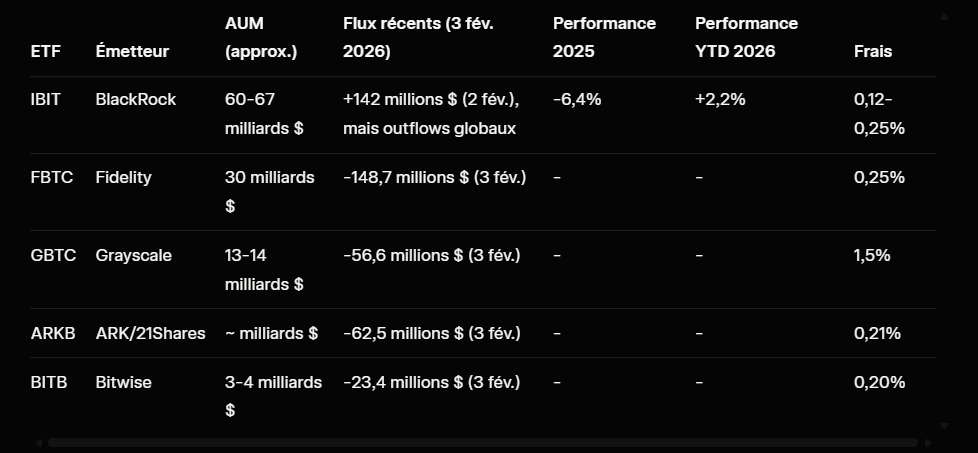
BTC ETFs dominate the market, with BlackRock (IBIT) and Fidelity (FBTC) leading. In February 2026, the sector experienced massive outflows, with assets falling below $100 billion after -$272 million on February 3. This follows a brief recovery with +$562 million on February 2, breaking a streak of outflows. January 2026 saw -$1.61 billion in net outflows.
Analysis of Major ETH ETFs
ETH ETFs struggle more, with lower capitalization and persistent outflows (e.g. -$252 million in January). However, +$14-15 million on February 3, breaking a streak of outflows, indicating a rotation towards alts. ETH underperforms BTC (ETH/BTC ratio at 0.03-0.04).
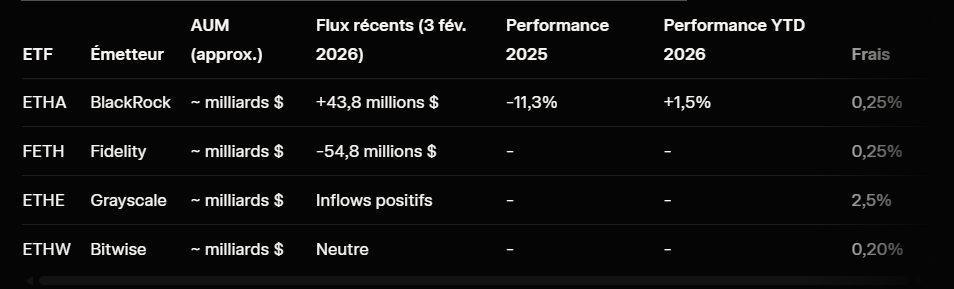
Performance: ETH at ~$2,300-$2,400, -18% in January. Less attractive for institutions despite tech upgrades (e.g. Dencun). Recent inflows suggest selective interest.
Impact on the Crypto Market
Positive: ETFs have absorbed billions, institutionalizing crypto. Record inflows in 2024-2025 pushed BTC to new heights. They act as 'marginal demand', with 12x the daily mining supply.
Negative: Outflows amplify drawdowns (e.g. $500 billion wiped out in one week). BTC correlated to equities (beta 1.25 to S&P 500 in crashes), not a 'digital gold'. Massive liquidations (+$680-740 million in 24h).
Rotation: Inflows ETH/XRP (+$20 million for XRP) vs outflows BTC indicate diversification.
Risks and Outlook
Risks:
Macro: Fewer Fed rate cuts (one expected in 2026), strong dollar (UUP +1%).
Regulation: US bills on standby, SEC scrutiny.
Volatility: BTC sensitive to geopolitics, without a hedge like gold.
Persistent outflows: Equivalent to 2 months of monthly mining supply, bearish pressure.
Outlook:
Bullish: Institutional re-accumulation (e.g. Ark Invest buying the dip). Forecasts: $90-120k for BTC (base case), up to $180k if 401(k) and Fed cuts.
Bearish: Testing $70k if outflows continue.
Neutral: 'Dead' halving cycle in favor of ETF flows. Strategy: HODL/DCA for long-term, light leverage.
In summary, mature crypto ETFs but remain volatile, correlated to global risks. For 2026, watch inflows and macro for potential rebound.


