
An X account with 863,000 followers, featuring group photos of several blockchain giants 'personally endorsing' it, along with the aura of Forbes elite list and the Chief Revenue Officer of BNB Chain. It appears to be an industry authority, but in reality, it is a carefully designed scam.
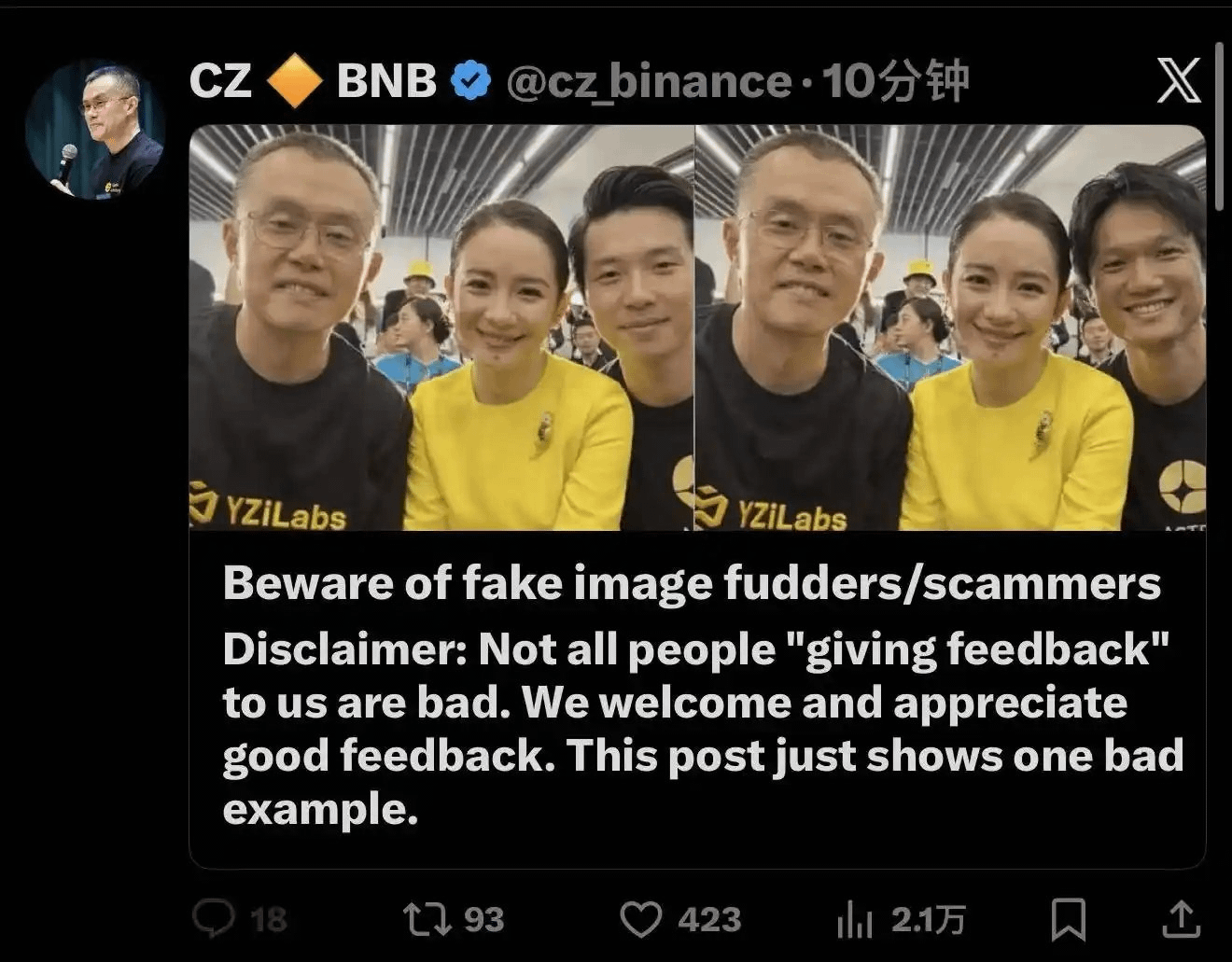
CZ's screenshot of the X account revealed a false group photo posted by Wei Wei, where the color of CZ's clothes did not match his usual dressing habits, showing clear signs of forgery. This discovery not only exposed a potential scam trap but also sounded the alarm for the entire cryptocurrency community.
01 Masquerade Ball
The world of cryptocurrency has once again staged a farce that is difficult to distinguish between reality and fake. In February 2026, Binance founder CZ issued a warning on social media X, revealing the fraudulent behavior of an account with 863,000 followers named 'Wei Wei'.
This account not only blocked CZ's own X account but also set its homepage banner to a photo from a recent BNB Chain event held in South Korea, creating an illusion of being closely related to the industry.
The most eye-catching aspect of the “Wei威” account is its personal introduction, which claims to have appeared on the (Forbes Asia) and (Prestige) 30 Under 30 elite list, and that it once served as the Chief Revenue Officer (CRO) at BNB Chain. These glamorous titles are enough to instill trust in any newcomer to the industry.

02 Flaws abound
While investigating the account deeply, CZ discovered several obvious flaws. First, he noticed that the account posted a photo with him in which he was wearing a blue or purple shirt.
CZ clearly pointed out: 'I never wear blue or purple clothes; that shirt does not exist at all.' Moreover, the background of the photo does not match the actual location he attended the event.
Even more suspicious is that multiple group photos posted by this account have technical inconsistencies. In another photo with CZ and He Yi, the image resolution of CZ and He Yi is noticeably low, while the image of 'Wei威'本人 is much clearer.
Upon verification by CZ, the original image of this photo is actually a picture of him with Aster CEO Leonard. This poor photo splicing technique reveals the perpetrator's technical level and intentions.

03 Tracing the Source
CZ further traced the history of the account and discovered more suspicious aspects. The account almost exclusively posted women's photos before February 2015 and suddenly shifted to exclusively posting cryptocurrency-related content after July 2015.
This sudden content shift suggests two possibilities: either the account was taken over by hackers, or it was directly purchased. Ironically, the account operators were even too lazy to delete earlier photos of women, which can still be found on its media page.
This rough operation method, CZ directly referred to as 'lazy water army'. More worryingly, such accounts have managed to accumulate over 860,000 followers, reflecting the weakness of the verification mechanisms on social media platforms and the lack of discernment among users.
04 Analysis of Scam Techniques
The scam techniques used by the 'Wei威' account are not isolated cases but are typical patterns of current online scams. This model usually involves three key steps: identity disguise, trust establishment, and interest inducement.
First, scammers establish superficial credibility by fabricating authoritative identities (such as Forbes elites and former BNB Chain executives) and using photos with industry leaders. Second, they leverage these fabricated credentials and networks to publish seemingly professional industry analyses on social media, attracting followers.
Finally, after accumulating enough trust, they may launch fake investment projects, raise funds, or directly commit fraud. CZ specifically reminds: 'If you still believe in these, then you might not be very successful in life. Accurately understanding the world is crucial for success.'

05 Industry Warning
This incident is not just a problem with individual accounts, but reflects a widespread trust crisis in the cryptocurrency sector. With the development of AI technology, fabricating images, videos, and identity information has become unprecedentedly easy, while the verification mechanisms on social platforms have lagged far behind these technological advancements.
CZ specifically emphasized in the warning: "Not everyone who 'provides feedback' to us is bad. We welcome and appreciate good feedback. This article simply showcases a bad example."
This statement shows that CZ does not oppose all criticisms but targets behaviors that obviously involve forged identities and malicious intentions. In the highly trust-dependent and transparent cryptocurrency industry, any form of forgery can cause serious harm to the entire ecosystem.
06 Defense Strategies
In the face of increasingly complex online scams, individuals and communities need to stay vigilant. Verifying information sources, cross-referencing, and thinking from multiple perspectives are basic strategies for defending against fraud.
Users should maintain a skeptical attitude towards so-called 'authoritative accounts' on social media, especially when these accounts claim close relationships with well-known figures. These relationships can be verified through various channels, such as checking whether the official accounts of relevant individuals follow the account in question or directly verifying with official channels.
In addition, paying attention to the details of images and videos is also an important means of identifying scams. As CZ discovered, inconsistencies in clothing colors, image resolutions, etc., are all obvious signs of forgery. In the cryptocurrency field, officials usually have clear communication channels, and any information published without these channels should be considered suspicious.


An anonymous blockchain security expert pointed out that the operation model of the 'Wei威' account is known in the industry as 'social engineering attacks'. Scammers exploit people's blind trust in authority, carefully weaving a web of false identities, with the ultimate goal often being to induce victims to participate in fake investments or directly defraud funds.
As the end of the year approaches, such scam activities may become even more rampant. In the masquerade ball of the digital world, every participant should remain sober and remember CZ's advice: 'Accurately understanding the world is crucial for success.'
