

Data from L2Beat shows that the Layer 2 ecosystem on Ethereum is expanding in quantity but shrinking in users.
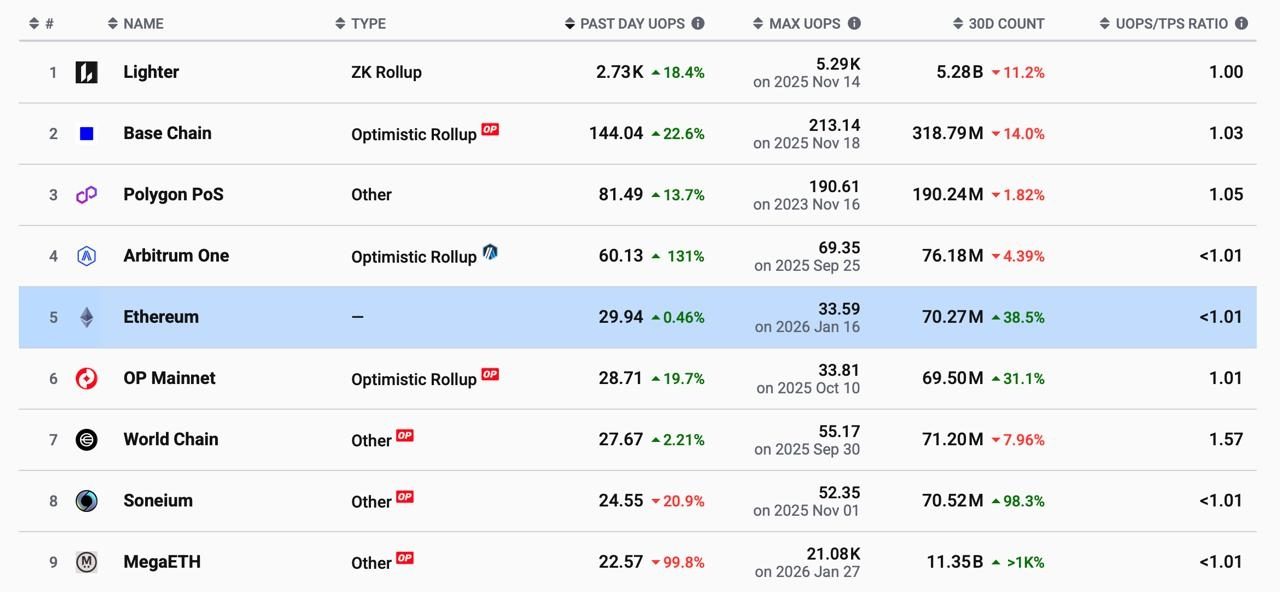
- Currently, there are ~135 L2 networks, but 109 networks recorded UOPS < 1/day → almost no real activity.
- Only a few leading names are still thriving: Base, Polygon, Arbitrum $ARB , Optimism $OP
- Many L2s that were once a 'hot trend' are now almost forgotten: ZKsync Era $ZK , Blast, Linea, Manta
- Even some true L2s have names but no users: Loopring, Redstone
When most L2s fall into a situation of lacking users, use cases, or liquidity, it is not hard to understand why Vitalik had to declare that Ethereum does not need L2.
Layer 2 was expected to help Ethereum scale, but now Ethereum can do it on its own; Vitalik has also stated that L2s need to find other reasons for existence instead of just clinging to Ethereum.
Why has Vitalik changed his view on Layer 2?
For many years, Layer 2 was seen as the central solution to Ethereum's scaling problem. The core idea was to move most transactions to L2 networks to increase processing speed and reduce fees while still 'inheriting' the security of the Ethereum mainnet (L1).
However, according to Vitalik Buterin, the actual deployment shows that many L2s have not met the decentralization standards as expected. Some systems still rely on multisig bridges to connect with L1, instead of fully relying on Ethereum's core security mechanism.
Vitalik emphasizes that if a system achieves 10,000 TPS but connects to L1 through a multisig bridge, it does not truly mean 'scaling Ethereum'. In other words, high speed is not enough if security and decentralization at the foundational level are not ensured.
Where will Layer 2 go?
Vitalik does not completely deny the role of Layer 2, but he believes that L2s should focus on specialized areas instead of becoming a general scaling solution for all of Ethereum.
Potential areas mentioned include privacy, digital identity, decentralized finance, social networking applications, and artificial intelligence. Instead of competing on TPS, L2s can create value by optimizing for specific niches.
This may lead to a repositioning in the L2 ecosystem, where projects need to prove differentiated value instead of just promoting scalability.


