Self-custody has become a key theme in the development of crypto finance. Following the collapse of centralized platforms like FTX and Celsius, more and more users are turning to solutions that allow them to fully control their own assets and private keys. This trend promises greater financial freedom but also exposes shortcomings in usability: managing wallets, paying gas fees, connecting bridges, and using multiple applications are still too complex for the average user. Although cryptocurrency as a financial system has matured, it still lacks the convenience of traditional digital banking for everyday use.
Tria aims to bridge this gap. Tria is set to launch at the end of 2025, positioned as a self-custodial new bank—a platform where users can spend, trade, and earn cryptocurrencies daily without relinquishing control over their funds. It offers crypto-related Visa cards, on-chain yield products, gasless cross-chain transactions, and unified wallet access across over 200 chains. Most importantly, Tria integrates these features into a user experience familiar to new bank users while ensuring ownership of assets. In this article, we will learn what Tria (TRIA) is, how it works, the team behind it, and the role its token may play in shaping the future of on-chain finance.
What is Tria (TRIA)?

Tria is a self-custodial crypto new bank that aims to seamlessly integrate on-chain finance into everyday life. Unlike traditional new banks that rely on centralized infrastructure and custodial accounts, Tria allows users to fully control their assets while providing a modern banking experience. With Tria, users can spend cryptocurrencies using a Visa card, earn yields through audited on-chain strategies, trade assets across over 200 blockchains, and access a unified balance—all without managing seed phrases, paying gas fees, or using specific blockchain tools.
Tria's core design lies in a technology layer called BestPath—a permissionless routing engine that can automatically handle cross-chain transactions in real-time. Whether you are exchanging tokens, making payments, or opening leveraged trades, BestPath finds the fastest and most cost-effective path across supported networks and liquidity sources. This allows Tria to abstract the complexities of blockchain, making the cryptocurrency experience more immediate, flexible, and user-friendly—like a new bank, but without centralized custody. The platform is fully self-custodied, audited, and compliant, enabling users to conduct 'banking' transactions globally while maintaining complete ownership of their digital assets.
Who Created Tria (TRIA)?
Tria was co-founded by Vijit Katta (CEO) and Parth Bhalla (CTO) in 2022. Both founders have extensive experience in the blockchain and tech industry. Before founding Tria, they were involved in well-known projects and companies including Binance, Polygon, OpenSea, Intel, Nethermind, the Ethereum Foundation, and Cardano. Their combined background in blockchain infrastructure, DeFi, and consumer product design shapes Tria's vision: to build a new bank that integrates Web3 ownership with fintech usability.
Tria's core team consists of engineers, product managers, and security experts from several crypto-native and traditional companies. By early 2026, the team includes veterans from companies such as Binance, OKX, HubSpot, Yext, OpenSea, and Nethermind, with approximately 40 contributors globally. The project is operated by Threely Dimensions Inc. and continues to evolve with a large ambassador program and an expanding early user community. This team, which blends deep knowledge of crypto infrastructure with mainstream product experience, embodies Tria's core philosophy: to build for advanced Web3 users while ensuring it is usable by everyone.
Which venture capital firms support Tria (TRIA)?
In October 2025, Tria announced the completion of a $12 million seed pre-strategic financing round, led by P2 Ventures, a venture capital firm focused on the Web3 space. The financing also received support from Aptos Labs, Tria's early user community, and many cryptocurrency-native investors and operators. Notably, the equity structure table lists affiliates from institutions such as Polygon, the Ethereum Foundation, Wintermute, Sentient, 0G, Concrete, and Eigen.
The most notable supporters include Polygon co-founder Sandeep Nailwal, who personally invested in the project. Tria also received advisory support from Polygon Ventures and Polychain Capital during this funding round. Beyond the cryptocurrency space, the company revealed that members of the UAE royal family and regional government officials are also involved, indicating strong interest in the platform’s self-custodial infrastructure and payment capabilities in the Middle East.
As of early 2026, Tria has raised approximately $15 million, including strategic financing and community funding. The team emphasizes that most of the funds come from active users and contributors, rather than just institutional capital. This community-first philosophy is also reflected in the token distribution, with a significant portion allocated for user and ecosystem development rather than private investors.
How Tria (TRIA) Works
Tria is a self-custodial new bank based on a cross-chain execution network. It aims to provide a convenient experience similar to banking applications while giving users complete control over their crypto assets. The platform handles complex blockchain interactions in the background, allowing users to trade, earn, and use cryptocurrencies without managing gas fees, bridging, or seed phrases. Tria achieves this by combining its embedded wallet technology, smart routing engine, and a suite of financial tools.
Self-custody Wallet: Tria provides users with a secure and reliable self-custody wallet without the need to manually store keys. Users can access the wallet through a secure abstraction layer without managing private keys or seed phrases, which includes social recovery and embedded key management. All transactions are carried out on-chain, but the user experience is as seamless as using a fintech application. Users always maintain control over their assets.
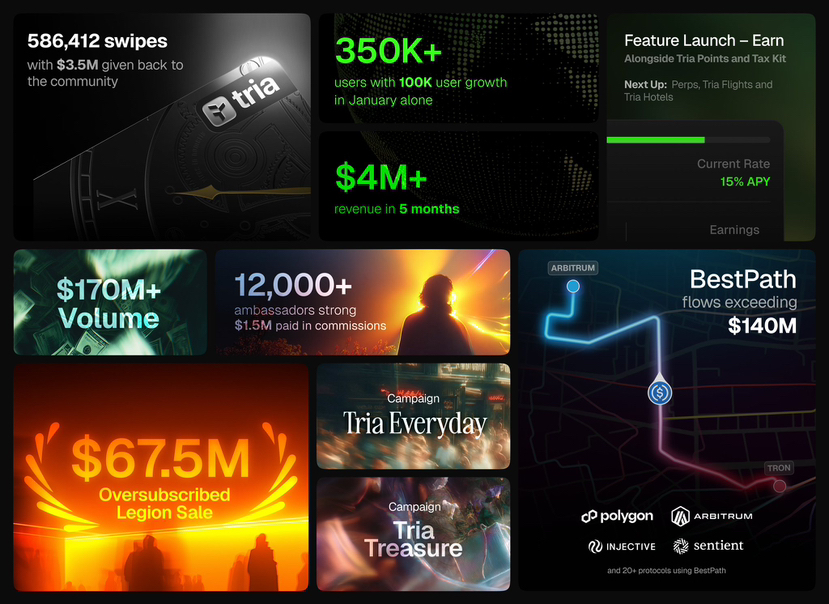
BestPath Routing Engine: BestPath is Tria's AI-optimized, permissionless execution layer. It scans over 70 protocols and multiple blockchains to find the fastest and cheapest path for a given transaction. Whether users want to exchange tokens, pay with cryptocurrencies, or open leveraged positions, BestPath automatically completes the entire cross-chain process—without bridging or manual asset conversion. The engine is powered by decentralized PathFinder nodes that stake TRIA to participate.
Tria Card: The Tria Card is a Visa-compatible debit card that allows users to spend cryptocurrencies at over 130 million merchants in more than 150 countries. It supports Apple Pay and Google Pay and can be topped up with over 1000 tokens. Its uniqueness lies in the fact that users spend directly from their self-custodied balances—Tria uses BestPath for real-time conversion and settlement, allowing users to realize asset gains before swiping their card.
Earn Yield and Trade: Users can earn passive income by depositing cryptocurrencies into on-chain yield vaults. These strategies are audited and transparent, with interest paid directly into users' wallets. Yields can even be used to pay off credit card debts. In terms of trading, Tria supports gas-free exchanges and cross-chain perpetual trading, with all transactions executed through the BestPath engine, without the need for centralized exchanges or multiple wallets.
These components work together to enable users to interact with cryptocurrencies in an instantaneous, unified, and secure manner. Tria's platform eliminates the typical barriers that hinder the mainstream development of on-chain finance while ensuring users have complete ownership of their assets.
Tria (TRIA) Tokenomics
TRIA is the native utility token of the Tria ecosystem, designed to coordinate settlement, staking, governance, and participation between its self-custodial new bank and permissionless infrastructure layer. TRIA plays a central role in facilitating the flow of value through the Tria platform, coordinating incentives between users, operators, developers, and institutional participants.
Token Details
Token Code: TRIA
Blockchain: Ethereum (ERC-20)
Total Supply: 10,000,000,000 TRIA (fixed supply)
Initial Circulating Supply at Launch: Approximately 2.19 billion TRIA (21.89%)
Maximum Supply Inflation Rate: 0%—all tokens are minted at genesis.
Token Generation Event (TGE): 2026
Token Distribution
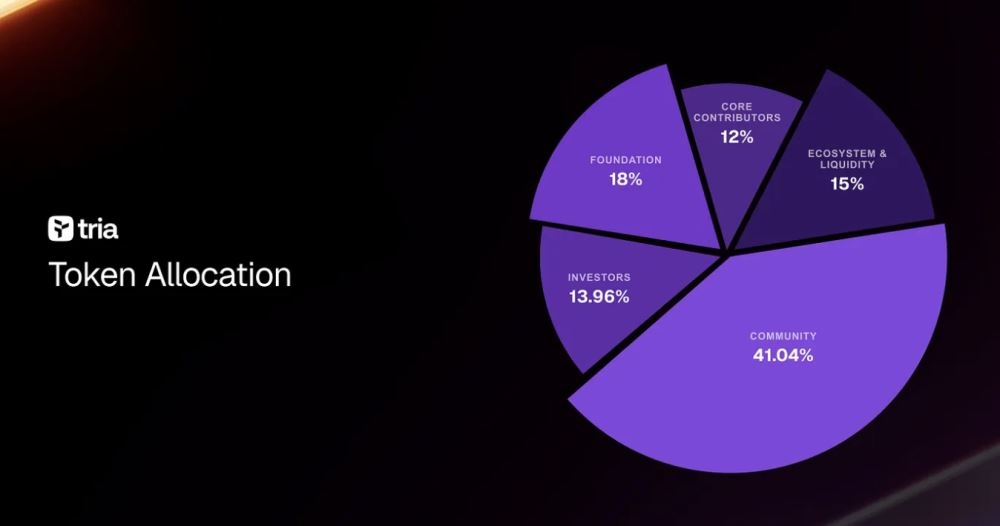
Community (41.04%): Used to reward users, ambassadors, and ecosystem participants through airdrops, incentive programs, and usage-based distributions. This is the largest share, aimed at linking ownership with actual network activity.
Foundation (18.00%): Supports long-term protocol operations, including development, legal, compliance, grants, and governance infrastructure. Enables Tria to operate as a resilient and autonomous system.
Ecosystem and Liquidity (15.00%): Used to guide liquidity, support exchange listings, fund integrations, and strengthen collaborations between applications, blockchains, and payment rails.
Investors (13.96%): Reserved for early strategic supporters. These tokens are fully locked at the TGE (Token Generation Event) and will gradually unlock over the years to ensure alignment with Tria's long-term success.
Core Contributors (12.00%): Allocated to developers, engineers, and builders behind Tria's infrastructure and products. A multi-year vesting mechanism is employed to incentivize long-term contributions and reliability.
Token Utility
Cross-chain Settlement: TRIA is used to settle all activities routed through BestPath, including transactions, payments, and deposits across supported blockchains.
Staking and Routing Access: PathFinder nodes stake TRIA to access BestPath's execution markets and earn fees for routing and validation work.
Fee Subsidies: TRIA offsets network gas fees, transaction costs, forex charges, and subscription fees, creating a seamless, gasless user experience.
Governance: TRIA supports token-weighted voting on protocol parameters, incentive programs, and governance upgrades.
Membership Benefits: Holding TRIA unlocks platform privileges such as lower fees, higher rewards, and access to premium product tiers.
Tria (TRIA) Price Prediction for 2026, 2027 to 2030
As of early 2026, TRIA's circulation is approximately 22% of the total supply, with the remainder gradually unlocking through long-term lock-up mechanisms. In the short term, the token's value may reflect platform usage, staking demand, and overall network growth. Preliminary estimates indicate that, assuming user growth continues and TRIA's virtual bank and infrastructure services develop, TRIA's price may reach between $0.13 and $0.14 by 2027.
Looking ahead to 2028 to 2030, Tria's price performance will depend on its ability to expand into broader use cases, such as cross-chain payments, developer integrations, and institutional adoption. If usage increases and demand at the protocol level strengthens, some predictions suggest that by 2030, TRIA's price could reach between $0.20 and $0.30. These predictions are speculative and depend on various factors, including revenue growth, staking activity, and competition in the crypto finance space.
Conclusion
The emergence of Tria coincides with users seeking to better control their assets without sacrificing usability. Tria combines a self-custodial architecture with a new banking-style interface, creating a platform that integrates the spending, trading, and earning of cryptocurrencies. Its infrastructure, including the BestPath routing engine and gas-free transaction model, aims to remove many complexities that hinder the mainstream application of on-chain finance.
The success of the TRIA token is likely to depend on the efficiency of user growth on the platform and the degree of integration with real financial activities. Although early indicators show some growth momentum and community interest, long-term performance will still require sustained user growth, reliable infrastructure development, and adaptability to regulatory and market changes. As with any early project, investors should assess its potential and risks and keep an eye on TRIA's development as a self-custodial financial network.
This article is for reference only and does not constitute any investment advice!