
In January 2025, when Bitcoin was still hovering around $100,000, a silent winter had quietly arrived. The $75 billion influx of ETF and crypto treasury companies (DAT) masked the brutal reality of the retail market, until the crash in February exposed everything. This article analyzes the causes, structural differentiation, and ending signals of this "invisible winter," exploring why spring may be closer than expected.
1. The hidden truth: the winter began in January.
Let's talk about an obvious thing that most people overlook: we are in the midst of a complete crypto winter.
This is not a bull market correction, nor a technical dip, but a harsh winter comparable to 2022, like what Leonardo DiCaprio experienced in (The Revenant).
Data does not lie. As of early February 2025, Bitcoin had fallen about 39% from its historical peak in October 2025, with Ethereum down 53%, and many altcoins suffering significant losses. This is comparable to the market devastation after the FTX collapse in November 2022.
But why did it take until the crash in February for most people to realize this?
The answer lies beneath the veil of institutional funds.
Two, Tier Three Differentiation: How Institutional Funds Distort Market Perception
The performance of the Bitwise 10 Large Cap Crypto Index constituents since January 1, 2025, clearly reveals the market's triple structure:
First Tier: Institutional Darlings (BTC, ETH, XRP)
A decline of 10.3% to 19.9%, performance 'acceptable'. This tier received substantial support from ETF and DAT throughout the year—744,417 bitcoins, worth about $75 billion. Without this $75 billion, Bitcoin might have dropped by 60%.
Second Tier: ETF New Stars (SOL, LTC, LINK)
A decline of 36.9% to 46.2%, experiencing a standard bear market. These assets were approved for ETFs in 2025, receiving some degree of institutional protection, but capital inflow is far less than the first tier.
Third Tier: The Forgotten Ones (ADA, AVAX, SUI, DOT)
A decline of 61.9% to 74.7%, a brutal washout. These assets have always lacked ETF channels and are fully exposed to the retail market's winter.
The core logic of this differentiation is simple: do institutions have channels to invest?
XRP is an interesting exception. It did not have an ETF at the beginning of 2025 but rebounded significantly due to the withdrawal of the SEC lawsuit. This indicates that regulatory certainty is more important than capital inflow during winter.
Three, The $75 Billion Illusion: The Double-Edged Sword of Institutional Funds
The $75 billion inflow from ETFs and DAT created a dangerous illusion: the market is still in a bull market.
This illusion made retail investors ignore early signals—the early collapse of altcoins, continuous shrinking of trading volumes, and the loss of active realized prices. It wasn't until February, when the 'Walsh Shock' and the Epstein documents triggered macro panic, that the truth surfaced as institutional funds began to withdraw.
This $75 billion is both a cushion and a fig leaf. It delayed the perception of winter but could not stop the essence of winter—excessive leverage liquidation, massive profit-taking by early players, and systemic liquidity exhaustion.
When the fig leaf is lifted, the market finds itself already naked.
Four, The Causes of Winter: From Leverage to Trust Crisis
The causes of this winter are multiple and intertwined:
Excessive Leverage Liquidation
The bull market of 2024 gave rise to a large number of leveraged positions. From negative funding rates on perpetual contracts to cyclical lending in DeFi protocols, the market has accumulated systemic risks amid the frenzy. The crash in February triggered forced liquidations across markets, from gold and silver to cryptocurrencies, with no exceptions.
Profit-taking by early players
Long-term holders who entered in 2020-2021 chose to cash out around $100,000. On-chain data shows that a large amount of Bitcoin that had been dormant for years started flowing again in January-February 2025, creating immense selling pressure.
The Shift in Macro Liquidity
"Walsh Shock" is not without reason. Kevin Walsh's hawkish stance, expectations of Fed tapering, and uncertainties in Trump's tariff policy combined to form the perfect storm of liquidity tightening. Cryptocurrencies, as a barometer of risk assets, are the first to suffer.
The Spread of the Trust Crisis
The exposure of the Epstein documents, the oscillation of regulatory policies, and compliance risks of certain exchanges have exacerbated market confidence. In the depths of winter, trust is scarcer than gold.
Five, Historical Patterns: Winters usually last 13 months, but is this time different?
The historical pattern of the crypto winter seems clear: peak in December 2017, bottom in December 2018; peak in October 2021, bottom in November 2022. The cycle is about 13 months.
Based on this calculation, if Bitcoin peaks in October 2025, winter may last until November 2026. But this time, the pattern may break.
Key Difference 1: The Winter Started Early
A close analysis of the data shows that the winter actually started in January 2025, only obscured by institutional funds. This means that when the market realizes the existence of winter, we have already been in it for 2 months.
Key Difference 2: Institutional Infrastructure Has Taken Shape
Unlike 2018 and 2022, the current crypto market has established a complete institutional infrastructure—ETFs, custody services, compliant exchanges, and formal participation from Wall Street. These infrastructures will not disappear; they will be activated rapidly after the winter ends.
Key Difference 3: Enhanced Regulatory Certainty
The advancement of the (Clarity Act), the SEC's friendly turn towards cryptocurrencies, and the expectation of including crypto assets in 401(k) plans—these positives were ignored during the winter but have not disappeared. They are stored in the form of momentum, waiting for the right moment to be released.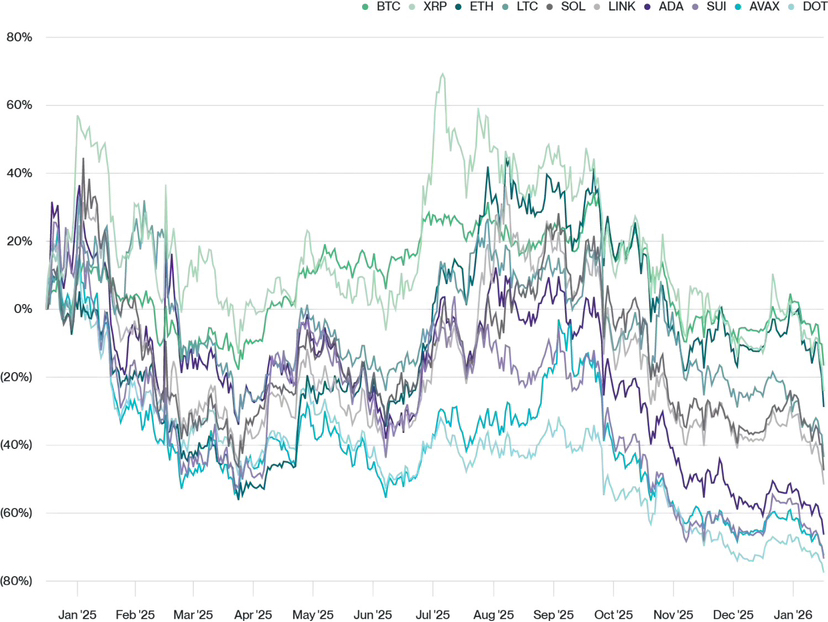
Six, The Darkness Before Dawn: Signals and Noise
In the depths of winter, good news is meaningless. This is a shared memory of veterans who have experienced 2018 or 2022.
Morgan Stanley doubles down on crypto, Wall Street is hiring en masse, and rumors of sovereign nations adopting Bitcoin—these things are important in the long term, but not important right now. The market will not rebound because of good news; it will only bottom out because of exhaustion.
So, when will the winter end?
Signal 1: The Complete Despair of Retail Investors
When the last wave of leverage is liquidated, when discussions of crypto on social media shift from 'buying the dip' to 'never touch again', and when the number of active users on exchanges drops to a freezing point—this is the signal of the bottom.
Signal 2: The Return of Institutional Funds
The reversal of ETF fund flows is a key indicator. When institutions start net buying again, rather than just maintaining existing positions, it indicates that smart money believes the risk-reward ratio has tilted.
Signal 3: The Shift in the Macro Environment
Strong economic growth triggers a comprehensive rebound in risk assets, the softening of Federal Reserve policy stance, and the alleviation of geopolitical risks—these external factors will provide tailwinds for the crypto market.
Signal 4: The Passage of Time
Sometimes, the end of a winter needs no reason, only time. The cyclic pattern of 13 months may be broken, but the power of mean reversion will not disappear.
Seven, Signs of Spring: Stored Momentum
What needs to be remembered at this moment is that the fundamentals of the crypto space have not changed.
Regulatory progress is real. The SEC's friendly policy towards cryptocurrencies is being implemented, and the advancement of the (Clarity Act) is encouraging.
The adoption by institutions is real. BlackRock's crypto investment portfolio has surpassed $100 billion, and Wall Street's embrace is not insincere.
Technological innovation is real. Stablecoins and asset tokenization are reshaping financial infrastructure, and the Bitcoin network itself has not experienced any operational issues.
These positives were ignored during the winter but will not disappear. They are stored in the form of momentum and will be released in a retaliatory manner once the clouds clear.
Eight, Strategy: Survive in Winter, Flourish in Spring
For investors, winter is not an end but a selection process.
Examine Position Structure
If your holdings are concentrated in the third tier (altcoins without ETF support), you may need to consider migrating to the first tier (BTC, ETH). In winter, liquidity is life.
Manage Leverage Risk
The tail risk of winter is often the greatest. Reducing leverage, keeping cash, and preparing for extreme scenarios are key to survival.
Focus on Long-Term Logic
The scarcity of a total supply of 21 million, the reduction in supply after halving, and the long-term expansion of global liquidity—these core logics have not changed due to price fluctuations.
Stay Patient
Winter will not end in frenzy but will conclude in exhaustion. As a veteran who has experienced multiple cycles, I can tell you: the feeling before the end of winter is very much like now—despair, helplessness, and gloom. But this is precisely the moment closest to spring.
Conclusion: We are closer to the end than to the beginning
The bad news is that we have been in a crypto winter since January 2025, and we may have to endure a tough period.
The good news is that we are likely closer to the end of winter than to the beginning.
After all, winter began in January 2025. Spring is certainly not far away.
When the $75 billion veil is lifted, the market finally sees the truth. But this truth itself is the starting point of a new cycle.
The long night is coming, but you and I are both night watchmen.
Do you also feel the chill of this 'invisible winter'? How is your position structure? Feel free to share your coping strategies in the comments!
If you find this article helpful, please like, bookmark, and share it. In winter, we need each other's warmth more than ever. Follow us so you don't get lost, and let's wait for the first ray of sunlight in spring together!
Disclaimer: This article is based on market analysis and historical patterns and does not constitute investment advice. The cryptocurrency market is highly volatile; please make decisions cautiously based on your own risk tolerance.#特朗普称坚定支持加密货币 #黄金白银反弹 #V神卖币 #Strategy增持比特币 #爱泼斯坦案烧向币圈 $BTC


