
In an email from 2016, Jeffrey Epstein showcased his connections in the crypto world to a Saudi contact: “I have spoken with some Bitcoin founders, and they are all very excited.”
A hidden chapter in the history of digital currency slowly unfolds with the exposure of the Epstein documents. While ordinary investors are still analyzing Bitcoin's candlestick charts, a crypto network that spans finance, technology, and the core of power has quietly woven itself during the infancy of digital currency.
The key nodes of this network include the edges of the Satoshi Nakamoto mystery, the sources of funding for Bitcoin core developers, academic appointments of senior regulatory officials, and the investment layout of Silicon Valley tycoons.
01 Epstein's Crypto World: A Panorama
Epstein's intersection with the crypto field is not accidental, but a multi-layered, systematic network. From early personal contacts to institutional investments and academic donations, his presence almost spanned every key link in the development of the crypto industry.
The table below summarizes the three main points of contact between Epstein and the crypto ecosystem:
Contact Points Specific Performance Timeline Potential Impact Areas Personal Interests and Claims 2011 Expressed views on Bitcoin; proposed creating an Islamic law-compliant digital currency in 2016 2011-2016 Spread of digital currency ideas, elite circle cognition Institutional Investment Behavior Invested in Blockstream (seed round of $500,000), invested in Peter Thiel's Valar Ventures ($40 million) From 2014 Bitcoin infrastructure, Silicon Valley venture ecology Academic Donations and Influence Donated to MIT Media Lab (total of about $525,000), part of which supported Bitcoin core developers 2013-2017 Bitcoin core development, academic research orientation
These relationships outline a clear picture: Epstein established a significant presence in the early stages of the crypto industry through his wealth and social network.
02 The Mystery of Satoshi Nakamoto: The 'Founders' in Emails
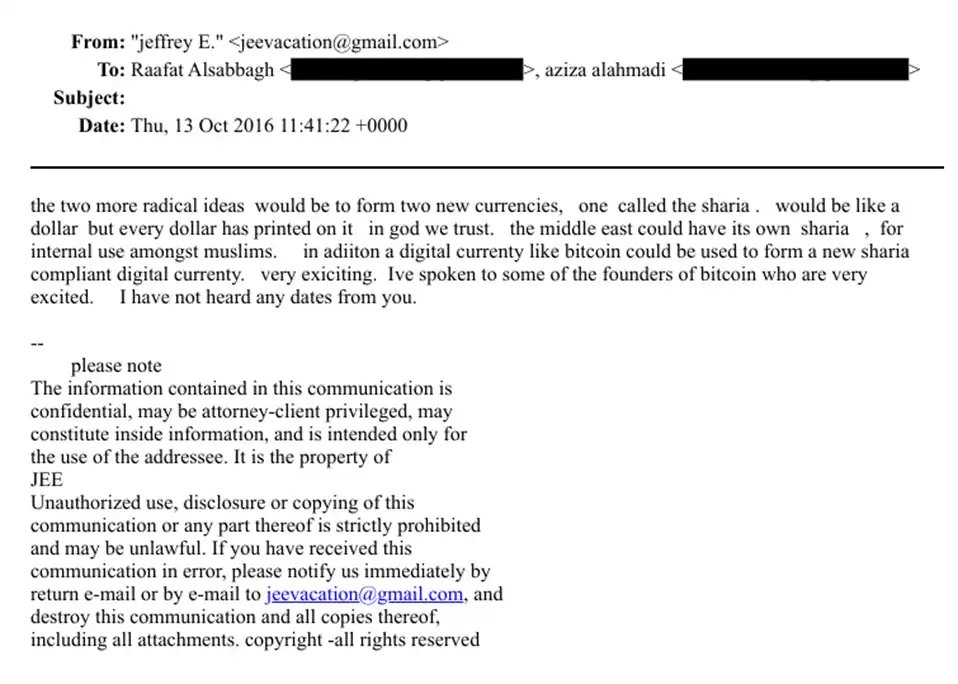
In 2016, Epstein proposed two 'radical' ideas in an email to Saudi Royal Court advisor Rafat Al-Sabagh. One was to create a 'Sharia-compliant' currency exclusive to the Middle East, and the other was to develop a digital currency based on Bitcoin technology that complies with Islamic law.
In describing the second idea, he casually added, 'I have already communicated with some Bitcoin founders, and they are very excited.'
This short sentence has triggered a huge shock in the crypto world. The plural expression 'some Bitcoin founders' provides a new imaginative space for the origin of Bitcoin.
Combining Bitcoin's anonymity and decentralization, many observers believe that Satoshi Nakamoto may not be a single individual, but a team, or at least an individual who received assistance from the core circle.
Notably, there was a circulated email claiming to be from Epstein to Ghislaine Maxwell that directly mentioned the pseudonym 'Satoshi Nakamoto' and 'our little digital gold mine.'
However, this email has been confirmed as a forgery. In the documents released by the Department of Justice regarding Epstein, the phrase 'little digital gold mine' cannot be found, and there are also obvious errors in the email's formatting (such as containing two 'recipient' lines).
03 The Birth of Crypto Politics: Funding Flows at MIT
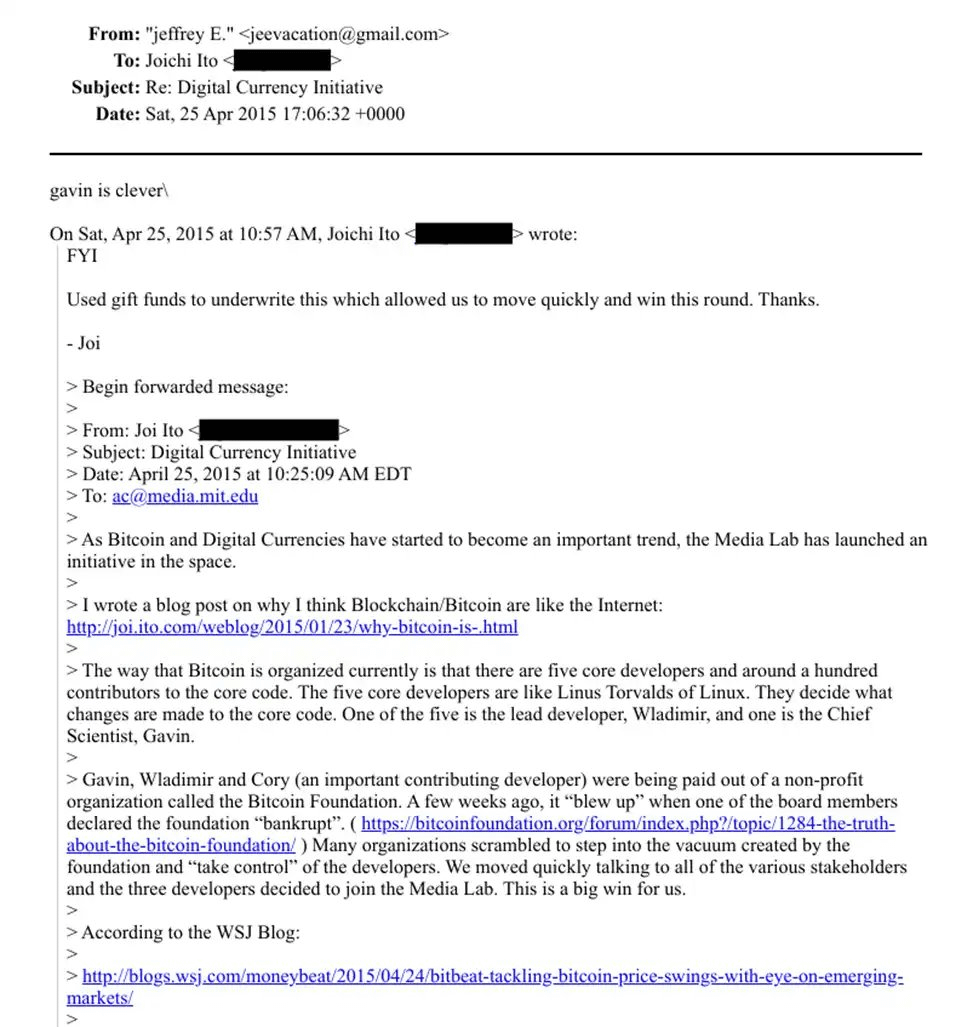
Just as the Bitcoin Foundation was collapsing and core developers faced payment dilemmas, the MIT Media Lab's digital currency program began paying several Bitcoin Core developers.
The seemingly timely academic support reveals Epstein's shadow behind it. Documents show that Epstein donated to the MIT Media Lab. Some of this funding was used to support the work of Bitcoin core developers.
In 2015, Joi Ito, then-director of the MIT Media Lab, wrote to Epstein in an email: 'Thanks to this gift funding, we were able to act quickly and win this round.' He added that 'many organizations want to take advantage of the situation to control Bitcoin developers.'
During this period, three Bitcoin Core developers—Gavin Andresen, Vladimir van der Laan, and Cory Fields—joined the MIT Media Lab's digital currency program. Epstein learned about it and simply replied, 'Gavin is smart.'
This connection between sources of funding and developers places Epstein at a critical juncture in the development of Bitcoin technology—despite never writing a line of code, he influenced the mechanisms for paying for that code.
04 Investment Landscape: The Collision of Blockstream and Silicon Valley
In 2014, Epstein invested approximately $500,000 in the seed round of Blockstream, a Bitcoin infrastructure company, through Kyara Investments III, which he co-owned with former MIT Media Lab director Joi Ito.
This investment itself was not surprising. What was unexpected were the internal competitions and moral ambiguities of the early crypto industry revealed during the investment process.
On July 31, 2014, Blockstream co-founder Austin Hill told Epstein and Joi Ito in an email that Ripple and Stellar are 'harmful to the ecosystem we are building,' as Epstein seemed to have invested in these two competing projects while investing in Blockstream.
Hill wrote that due to investors 'supporting two horses in the same race,' he might have to 'reduce or even eliminate your share.'
This early tension among projects reveals a complex web of interests that existed in the crypto industry during its infancy. Former Ripple CTO David Schwartz later commented, 'I don’t want to be a conspiracy theorist, but I wouldn’t be surprised if this is just the tip of the iceberg.'
05 Insider Directory: From Musk to Regulators
The scope of Epstein's crypto network far exceeds general imagination. Documents indicate that Elon Musk had multiple discussions with Epstein about visiting his private island. In 2012, Musk directly asked Epstein, 'When will the craziest party on your island be held?'
Meanwhile, PayPal co-founder and well-known crypto investor Peter Thiel maintained close communication with Epstein, discussing everything from world politics to his lawsuit against Gawker. Epstein even invested $40 million in Thiel's Valar Ventures.
MicroStrategy CEO Michael Saylor, a billionaire known for only buying Bitcoin and not selling, also spent $25,000 to enter Epstein's party circle through Epstein's PR person, Peggy Siegel. Siegel described him as 'like a drugged zombie,' lacking social skills.
Most notably, the name of Kevin Walsh, a candidate for the next Federal Reserve Chair, appeared on Epstein's guest list. Former SEC Chairman Gary Gensler also had interactions with Epstein; emails from 2018 show Epstein referred to Gensler as 'quite smart' and discussed digital currency topics.
06 The 'Original Sin' of Cryptocurrency: The Invisible Historical Costs
The exposure of Epstein's documents forced the crypto world to face a harsh reality: an industry aimed at 'decentralization' and 'trustlessness' was profoundly influenced by traditional power and financial networks during its early development.
These historical connections have produced undeniable shocks to today's crypto industry. A representative case is the reaction from the XRP community.
When documents showed that Epstein invested in Blockstream, while Blockstream's co-founder criticized Ripple and Stellar, some XRP supporters immediately linked this historical hostility to the SEC's lawsuit against Ripple. Although this logical chain lacks direct evidence, it gained traction in community narratives.
The greater challenge lies in reputation risk. The crypto industry has long tried to distance itself from the pitfalls of traditional financial elites, emphasizing transparency, democratization, and the purity of 'code as law.' The exposure of Epstein's network has challenged this self-narrative.
Adam Back—this early cryptographer who communicated with Satoshi Nakamoto and co-founder of Blockstream—had to publicly clarify: 'Blockstream has no direct or indirect financial ties to Jeffrey Epstein or his estate.' He explained that Epstein's investment was made through a fund and was sold months later.
A decade later, as Bitcoin prices surpassed $100,000 and major institutions established crypto asset allocations, early core figures like Adam Back are still explaining their financial distance from a deceased sex offender.
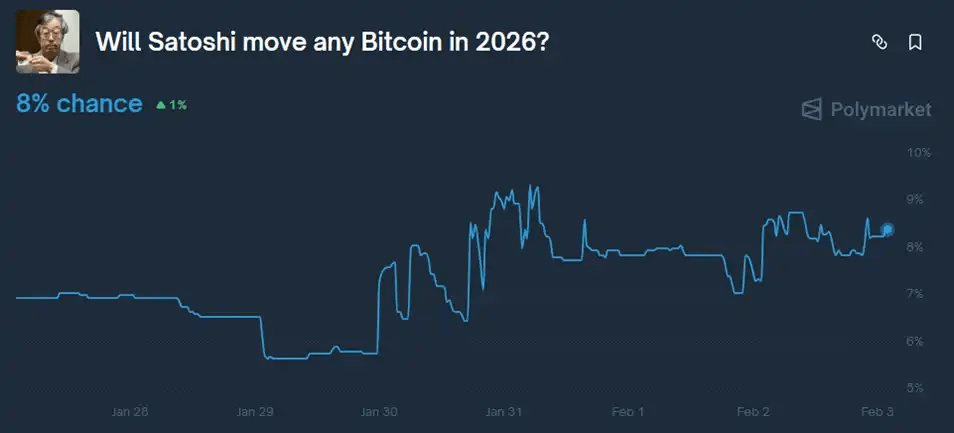
In 2026, more crypto figures were exposed to have partied with Epstein, and the probability of 'Satoshi Nakamoto's Bitcoin address being active in 2026' rose from about 6% to around 9.3%.

