
Every other project in crypto claims to be 'faster' and 'cheaper'.
The first thing that seems different when looking at Plasma is that it is not even competing in the race.
It is simply not trying to become another generic Layer-1.
Its starting point is different:
Stablecoins first, everything else later.
The idea is simple — if the most actual use of crypto in the real world is happening, it is not trading or NFTs, but rather the movement of stablecoins. Payments, remittances, settlements. Plasma is optimizing that layer.
Stablecoins as Money, Not Tokens
Most chains treat stablecoins as just “another token.”
Plasma considers them a core primitive.
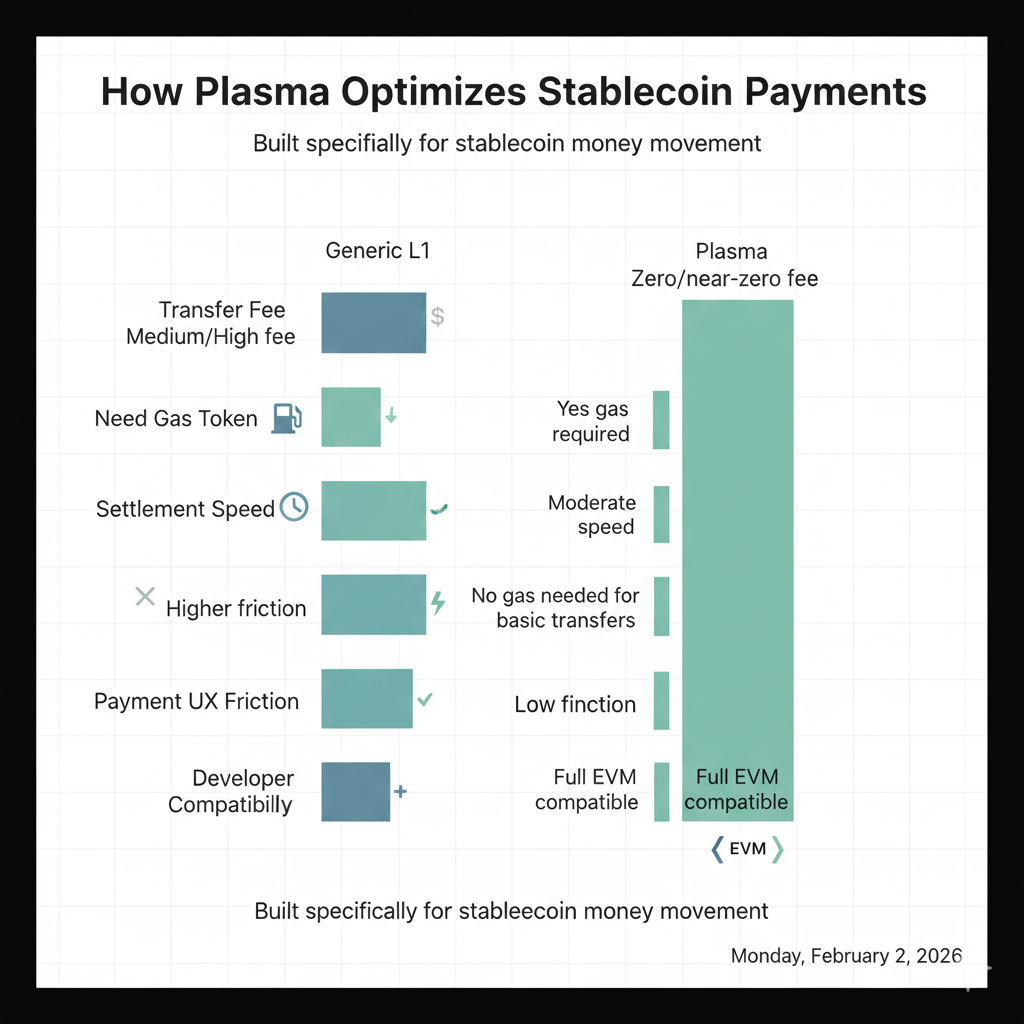
The design of the network is such that simple USD₮ transfers become frictionless. Meaning if you just want to send stablecoin, you don't even need to hold a gas token.
Basic transfers can be zero-fee.
This may seem small, but in the context of payments, it makes a massive difference.
If you have to calculate gas on every transaction, using everyday money becomes impractical.
Plasma quietly removes this friction.
Mainnet Launch And Early Liquidity
The interesting part was that Plasma did not start from theory.
During the mainnet beta, billions worth of stablecoins were active on the network. Multiple DeFi protocols and liquidity partners were already connected.
One thing is clear from this — it was not just a whitepaper project.
Infra was ready before, then traffic came.
Under the Hood — Tech Without Drama
The approach on the technology side also seems practical.
Consensus is tuned for fast finality.
The execution layer is EVM compatible, so developers do not need to learn a new stack.
Use tooling like Ethereum, deploy, done.
And things like Bitcoin anchoring show a long-term security mindset.
The focus here is more on “reliability” than flashy innovation.
$XPL The Role Is Straightforward
Token mechanics were not kept unnecessarily complex.
$XPL The task is simple:
Secure the network (staking)
Pay gas for complex transactions
Participate in governance
Just.
No confusing multi-utility or gimmicks.
Simple utility = predictable economics.
Beyond Payments — Real Products
Plasma is not just stopping after creating a chain.
Their direction is clearly towards payments infra — wallets, integrations, and even consumer-facing products where stablecoins can be spent directly.
This approach is quite different from the typical “DeFi farming” narrative.
The focus here is:
send
receive
settle
spend
It behaves like normal money.
Big Picture
Stablecoins are already being used on a global scale.
But they are still run on chains originally built for DeFi/trading.
The thesis of Plasma is simple:
“If stablecoins are the use case, then create dedicated rails for them.”
This doesn't seem like a hype play.
This seems like an infra play.
And infra projects usually start slow…
But if adoption comes, they become the backbone.
Short take:
Plasma was not made for speculation.
This is made for money movement.
If real-world payments scale on-chain, chains like Plasma naturally become relevant.
Everything else will depend on execution.
