
Introduction: A sudden financial storm. At the end of January 2026, global financial markets experienced an unprecedented crash. Prices of gold, silver, and other precious metals plummeted from historical highs, and the cryptocurrency market was not spared. Within just a few days, trillions of dollars in market value vanished, leaving investors stunned. This is not just a market adjustment; it is a 'perfect storm' resulting from multiple intertwined factors.
According to the latest data, gold prices fell from a peak of $5,600/ounce to around $4,700, a drop of up to 12%; silver was even more brutal, crashing from $120/ounce to $75-78, with a single-day drop of over 30%, marking the worst record since 1980.
Bitcoin, as 'digital gold,' also fell from its high to $82,000-$83,000, with market panic quickly spreading.
This crash not only tested investors' nerves but also exposed the fragile side of the global economy.
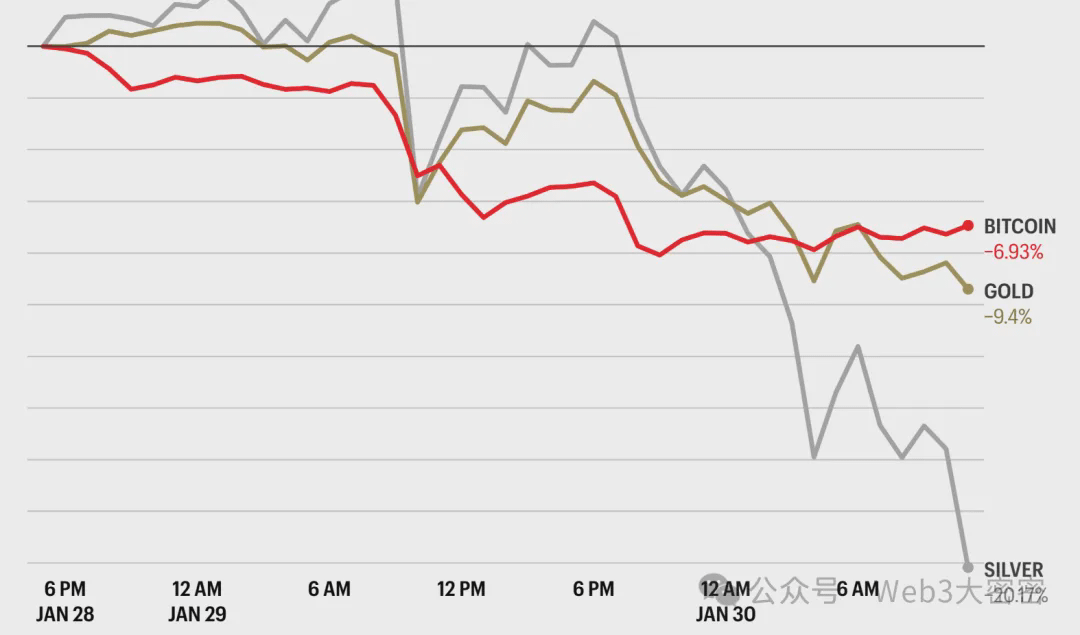
Event review: A thrilling journey from peak to trough. Everything began in late January 2026. Gold and silver hit new highs at the beginning of the year, with gold breaking through the $5,000 mark and even reaching $5,600, while silver soared to $120/ounce. This was due to geopolitical tensions, inflation expectations, and a central bank gold-buying frenzy.
However, on Friday, January 30, the market changed dramatically. The silver futures settlement price plummeted 31.4% to $78.53, while the spot price of gold fell 9% to $4,895.
Entering Monday, February 1, the downward trend continued, with gold further dropping by 6.3%, and silver reaching a low of $75 amid severe fluctuations.
The crypto market also suffered heavy losses. Bitcoin approached the $80,000 mark during the crash, down about 2-6.5%, with the entire crypto ecosystem evaporating hundreds of billions.
It is estimated that this crash caused the precious metals market to evaporate more than $30 trillion, with the crypto market losing hundreds of billions, totaling a wipeout of $6.5 trillion in market value.
Causes of the crash: Fed nomination ignites the collapse of the 'devaluation trade.' The trigger for this crash was President Trump's nomination of Kevin Warsh as the next Fed chair. This news broke on January 30, immediately hitting the 'devaluation trade' in the market—investors had bet on a weakening of Fed independence and uncontrolled inflation, thus raising the prices of precious metals and crypto assets.
Warsh is seen as a hawk; his appointment may strengthen the Fed's independence and ease inflation worries, leading to a stronger dollar and pressure on precious metals. In addition, multiple factors amplify the downward trend:
Leverage and speculative bubbles: The surge in precious metals at the beginning of the year attracted a large amount of leveraged funds. User X pointed out that institutions 'whales' are shifting from paper contracts to physical gold and silver, making retail investors 'the ones left holding the bag.'
Geopolitical and supply pressure: US-China trade frictions, China's restrictions on silver exports, and escalating geopolitical conflicts have driven initial increases but also buried volatility risks.
Liquidity reset: Index funds forced to sell, huge short positions in banks (such as JPMorgan, HSBC) exacerbate the sell-off. CFTC data shows that banks' net short silver contracts reached 40,142.
Crypto linkage: Bitcoin, as 'digital gold,' failed to decouple and was dragged down by precious metals. Experts say this crash highlights Bitcoin's volatility but also strengthens its long-term safe-haven status.
Some analysts question manipulation: social media users claim, "$30 trillion evaporated in minutes," which is larger than the total crypto market cap, suspected of being manipulated.
Market impact: Investors suffer heavy losses, economic warning bells ring constantly.
The crash directly led to a sharp decline in mining stocks, with gold and silver mining companies' stock prices halving. On a broader scale, the precious metals crash affected the global commodity market, with industrial metals like copper and platinum experiencing double-digit declines.
Crypto investors face a wave of liquidations, with leveraged positions collapsing by hundreds of billions. On the economic front, this rings alarm bells. The traditional safe-haven function of precious metals has failed, indicating systemic risk. Reddit discussions mention intertwined factors such as interest rate expectations and a strengthening dollar.
Experts predict: 'This is the starting point of the liquidity reset, funds will shift to stocks and crypto.' However, short-term panic may exacerbate the inflation cycle, forcing central banks to inject liquidity.
Expert opinions: Bubble burst or buying opportunity? Analysts are divided. CoinDesk states that the gold and silver bubble has burst, but Bitcoin remains relatively stable. Bloomberg points out that this is the largest drop in a decade, but the long-term bull market arguments remain unchanged: central bank purchases of gold, de-dollarization, and geopolitical risks.
Some experts warn: 'Is the 2026 market crash canceled? This is just a liquidity reset.'
Another perspective argues that Warsh's nomination helped fuel the 'hottest trade.' YouTube videos (Monday reset) analyze algorithms that erased gains, calling it a 'designed liquidity vacuum.'
Overall, experts recommend that investors avoid leverage and focus on rebound signals such as a reduction in bank short positions. Future outlook: rebound or deeper bear market? Looking to February, the market may continue to fluctuate. Experts predict: "Gold-silver ratio compression, silver has more room for growth."
If the Fed maintains tightening, precious metals will be under pressure; conversely, easing may rekindle a bull market. In crypto, Bitcoin may benefit from a return to the 'digital gold' narrative.
In the long term, geopolitical tensions and Chinese demand support gold and silver, but in the short term, further liquidation needs to be watched. Some prophets claim 2026 is the 'year of wealth transfer,' and Bitcoin will replace gold. Investors should diversify their assets, learn market structures, and avoid becoming 'cannon fodder.'
Conclusion: Lessons and opportunities coexist.
This crash is the 'Black Friday' of the 2026 financial markets, erasing trillions in wealth but also reminding us of the market's volatility.
Gold, silver, and crypto have been bloodied in the short term, but their long-term safe-haven value remains. Investors need to be rational, stay away from speculation, and turn to knowledge and strategies. In the future, whoever can seize the rebound will be the winner.
