How STONfi turns DeFi into a familiar digital experience
Decentralized financial protocols have created powerful tools — automated market makers, credit markets, yield strategies, and compositional mechanisms. But the main barrier to mass adoption is no longer technology: it lies in friction. Too many products still require users to have specialized knowledge, complex interactions, and tolerance for opaque interfaces. STONfi changes this approach by designing DeFi around familiar user behavior, rather than the expectations of 'crypto specialists'.
Designing for humans, not for experts
The main idea of STONfi is simple: people are used to interacting with digital services through understandable applications and conversations, rather than through complex panels and terminals. Instead of imposing crypto terms and manual transaction management on the user, the platform restructures financial operations into familiar, step-by-step scenarios. As a result, the interaction feels more like using a consumer application than working with a professional tool.
Technical foundation—why it matters
STONfi is built natively on the TON blockchain, ensuring fast transaction confirmations, low fees, and high throughput. These characteristics eliminate familiar friction points—long confirmations and unpredictable fees—that deter new users. This enables frequent and inexpensive interactions, micro-transactions, and rapid state updates without unnecessary delays.
Telegram as the primary interface
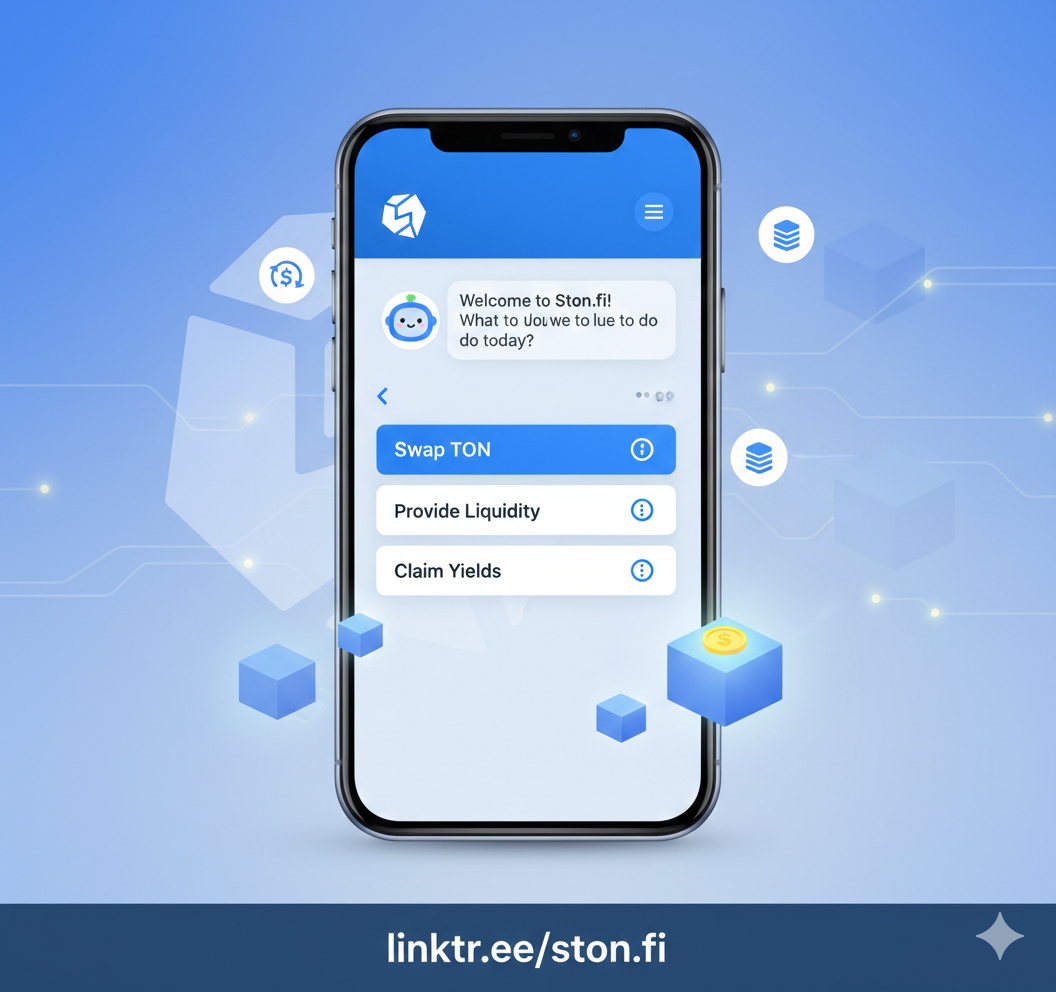
The key difference of STONfi is that Telegram is viewed not as a supplement but as the primary user interface. This changes the logic of interaction:
Opening opportunities where people already communicate. Information about pools, swaps, and promotions appears in the familiar chat, not in a separate panel.
Contextual execution of actions. Exchanges, adding liquidity, and participating in yield programs take place through a clear chat interface with step-by-step hints.
Built-in support and social proof. In one place, the user can ask questions, see the actions of others, and get help—without switching to external resources.
This social component reduces the feeling of loneliness when exploring DeFi and accelerates spread through recommendations and shared experiences.
Reducing both technical and emotional friction
Trust on the platform is formed simply and transparently: the user remains the owner of the keys, fees are predictable (below $0.30), and communication is free of unnecessary jargon. Such solutions reduce both technical and psychological barriers—people are more willing to try new operations when they understand the consequences and are not afraid of unexpected costs.
Practical principles that STONfi applies:
Clear, action-oriented interfaces instead of overloaded analytical screens.
Transparent information about the cost and time of operations.
Built-in hints and assistance available at the moment when the user makes a decision.
Results and conclusions
The project's metrics—significant volumes and millions of completed swaps—confirm: competent UX makes DeFi scalable. The STONfi approach offers a clear roadmap for mass adoption of Web3: focusing on product simplicity, choosing infrastructure that minimizes friction, and integrating financial tools into social contexts.
Conclusion
STONfi rethinks the task not as 'how to create more powerful primitives,' but as 'how to make primitives familiar and understandable.' By combining the technical advantages of TON and the social interface of Telegram, the platform turns DeFi into a fast, accessible, and understandable financial experience—the kind that people can use in everyday life. Learn more and get acquainted with the platform: linktr.ee/ston.fi.