
On January 31, 2026, under the continued attention of the community, Binance finally released a detailed report on the "1011 Incident" (also known as the 1010 Incident due to the difference between UTC and UTC+8 time zones). This report provides a comprehensive review of the severe fluctuations that shocked the global cryptocurrency market on October 10, 2025 (UTC time), revealing the technical failures, market background, and subsequent handling measures that occurred under extreme conditions. This article will deeply interpret the report from three dimensions: core of the report, industry controversies, and future impacts, in conjunction with the official infographic released by Binance.
1. Core of the report: "Local" failures under macro shocks
The core position of the Binance report is very clear: the market's flash crash was triggered by systemic macro risks, not by a single failure of the platform. The report attempts to prove this through detailed data and timelines.
1. The underlying cause of the flash crash: Global financial resonance
As shown in the upper left corner of the infographic, the report lists the "Trade War News" that triggered the "US Stocks Plunge" as the fuse of this crisis. On that day, the S&P 500 and Nasdaq indices saw their largest single-day drop in six months, with the US stock market evaporating $1.5 trillion in market value, leading to a systemic liquidation scale of up to $150 billion.
This global financial panic quickly transmitted to the cryptocurrency market. The cloud of "Systemic Macro Risk" in the infographic vividly depicts this, directly leading to a "Liquidity Vacuum" and "Network Congestion" (specifically referring to the surge in Ethereum Gas fees). In this extreme environment, the cryptocurrency market's inherent high leverage characteristics (with Bitcoin futures and options open contracts exceeding $100 billion) were infinitely amplified, ultimately triggering the "Flash Crash." The candlestick chart in the lower left corner is alarming, with BTC/USDT plummeting to an extreme low of $0.65 (although it was later proven to be a UI display issue, it also reflects the chaos at that time).
2. Platform technical failure: It is a result, not a cause
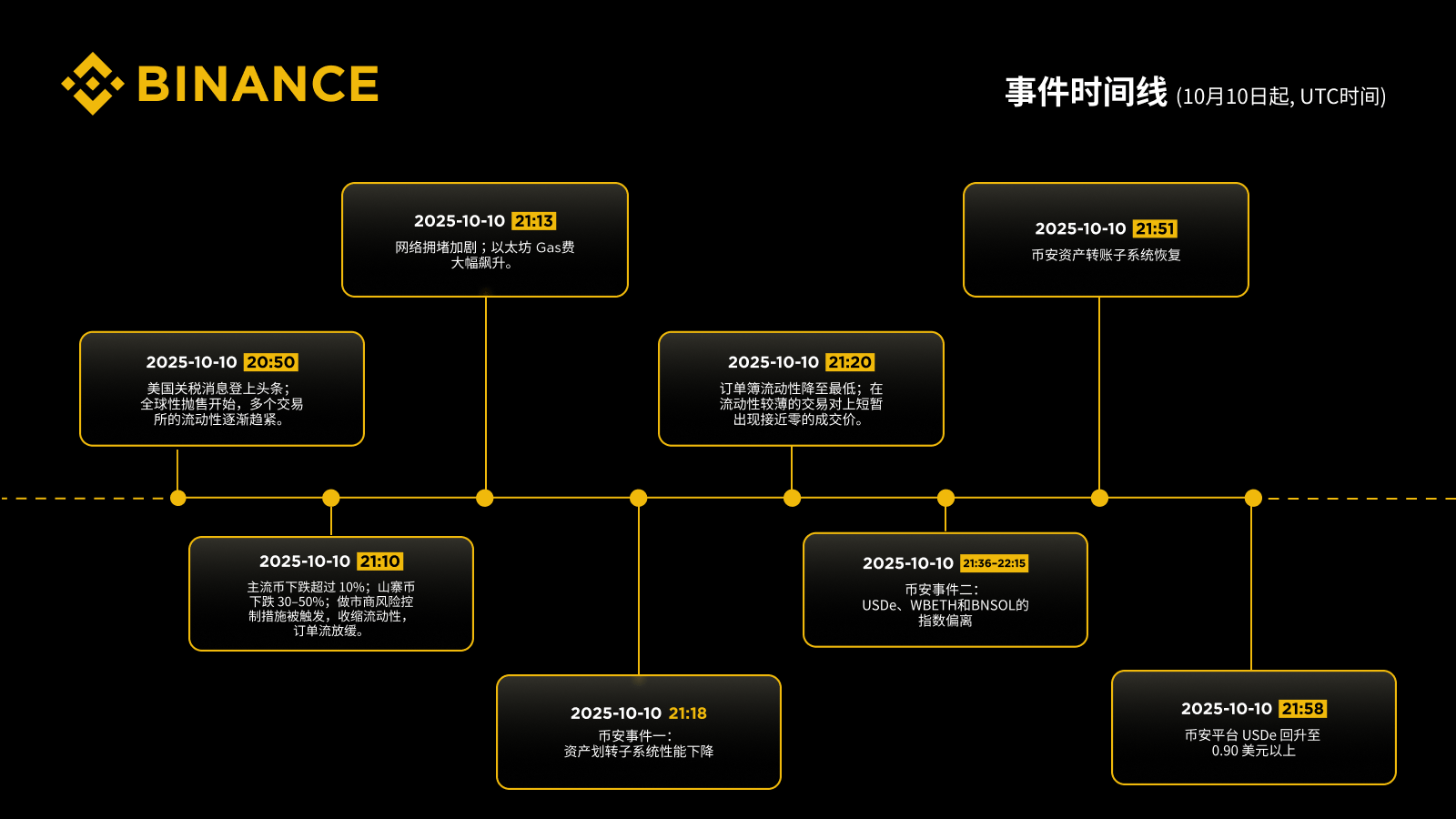
The report admits that during the most turbulent times in the market, the Binance platform indeed experienced two major "local technical failures" (as shown in the two boxes in the middle of the diagram):
Asset Transfer Subsystem Down: Occurred between 21:18 and 21:51 (UTC), lasting about 33 minutes. This caused some users to be unable to transfer funds between different accounts, with panic situations where balances were displayed as "0". The report explains that the root cause was the degradation of database performance under high load and reduced fault tolerance due to cloud service upgrades.
Index Skew (USDe/WBETH Index Skew): Occurred between 21:36 and 22:15 (UTC), lasting about 39 minutes. The price index of tokens such as USDe exhibited abnormal deviations, mainly due to the index calculation's excessive reliance on its own order book, failing to effectively anchor to external reference prices during liquidity depletion.
The key lies in the timeline. The report emphasizes that the global sell-off began at 20:50 (UTC), and 75% of the liquidations on that day were completed between 21:10 and 21:20. This means that most market liquidations and price declines had already occurred before the asset transfer subsystem at Binance encountered a failure (starting at 21:18). Therefore, Binance insists that the platform failure was the result of extreme market volatility, not the cause of the flash crash.
2. Industry Controversy: Avoiding the heavy points or objective review?
Despite Binance releasing a detailed report and promising "User Compensation," it has not quelled all controversies within the industry. The right side of the infographic showcases different viewpoints from several heavyweight figures in the industry.
1. Skeptics: Directly addressing product design and marketing risks
OKX CEO Star Xu is one of the sharpest critics. He points out that Binance's "Aggressive Marketing" is the root cause, arguing that Binance packaged USDe, which has hedge fund attributes, as a "stablecoin" for promotion and encouraged users to leverage, creating a huge risk exposure during market downturns.
Moreover, there are opinions in the market suggesting that Binance's "Oracle Flaws" are key. In extreme market conditions, the oracle failed to reference aggregated data from multiple platforms, relying solely on its own illiquid order book for pricing, leading to severe price dislocation of assets like USDe, which triggered larger-scale cascading liquidations.
2. Neutral/Supporters: Acknowledging the dominance of macro factors
The founder of Wintermute believes that attributing the flash crash to a single exchange is one-sided; it is an inevitable result of "macro shocks + high leverage + insufficient liquidity." A partner at Dragonfly also stated that this is more like a "microstructure failure" rather than the responsibility of a single entity.
3. Future Impact: Bear Market Signals and Regulatory Shadows
The impact of this incident is profound. Solana's co-founder Toly regards it as a clear "Bear Market Signal," believing it may initiate a bear market cycle lasting up to 18 months.
Equally noteworthy is the pressure from regulators. The upper right corner of the infographic prominently displays the words "PBOC Risk Warning," once again emphasizing the regulatory authorities' severe stance on the risks of virtual currency trading. This indicates that regardless of how technology recovers from failures, the entire industry will continue to move forward under strict regulatory scrutiny.
Summary:
The Binance 1011 incident report is an information-rich document that is also accompanied by significant controversy. It reveals the vulnerability of the cryptocurrency market as a risk asset within a highly interconnected global financial system. For investors, it is a painful lesson about high leverage, liquidity risks, and platform dependency. For the entire industry, how to build more robust infrastructure, design more reasonable product mechanisms, and properly respond to the increasingly stringent regulatory environment while pursuing innovation will be the core issues for future development.


