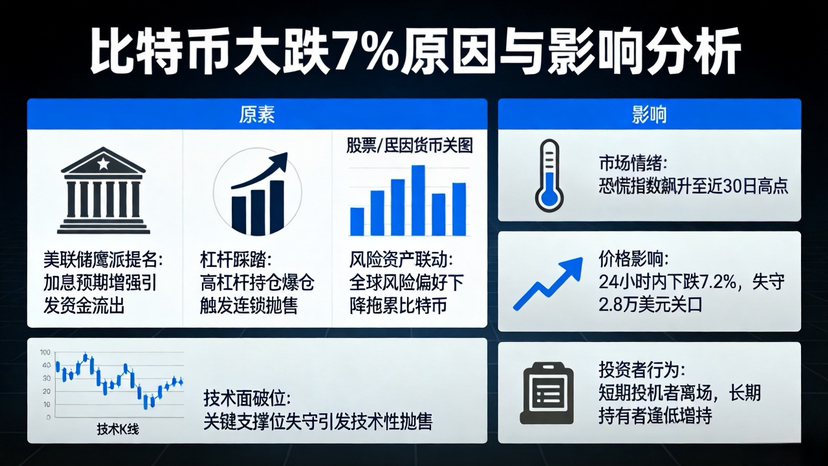
This time Bitcoin fell 7%, primarily due to liquidity expectations tightening triggered by the Federal Reserve chairman nomination, high leverage liquidations, and risk assets' coordinated sell-off, compounded by technical breakdowns, forming a chain reaction of 'policy upheaval + capital liquidation + emotional resonance.' As of January 31, 2026, Bitcoin hit a low of $81,000, with over $1.4 billion liquidated within 24 hours, affecting more than 200,000 people across the network.
1. Direct trigger: Federal Reserve personnel and policy expectation reversal
Hawkish nomination impact
On January 30, Trump nominated former Federal Reserve governor Kevin Walsh as the candidate for the next chairman, known for his 'hawkish background + pragmatic monetarism,' advocating for 'simultaneous interest rate cuts and balance sheet reduction'—reducing the balance sheet withdraws market liquidity and suppresses inflation, creating space for interest rate cuts, interpreted as a tightening signal of 'the private sector footing the bill.'
Market Chain Reaction
: The US dollar index rises, US Treasury yields soar, risk appetite plummets, Bitcoin, as a high-risk asset, is sold off simultaneously, and the 'digital gold' safe-haven attribute fails.
Data and Statements Catalyze
: On January 29, the Vice Chair of the Federal Reserve hinted that 'accelerating the balance sheet reduction and raising interest rates earlier cannot be ruled out,' combined with rising US PPI inflation data, strengthening liquidity tightening expectations.
II. Core Transmission Chain: Liquidity Crash and Risk Linkage
Leverage Crash
: Bitcoin fell below key support levels of 85000, 83000, triggering programmatic stop-losses and margin calls, forming a negative feedback loop of 'decline - liquidation - further decline,' with a total liquidation amount exceeding 1.4 billion dollars in 24 hours.
Risk Asset Resonance
: US tech stocks, gold, and silver all fell sharply (gold down over 12%, silver down over 36%), with funds collectively withdrawing from high-risk assets, leading to an increased correlation between Bitcoin and US tech stocks, resulting in a heavy drop.
Whales and Programmatic Selling
: Large holders took profits early, programmatic trading amplified volatility, widening the bid-ask spread, small orders could trigger large fluctuations, accelerating the decline.
III. Technical Factors and Market Structure Boost
Key Levels Breached
: Dropped below the 0.786 Fibonacci retracement level (approximately 85400 USD), support turned into resistance, daily volume increased on the decline, funds continued to flow out, and technical corrections were mostly downward continuations.
Market Structure Fragile
: Significant prior gains, crowded bullish positions, record high open interest in call options, under extreme sentiment, any bad news easily triggers panic selling.
IV. Subsequent Effects and Key Observations
Short-term
: A rebound needs to stabilize above the 85400 USD resistance level; otherwise, weakness will continue; pay attention to the Wash nomination process, Federal Reserve meeting minutes, and inflation data.
Medium-term
: If balance sheet reduction is implemented, liquidity in the crypto market may remain under pressure, increasing the risk of high-leverage strategies; vigilance is needed regarding policy expectation fluctuations and macro volatility.