
First, I want to talk to everyone about what compound interest and long-termism are.
I think that whether it's investment or our lives, an important concept is how we face cycles and fluctuations.
Because I personally believe the world is constantly developing and advancing amid fluctuations and cycles.
Relationships have cycles; your relationship with someone may be very close and good for a period of time. Then, after a while, the relationship may become poor again. The body and mind also have cycles; for a time, you may take good care of both, but after a while, your health may decline.
This investment market also has cycles; you might make money one period and lose money the next.
The most frustrating thing about cycles is that they always plant the seeds of trouble when you're at your most triumphant and quietly turn around when you're at your most desperate.
Cracks in a relationship often don't appear during arguments, but rather when the honeymoon period is overused and lacks novelty and patience.
Similarly, the breakdown of your body is not due to staying up all night one day, but rather the illusion that you have unlimited energy when you are at your peak.
You can't expect crops to grow all year round. When the market's "winter" arrives, the most important thing to do is not to fuss over things, but to "store up grain" and "survive."
Those who thrive amidst market fluctuations often possess a "farmer's mindset":
Sow in spring, weed in summer, harvest in autumn, and hibernate in winter.

I believe that a wise person, or someone who can truly view these cycles and events from a higher, longer-term perspective, is more capable.
He will be better able to embrace this process of yin and yang alternation. So, whether it's your physical and mental state, the results of your investments, or your career...
This "embracing" is not merely acceptance, but also a subjective act of going with the flow. In times of hardship, do what is appropriate for a hard time (lay low, accumulate experience); in times of success, do what is appropriate for success (respect, detachment).
When you underestimate something, you must believe that once you get past that lowest point, it will start to rise.
When you're at your peak, remind yourself that once you pass that peak, your performance will decline. It will always be a fluctuating process, like a sine wave. But...
As long as we persist in doing the right thing in the long run, the fluctuations will eventually return to their average value.
In other words, as we've discussed, prices fluctuate around a certain price. As long as you're not too concerned about the current price, and you're certain that the core value of what you're doing and the choice you're making remains unchanged.
One day, you will get what you deserve, and you will reap what you deserve, not a penny more and not a penny less.
The world will eventually achieve a dynamic equilibrium, transforming your perceptions and those perceptions into reality. Your current anxiety mostly stems from the fact that your current circumstances are dictated by the fact that your personal timeline is too fast, while the pendulum of value is swinging too slowly.
But in this day and age, I feel that many things are developing too fast.
It's as if we desperately want to build a skyscraper in six months, double our revenue in a few hours, earn dozens of times more in a year, and reach the peak of our careers in five years. This seems to have become the main theme of our times.
Narrative storytelling is also a kind of rhythm pursued in our mainstream society. We all seem to expect that our investment will be rewarded immediately and our efforts will be responded to instantly.
To revisit the concept of long-termism in this society seems a bit unwise, or even foolish.
The price of haste: those skyscrapers that rise from the ground in six months may have cracks in their walls filled with anxiety that hasn't even dried yet.
The power of compound interest through deep cultivation: Long-termism is not about relentlessly pursuing one path, but about securing a niche in a deep, uncontested area when everyone else is frantically changing lanes.
In the story of the tortoise and the hare, everyone wants to be the hare; no one wants to be the slow-moving tortoise.
Take Binance, for example. I specifically looked into it, and in my understanding, Binance is like a "slow-moving tortoise."
I used to think that Binance, being such a large company, seemed clumsy with every step it took, and even a bit unable to keep up with the pace of those little rabbits who claimed to be "turning the world upside down" there.
When you actually look at those once-glorious platforms like Huobi, FTX, VDI, and CNK, those leaping and bounding rabbits always try to cross the finish line with an empty promise or a moment of attention. As a result, they run and run until they lose even their own shadow.
You'll find that when the rabbits collectively give up before the finish line due to exhaustion, the big guy who always looks down at the road and even seems a bit bored is still moving forward step by step, one step at a time.
Over the past few years, I have learned from my own experiences, growth, mistakes, and reflections.
At this moment, I am absolutely certain that I choose to move closer to faith, and I want to be the tortoise, not the hare in the tortoise and hare race, the one that runs faster.
I want to be a diligent and hardworking tortoise.

Many people may think that this is indeed correct in theory, but it is often difficult to make the right choice in the actual implementation process.
If you take a long-term perspective when considering every choice you make, you'll find that there are actually many obstacles and difficulties in the process.
This feeling of being stuck is actually an extremely valuable signal. It means you are standing on the line between mediocrity and excellence, and every painful struggle is a vote for your future self.
I think that truly practicing long-termism lies in the logic and mindset you use when making choices.
A choice, whether for investment or life, often has a huge impact. A right choice can determine the direction and experience of your life for the next few decades.
A wrong choice will cause you to pay the price for a considerable period of time in the future.
The first key to making the right choices, in my opinion, is to make as few choices as possible, and not to make choices lightly.
Many outstanding people around me, even those more capable than me, often encounter a problem. They choose to do one thing, but after a while, they give up and switch to doing something else.
Then he might invest several months or half a year in it, then stop and give up, which makes it impossible for him to continuously accumulate knowledge in any one thing.
I believe that every temptation labeled as "opportunity" is actually like a beautiful coin laced with deadly poison. They glitter in the sunlight, deceiving you into throwing away your well-honed old axe in exchange for a new, unpredictable knife. In the end, you might even lose the firewood you could have chopped.
Then there's no way to accumulate the results of the previous compound interest.
In fact, every choice has an opportunity cost, and most people waste their time looking around.
In any industry, the most fundamental logic is never "how to choose," but "how to survive."
Warren Buffett once gave some excellent advice on investing.
He said if you want to improve your financial situation, you should take out a card with 20 boxes on it.
Every time you make an investment decision, you should check a box on it. You can only make these 20 choices in your lifetime, and once you've made them, you can't invest anymore.
If you consider these 20 squares as 20 bullets, you'll find that even the sound of a breeze rustling through the grass is worth holding your breath and observing intently before pulling the trigger. This "awe" of choice can directly eliminate 90% of low-quality social interactions and ineffective efforts.
Even now, I think this is a brilliant piece of advice that we can apply not only to investing, but also to all aspects of life, whether it's choosing a partner, choosing what you do, or even making friends.
We should all be very serious, prudent, and devout in facing every choice we make, because the hardest thing is actually deciding what not to do, rather than what to do. There is actually a very important reverse thinking involved in this.
When this sense of urgency—that you only get 20 chances in your life—is ingrained in your blood, you'll find that the fog in front of you dissipates very quickly.
For example, when you see an altcoin experiencing a violent price surge, or when you close your position because of noise, you might be holding onto a losing trade.
Slow down.
Ask yourself: Is this decision really worth exchanging this one-twenty-fifth of my "decision-making power" for? If the answer isn't a resounding "of course," then it's most likely just a discrepancy that needs to be eliminated.

Munger said his advice to young people on how to ensure a miserable life is to avoid doing what you're doing with devotion. Instead, constantly look around and hesitate, wasting your time in indecision. I often feel that many of our current dilemmas stem from having too many choices.
As Lao Tzu said in the Tao Te Ching: Too much leads to confusion.
When we have too many choices, we become unable to quiet our minds and connect with our inner selves.
What do I truly need? What are my purposes, considerations, and reasons for making my current decision? Why did I make this choice arbitrarily?
Five colors can blind the eye
When the various possibilities on the screen came at me like bullets, the real "me" shrank into a corner.
Those who can stand firm amidst the sifting of the waves are often not those who have chosen the "perfect" path, but those who, after making their choice, dare to personally eliminate other possibilities and then pour all their vitality into the land they are on now.
We actually spent most of our time changing tracks, changing teams, changing tasks, changing mentors, and changing stocks.
In this process of constant transformation, there is a hidden transformation cost and opportunity cost behind every choice.
Ultimately, this will lead to a situation where, in this context, we are unable to accumulate benefits or achieve results in any endeavor.
Instead of thinking about how to succeed, you should think carefully about how to avoid failure.
Many of life's failures stem from our reckless actions and choices, meaning we don't take each decision we make seriously.
Choosing and doing things haphazardly will ultimately lead you down the wrong path, without accumulating any substantial experience or knowledge on the road to success.
Therefore, a true value investor in the cryptocurrency market will not frequently place orders.
Do you spend a lot of time making choices? Do you spend a lot of time constantly switching between your options?
The common problem of our generation is that "entry is too easy".
Because the barrier to entry is low, people treat choices as casually as they would a food delivery order; if they choose the wrong one, they can simply cancel the order. But life doesn't allow for refunds.
That "just give it a try" mentality is actually a form of extreme arrogance and a disguised trampling on one's own right to life.
When you scatter your energy across countless "seemingly good" options, you are actually giving up the opportunity to become a top performer in any field.
So-called success is often not because you did something earth-shattering, but because when others couldn't stand the boredom and started to jump around, you were like a fool who stayed rooted to the spot.
When we adopt quiet as a principle.
If you apply this to the big and small things in our lives, you'll experience a single sentence.
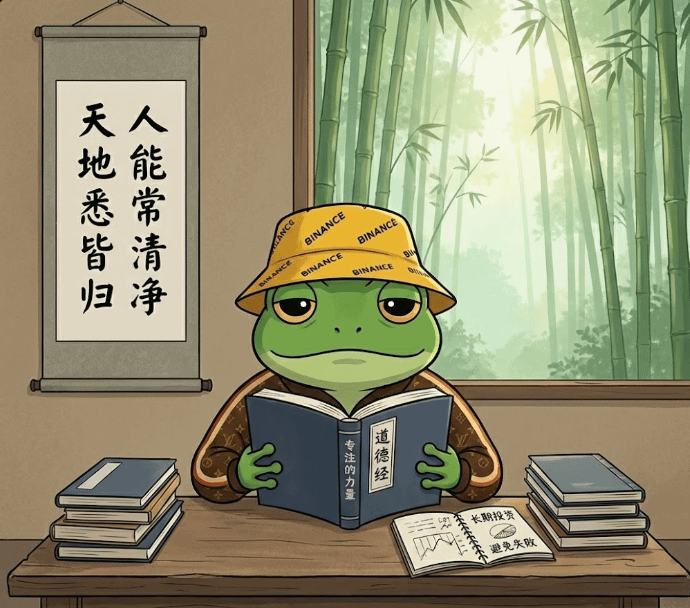
When your heart is not driven by greed, impatience, utilitarianism, and anxiety to make choices blindly or follow trends blindly, you can truly find peace.
Every option you make is of high quality, and at the moment you make a choice, you know very clearly in your heart that you will not regret it in the future.
Knowing the consequences of your choices allows you to approach each decision with a calm and balanced mindset.
You won't have the fear of missing out that we often talk about.
Many people make blind choices in an attempt to escape mediocrity, only to end up paying a high price for it.
When you stop being led by the nose by all sorts of "opportunities," and stop blindly betting to fill the emptiness in your heart, you'll find that those things that once kept you up all night with anxiety weren't worth even a second of peace.
Blindly following trends essentially means handing over the power of choice in one's life to "probability" and "the opinions of others." Choices made in quiet reflection, on the other hand, are based on one's own logic.
When you are quiet enough, you will understand: "The opportunities I missed were never meant to be mine, and the opportunities that are meant to be mine, I will never miss because of being quiet."
At this point, I think we need to spend a lot of time understanding our own human weaknesses in order to better become aware of and manage ourselves. For example, in what situations do you often experience negative emotions?
Does something interfere with your rational decision-making? Do you often make decisions because you're impatient or anxious? And when you make decisions in a state of impatience and anxiety, do you realize that your choices were made too hastily, without considering the causes and consequences, or all aspects of the choice?
If you've considered things thoroughly enough, don't rush into making a choice.
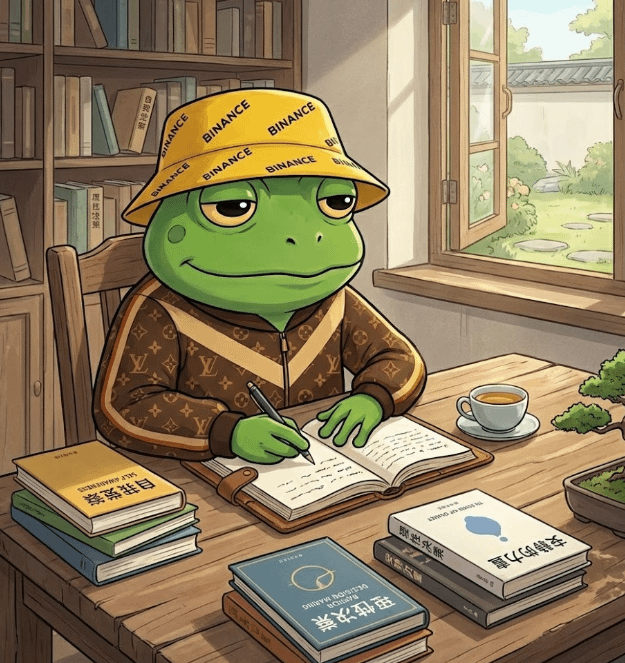
When you see someone doing very well in their career and you feel particularly envious of them; when you see someone making money through short-term investments and you feel particularly eager to imitate them; when you see small, short-term profits in front of you and you feel an overwhelming urge to go all in...
Seeing others climb higher and higher, you always feel like you're stuck in the mud, unable to move. This burning anxiety is actually your "unwillingness to accept defeat" fighting against "real life".
Behind that celebratory drink in his hand, who knows how many nights of tears and anxiety were mixed in? You only see his respectable appearance in a suit and tie, but you don't smell the blood that came from tearing open his wounds.
Envious.
This kind of emotion is most likely to make people lose their intelligence.
Seeing others make a few bucks through short-term speculation makes them think they can also stumble upon that incredible luck.
You only saw the one or two lucky survivors in the survivor bias, but you didn't see the layers upon layers of cannon fodder washed ashore by the waves; those people didn't even leave a sound.
Those petty gains are like pieces of fat hanging on a hook.
Take a bite.
But what followed was the excruciating pain of having one's palate pierced, and an involuntary struggle. When a person's patience is worn down by these quick money and windfall gains, they basically say goodbye to the word "long-term" for the rest of their life, and can only sink deeper and deeper into the quagmire of anxiety, until they lose all the hard-earned savings they have.
This instinct to "take shortcuts" is essentially a deep-seated human fear of scarcity. But reality loves to play tricks: the person who most wants to reach the finish line quickly often crashes at the first bend after the start.
In fact, when you can perceive that these weaknesses in your human nature are manipulating and controlling you, preventing you from rationally, clearly, objectively, and calmly seeing what you are actually doing, we can better manage ourselves.
Then you'll be able to make any major decisions without letting your emotions cloud your judgment, because decisions made based on emotions often come at a price and lead to regret.
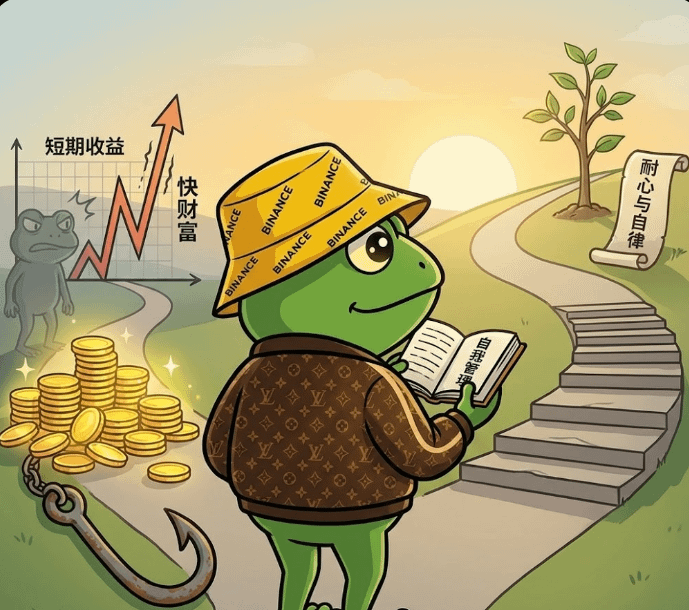
Therefore, I will be even more determined to incorporate long-term value investing into my future life philosophy. I am very much looking forward to 10,000 BNB and 300,000 BTC; it should be very interesting. Some people will say how long that will take—a year, five years, ten years. Or maybe never. #bnb #BTC
But so what? All that remains in my heart is perseverance. This is merely the perseverance of an ordinary person, the perseverance of a traveler. There are no mediocre years in this world, only those who bow to the passage of time. It's just a few trials and tribulations. @币安中文社区 @链上格格巫

