
Cryptocurrency signals are more lifesaving than indicators: from 100,000 to 20 million in 6 years, rapid rises and slow declines, continuous volume at the bottom... These 6 simple methods have outperformed 90% of traders
In that turbulent spring of 2015, I entered the cryptocurrency market with a principal of 100,000. At that time, looking at the K-line chart, I thought 'making money isn't hard'
As a result, in two months I fell into two pits: chasing the rising 'hot altcoins' lost 40,000, and bottom-fishing in 'crashing coins' trapped another 30,000. When my account was left with just over 30,000, I sat in front of the computer staring at the screen in a daze - it turns out that making money in the cryptocurrency market isn't about 'feelings', it's about understanding the 'language' of the market.
Later, I didn't give up and endured for six years, using a simple method of 'watching volume, observing emotions, and waiting for the right moment' to multiply my principal by over a hundred times.
There are no insider tips, and I don't engage in shady projects or complex indicators. Today, I'm sharing these signals, earned with real money, with you; even if you learn just one, you could save yourself hundreds of thousands in losses.
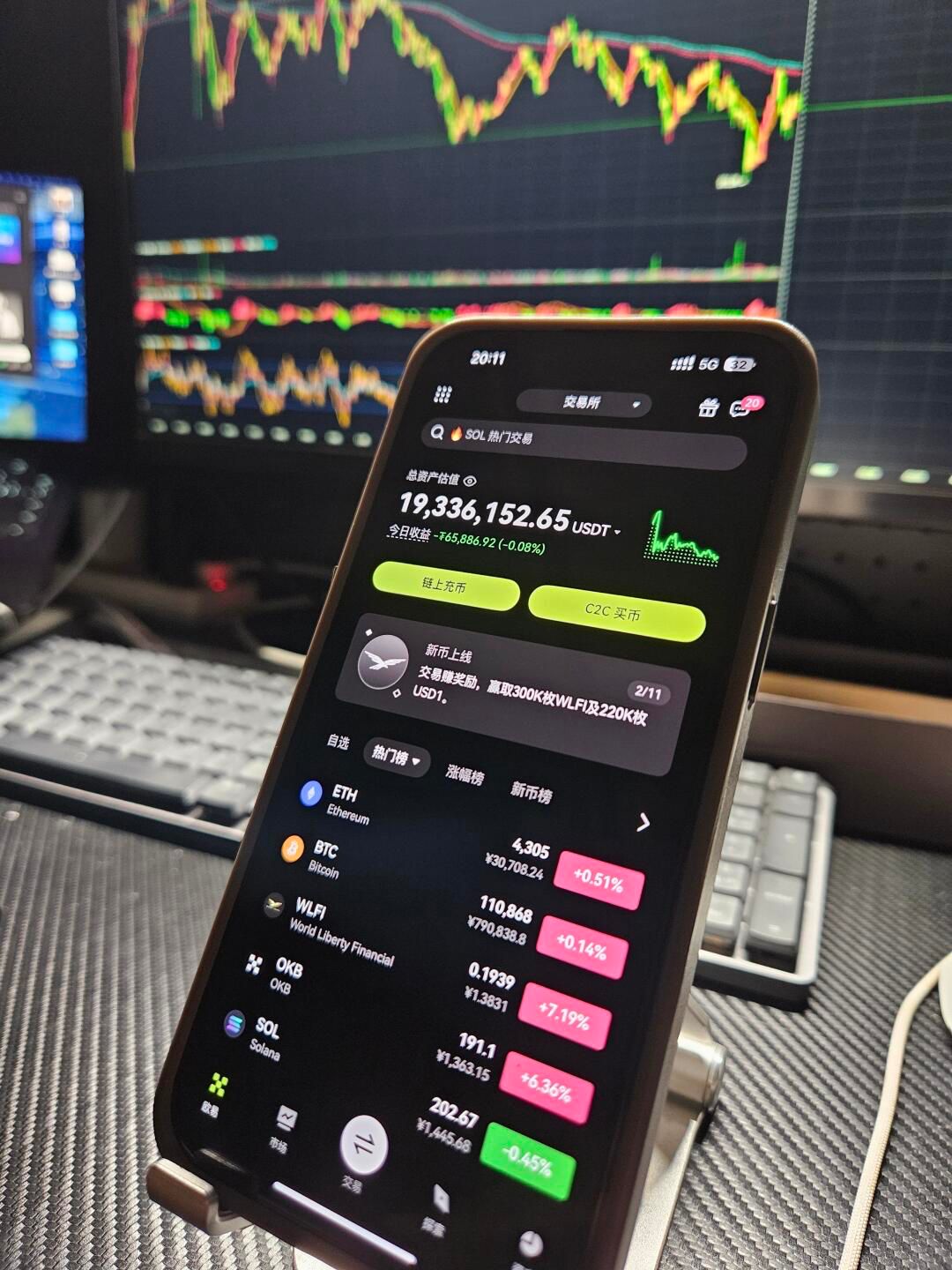
Before discussing the technology, I strictly adhere to the following 10 rules about the cryptocurrency world!
One, about returns.
Assuming you have 1 million, after achieving a 100% return, your assets will reach 2 million. If you then incur a 50% loss, it means your assets will return to 1 million. Clearly, losing 50% is much easier than earning 100%.
Two, about price fluctuations.
If you have 1 million, and after a 10% increase on the first day, your assets reach 1.1 million, then on the second day, if you drop by 10%, your assets will remain at 990,000. Conversely, if you drop by 10% on the first day and then rise by 10% on the second day, your assets will still be 990,000.
Three, about volatility.
If you have 1 million, earn 40% in the first year, lose 20% in the second, earn 40% in the third, lose 20% in the fourth, and earn 40% in the fifth.
In the sixth year, lose 20%, leaving assets at 1.405 million; the annualized return over six years is only 5.83%, even lower than the five-year treasury bond yield.
Rate.
Four, about 1% daily
If you have 1 million and earn 1% daily, then after 250 days your assets can reach 12.032 million, and after 500 days your assets will reach 145 million.
Five, about 200% annually.
If you have 1 million and achieve a 200% return for five consecutive years, after five years your assets will reach 243 million; however, this is rare.
High returns are hard to sustain.
Six, about tenfold in ten years.
If you have 1 million and hope to reach 10 million in ten years and 1 billion in twenty years, you need to achieve an annualized return of 25.89.
Seven, about averaging down
Assuming you bought 10,000 yuan of a certain cryptocurrency when it was 10 yuan, and now it has fallen to 5 yuan, if you buy another 10,000 yuan, your holding cost can be reduced to 6.67 yuan, rather than the 7.5 yuan you imagined.
Eight, about holding costs
If you have 1 million and earn 10% on a specific cryptocurrency, when you decide to sell, you can leave behind 100,000 yuan in market value; this will bring your holding cost to zero, and you can hold it long-term without pressure. If you are extremely optimistic about this cryptocurrency and leave behind 200,000 yuan in market value, you will find your profit will increase from 10% to 100%. However, don't get complacent, because if this cryptocurrency drops by 50% later, you may still incur losses.
Nine, about asset allocation
With a risk-free asset A (annual return 5%) and a risky asset B (return -20%-40%), if you have 1 million, you can invest 800,000 in risk-free asset A and 200,000 in risky asset B. Then your worst annual return is zero, and the best return could be 12%. This is the early form of the CPPI technique applied to capital preservation funds.
There is a saying I strongly agree with: the boundary of knowledge determines the boundary of wealth; a person can only earn wealth within the boundary of their knowledge.
Your mindset when trading cryptocurrency must be good; don't let your blood pressure surge during a big drop, and don't get carried away during a big rise. Securing profits is crucial.
Today I am revealing the 8 core steps that transformed me from a losing trader into a stable, profitable trader. This is not some mystical technique, but the most straightforward path to trading growth—if you follow it strictly, you can avoid the pitfalls of blind trading and build a profitable strategy that suits you.
Step 1:
Choose the right trading market; don't go against your lifestyle.
The most common mistake for beginners is jumping into a market recommended by others without considering if it fits their time.
The choice of trading market should first match your lifestyle. For example, if you work from 9 to 5 in Malaysia, the Malaysian stock market is definitely not suitable for you—you won't even have time during the day to monitor the market, are you going to trade while slacking off? In this case, forex or cryptocurrencies are better options, as they allow for 24-hour trading, giving you ample time to analyze and place orders after work.
If short-term trading makes you feel exhausted and monitoring takes up too much of your life, then switch to larger time frame charts—daily or 4-hour charts are sufficient. Large time frame trading does not require daily monitoring; spending 10 minutes each day to check the trends will not affect your work or life.
Remember: before you achieve stable profits, your job is your foundation. Trading must be a side business; don't lose sight of the essentials.
Step 2:
Use 9-18 months to find a trading strategy that suits you.
After choosing a market, the next step is to find a strategy. But I must first coolly remind you: beginners should not expect to become successful overnight; finding a strategy that suits you takes time and trial and error.
I've seen too many beginners obsessing over 'which entry point is the most precise,' but they don't realize—entry points are just a small part of the trading system. A complete strategy also includes trend judgment, stop-loss and take-profit, position management, and risk control; these are 100 times more important than entry points.
Here's a time frame suggestion: spend 9 to 18 months experimenting with different strategies. Price action strategies, trend-following strategies, breakout and pullback strategies, indicator strategies... all can be tried.
The goal at this stage is not to make money but to understand the underlying logic of trading: what are the rules of price fluctuations? What are the pros and cons of different strategies? Which strategy's trading rhythm matches your personality best?
For example, if you are impatient, a short-term breakout strategy may suit you better; if you prefer a steady approach, then a trend-following strategy is the first choice. The trial and error process helps you filter out the method that best matches your personality.

Step 3:
Stick to one strategy; don't frequently switch strategies.
Once you filter out a profitable backtested strategy from a pile of strategies that works smoothly for you, the next core aspect is persistence.
Many traders lose because of 'the allure of the new': if a strategy loses two trades, they immediately think it's no good and switch to a new strategy; seeing others make money with a certain indicator, they follow suit. The result is that they are always learning new things but always losing.
I can tell you clearly: no strategy can be 100% profitable; losses are the norm. Real profits come from refining a strategy to perfection—you know its entry conditions, exit rules, how it performs in different market conditions, when it may incur losses, and how to optimize its details.
Focusing on one strategy allows you to form muscle memory; focusing on one strategy means you won't panic during losses—because you know this is the normal fluctuation of the strategy, not a failure of the strategy.
Step 4:
Learn from losses; don't let losses be in vain.
Losses are inevitable in trading; the key is not to let losses be in vain.
When encountering consecutive losses, don't rush to switch strategies; first review: was this loss due to a problem with the strategy itself or with your execution?
I've seen too many people whose strategies are fine but get thrown off by their emotions: hesitating when they should enter, softening when they should stop loss, or even moving their stop-loss points back, hoping for a price reversal. This kind of emotional trading can ruin even the best strategies.
Remember: there is no best strategy, only the strategy that suits you best and the you who executes the strategy best.
I suggest you develop the habit of writing trading logs: for each trade, record the entry reasons, stop-loss and take-profit positions, profit and loss situations, and whether there were any violations during execution. During the review, look for problems in the logs—was it a signal judgment error or a discipline violation? Finding the problem allows for improvement.
Step 5:
Use backtesting to accelerate growth and build muscle memory.
If you want to quickly grasp a strategy, backtesting is the most efficient method, bar none.
Backtesting is using your strategy to 'simulate trading' in historical markets. For example, if you choose a price action strategy, you would pull up daily charts from the past 1-2 years and mark entry, stop loss, and take profit according to your strategy's rules.
The benefits of backtesting are endless.
Can verify the effectiveness of the strategy: can it be profitable? What is the win rate? What is the maximum consecutive loss? What is the average win-loss ratio? These data will give you the most intuitive answers.
Can build muscle memory for pattern recognition: by watching historical trends, you can quickly recognize which are high-probability signals and which are traps.
Can train your mindset: in backtesting, you will encounter various market conditions, continuous losses, profit retracements... all of these can help you adapt in advance, so you won't panic when encountering them in real trading.
When you backtest more than 100 trades, your understanding of the strategy will far exceed those who rely only on real trading.
Step 6:
Meet this condition before entering with real money.
Many people ask: when can I switch from a demo account to a real account?
My advice is: when you complete at least 100 valid backtests, and the backtest data for the strategy is profitable, then consider going live.
Here’s a reminder: backtest results ≠ real trading results. When backtesting, you have a god-like perspective without emotional interference; but in real trading, the fluctuations of real money amplify your fears and greed.
The significance of backtesting is not to replicate the results but to thoroughly understand every detail of the strategy—when to enter, when to stop loss, when to move the take-profit. With this foundation, you won't be flustered when trading live.
Step 7:
Risk control is your only trump card to survive in the market.
There's an old saying in the trading circle: those who can cut losses are apprentices; those who can manage risk are masters.
Newbies always dream of getting rich overnight, seeing others multiply their money several times in a day makes them envious. But you need to understand that high returns inevitably come with high risks—a single mistake can wipe out all your previous profits.
If you want to survive in the market long-term, remember this iron rule: the risk of each trade should not exceed 1%-2% of your total capital.
For example, if your account has 10,000 yuan, the maximum loss per trade should be 100-200 yuan. Using this rule to reverse-engineer your position: the greater the stop-loss space, the lighter the position; the smaller the stop-loss space, the heavier the position.
Don't underestimate this proportion; the power of compound interest is astonishing. A stable profit of 10% is far more reliable than gambling to earn 100%.
Step 8:
Be patient; trading is a marathon, not a sprint.
The last step, and the most core step: patience.
The profits from trading are never made from one or two windfalls, but through accumulated compound interest over time. This requires you to have three kinds of patience:
Patience for waiting for entry signals: do not trade in markets that do not meet your strategy, even if you see others making money.
Patience in holding positions: after entering, don't panic over minor fluctuations; follow the rules for stopping loss and taking profit.
Patience for capital growth: don't expect to become successful overnight; stable, profitable traders are all gradually refined.
Another piece of advice: before achieving stable profits, never quit your job. A job provides you with a steady cash flow, allowing you to trade without worries. Once you can really make more money from trading than your salary, and sustain that for more than six months, then consider full-time trading.
There is no shortcut on the trading path. But as long as you follow these 8 steps step by step, moving from loss to profit is just a matter of time.
Above is the trading experience shared by Yan An today. Many times, you lose many profitable opportunities because of your doubts; if you don't dare to try boldly, engage, and understand, how will you know the pros and cons? You only know how to take the next step after taking the first step. A warm cup of tea, a piece of advice, I am both a teacher and a good friend to you.
Meeting is fate, knowing is parting. I firmly believe that those who are destined to meet will eventually meet, and those who pass by are fate's decree. The journey of investing is long; the gains and losses are just the tip of the iceberg. Remember, even the wisest can make mistakes, and even the foolish can gain. Regardless of emotions, time will not pause for you. Pick up the frustrations in your heart, stand up again, and move forward.
The martial arts secrets have been given to you; whether you can become famous in the world depends on yourself.
Everyone should definitely save these methods, share them widely. If you find them useful, you can forward them to more people who trade cryptocurrencies around you. Follow me for more insights into the cryptocurrency world. After the rain, I am willing to hold an umbrella for the chives! Follow me, and we will walk together on the cryptocurrency path!


