
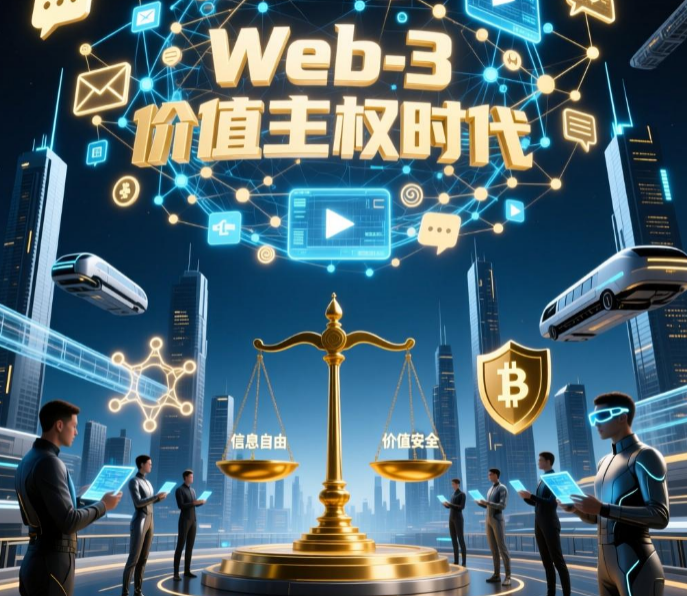
The evolution of the internet is not simply a technological iteration, but a fundamental reconstruction of the production relations of data and the distribution of value. Web3 aims to construct a trustless Internet of Value through cryptographic protocols.
1. Three leaps in the internet paradigm
The intergenerational evolution of the internet is essentially the evolution of user roles in the digital world.
1. Web1 (1990-2005): Static read-only network (Read-Only)
Core Logic: Unidirectional transmission of information.
Ecological Form: Dominated by portal websites represented by Yahoo and Sina. The internet is a huge 'digital library.'
Limitations: The network is built on open protocols (HTTP/SMTP), but content production rights are held by a very small number of nodes, with users being passive receivers due to information asymmetry.
2. Web2 (2005-2020): Platform monopoly of the Read-Write network
Core logic: Traffic monetization and data walls.
Ecological form: The rise of giants like Facebook and WeChat. Users become content creators (UGC), and interactivity explodes.
Invisible costs: Users have become the 'product' itself. Although interactions are free, users relinquish privacy rights and data ownership. Centralized giants monopolize the enormous value generated by network effects through algorithmic black boxes and data silos (Walled Gardens) and have the 'power of life and death' to ban accounts at any time.
3. Web3 (2020-Future): The Read-Write-Own network of returning value
Core logic: Data sovereignty and assetization.
Ecological form: Distributed networks built on blockchain. Ownership is secured through Tokens and NFTs.
Essential transformation:
Permissionless: Anyone can access the network without approval from centralized institutions.
Censorship Resistant: Code is law, and no single entity can tamper with the ledger or freeze assets.
Ownership returns: Transitioning from 'platform dominance' to 'user sovereignty,' users not only control data through private keys but also capture the dividends brought by network growth.
2. Web3 modular technology stack (The Modular Stack)
Web3 is no longer a single server architecture but a layered, composable 'Lego block' system.
1. Physical layer and consensus layer (Layer 0 & Layer 1) This is the 'settlement center' and security cornerstone of the digital economy.
Layer 1 (L1): Such as Ethereum, Bitcoin, and Solana. They are mainnets with independent ledgers responsible for processing final transaction settlements and maintaining consensus across the network. They sell 'block space' and 'trust.'
Layer 0 (L0): Such as Polkadot's relay chain or Cosmos's IBC protocol. They aim to solve the 'island effect' of blockchains and achieve interoperability and security sharing between heterogeneous chains through underlying communication protocols.
2. Scaling and execution layer (Layer 2) To address the performance issues sacrificed by L1 in the 'impossible triangle,' Layer 2 (L2) emerged.
Technical path: Mainly adopting Rollups technology. L2 acts like a 'highway' on the mainnet, efficiently processing computations off-chain and only returning compressed transaction data to L1 for verification.
Mainstream solutions: Including game theory-based Optimistic Rollups (like Optimism) and zero-knowledge proof-based ZK-Rollups (like zkSync), the latter having greater potential in privacy and security.
3. Middleware and infrastructure This layer is the bridge connecting closed blockchains and the real world.
Decentralized storage: The blockchain itself is extremely expensive and not suitable for storing large files. IPFS, Filecoin, and Arweave provide distributed hard drives, ensuring that NFT images or DApp front-end code do not disappear due to single points of failure.
Oracles: Smart contracts cannot actively obtain off-chain information. Oracles like Chainlink act as trusted data pipelines, feeding real-world asset prices, weather, and match results to on-chain contracts to trigger execution.
Data indexing and querying: The Graph is similar to Google in the blockchain world, allowing developers to quickly index complex historical data on-chain through APIs.
4. Application layer (Application Layer) Scenarios directly facing end users.
DeFi (Decentralized Finance): Financial services without bank intermediaries. Such as Uniswap (automated market maker) and Aave (lending protocol).
NFT Market: Digital property trading markets, such as OpenSea and Blur designed for professional traders.
SocialFi & GameFi: Bringing social graphs and gaming assets on-chain. For example, Lens Protocol aims to build portable social relationships, while Axie Infinity pioneered the Play-to-Earn model.
3. The entry point of Web3: From accounts to digital identities
In the Web3 architecture, wallets have undergone a functional leap from 'fund containers' to 'universal digital passports.'
The essence of non-custodial: This is a return to responsibility. 'Not your keys, not your coins' means users must independently bear the responsibility of asset custody, freeing themselves from reliance on banks or platforms.
Universal identity authentication (DID): Through Sign-in with Ethereum (SIWE), a user's wallet address becomes their account. This mechanism breaks down account barriers between different apps from the Web2 era. Coupled with ENS (like alice.eth), dull hash addresses transform into socially attribute-readable identities.
Data portability: The reputation, assets, and social relationships you accumulate in Application A can be seamlessly carried into Application B, completely ending the 'data lock-in' strategy of internet giants.
4. Extended dimensions: The organization and economic engine of Web3
1. A new form of governance: DAO (Decentralized Autonomous Organization) Web3 not only changes technology but also reshapes human collaboration models.
DAO replaces company articles with smart contracts, allowing on-chain voting through Governance Tokens. This organizational form achieves transparent management and global collaboration, enabling community members to jointly decide the development direction of the protocol and the use of treasury funds.
2. Tokenomics This is the key differentiator of Web3 from traditional software.
Through carefully designed incentive models, project parties can mathematically align the interests of users, developers, and investors. Tokens are not just payment tools but core vehicles for capturing network value, exercising governance rights, and incentivizing early contributors.
3. Existing challenges Despite the grand vision, Web3 still faces challenges such as high UI/UX thresholds, unclear regulatory compliance, and security risks (such as smart contract vulnerabilities).
The future mass adoption will depend on the invisibility of underlying technologies (making users unaware of the blockchain's existence) and the establishment of compliant channels.
------------I---------am-------the--------boundary--------line--------------
Disclaimer: The content published in this article aims to share business economic models and disseminate knowledge, and is not intended to provide any specific advice. The editor does not participate, invest, operate, advise, share, or privately analyze any projects. Before making any decisions, we strongly recommend that you conduct independent research and analysis and make informed decisions based on your personal situation.
If you like this content, feel free to like, follow, comment, and share for more technical analysis and other insights 🌹

