
In the contemporary landscape where global finance and technology intertwine, blockchain prediction markets have transcended the initial category of 'decentralized gaming,' evolving into a sophisticated discipline defined by industry pioneers as 'Info Finance.' Prediction markets, as a mechanism that aggregates collective intelligence and incentivizes participants to reveal true information, are redefining the costs and efficiencies of information discovery.
The core logic of this mechanism lies in the fact that market participants must incur economic costs for their opinions (Skin in the Game), thereby continuously correcting market prices through arbitrage behavior, making them approach the true probability of an event occurring.
As blockchain technology transitions from the experimental stage to large-scale application, prediction markets have not only addressed the centralized censorship, high transaction costs, and counterparty risks faced by traditional platforms, but also experienced explosive growth between 2024 and 2025. Data shows that Polymarket, a leading decentralized prediction platform, recorded over 60-fold growth in trading volume during this period, with monthly trading volume exceeding $2.1 billion. Its generated probability metrics have even been integrated into traditional mainstream financial tools such as the Bloomberg Terminal as an important reference for predicting political and economic events.
The underlying driving force behind this phenomenal growth stems from the technological breakthroughs of blockchain oracles in solving the "truth verification" problem, and the application of innovative on-chain asset management models such as Liquidity Trees.
This report aims to provide a comprehensive and in-depth analysis of the blockchain prediction market from the perspectives of technical architecture, liquidity engineering, governance logic, and global regulatory boundaries. By analyzing representative projects such as Polymarket, Kalshi, Azuro, and MetaDAO, it explores their evolutionary trends during the critical window of 2025-2026 and reveals how artificial intelligence (AI) agents are pushing the prediction market to new heights of "miniaturization" and "real-time operation" through automated game theory.
The core economic logic and tokenization mechanism of prediction markets
Prediction markets are essentially a form of information-based futures trading. In a blockchain environment, this process is achieved through "conditional tokens." Each prediction contract, upon creation, locks a corresponding amount of underlying collateral assets (usually stablecoins like USDC) to mint a set of tokens representing different outcomes.
Mathematical Models of Binary and Scalar Contracts
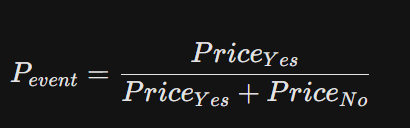
In the most common binary markets, contracts revolve around a "yes/no" question. According to the mechanism, if an event occurs, participants holding "yes" tokens can redeem $1.00 of collateral, while those holding "no" tokens lose everything; and vice versa. This process can be expressed using a simple odds and probability relationship:
Capital efficiency bottlenecks and leverage transformation
Despite rapid growth, most markets currently face the obstacle of inefficient capital management. The current "full collateral model" (1:1 margin) limits the return on equity (ROE) for professional traders, making position closing and hedging extremely difficult. To overcome this bottleneck, next-generation protocols such as Space (Solana ecosystem) are introducing leverage mechanisms of up to 10x.
Furthermore, the composability of forecast positions is being enhanced. For example, the Gondor protocol allows traders to leverage their forecast positions through the Morpho lending pool to finance up to 50% of their LTV (Loan-to-Value Ratio), thereby converting forecast positions into interest-bearing assets or releasing liquidity for secondary trading.
Deep Dive into Technical Architecture: Oracles and Toxic Traffic Governance
Since blockchain itself cannot perceive what is happening in the real world outside the chain, oracles have become the most critical technological hub for prediction markets.
Oracle Models and Truth Discovery
Platforms like Polymarket primarily use the UMA optimistic oracle. Unlike oracles like Chainlink that continuously push data, UMA employs a game theory-based "request-proposal-dispute" model, with the following workflow:
Request: The prediction contract initiates a data request.
Propose: The assertor submits the result and locks in the margin.
Challenge Period (Liveness): The challenger has a window of opportunity (usually 2-48 hours) for review.
Final Resolution: In case of dispute, a vote will be taken by the DVM (Discretionary Management System), employing the Schelling Point mechanism to ensure collective rationality.
"Toxic Traffic" and Bulk Auction Mechanism
A major obstacle to prediction markets is "toxic flow," where insider holders exploit information asymmetry to overwhelm market makers, leading to a loss of liquidity. To address this issue, organizations like Jump Crypto advocate for the introduction of "Dual Flow Batch Auctions." This mechanism processes transactions at discrete time intervals, rather than through millisecond-level continuous bidding, eliminating speed advantages by unifying settlement prices. This allows market makers to reverse erroneous quotes caused by sudden external price fluctuations, significantly reducing bid-ask spreads.
Liquidity Engineering: AMM, Order Book, and Licensing Bonus
Liquidity is the lifeblood of market forecasting. A lack of market depth leads to severe slippage, which in turn distorts price signals.
Hybrid On-Chain Order Books and Licensing Barriers
Currently, most liquidity is concentrated in sports events. This is because only about 20 Designated Contract Market (DCM) licenses have been issued nationwide in the US, allowing related transactions to take place where sports betting is illegal. This creates a liquidity haven for compliant platforms. Polymarket employs a hybrid architecture, combining the efficiency of a CEX with the asset control of DeFi through off-chain order matching and on-chain settlement.
Azuro's innovation: the Liquidity Tree
Unlike the order book model, the Azuro protocol introduces a "liquidity tree" technology, which achieves efficient peer-to-pool management based on the segment tree principle. This structure has a time complexity of O(log N), enabling odds calculations for tens of thousands of concurrent markets with extremely low gas costs. Its introduced "deferred lazy update" strategy further optimizes performance in high-concurrency scenarios.
Governance Revolution: Futarchy and Decision-Making Markets
The most cutting-edge application of prediction markets lies in their restructuring of organizational governance models, namely the "wealth-power" model: voting on values and betting on beliefs.
MetaDAO is currently a pioneer in this field. The passage of a proposal depends on the price performance of "Decision Markets." By creating two conditional markets, "Pass" and "Fail," participants trade tokens representing the value of the proposal after its execution. If the price in the "Pass Market" is significantly higher than in the "Fail Market," the proposal will be automatically executed. This mechanism significantly increases the cost of governance attacks through economic penalties (malicious actors must buy devalued assets).
Risk hedging and real-world applications: Towards the "Lloyd's Model"
As prediction markets mature, their function is shifting from retail speculation to professional risk underwriting.
Lloyd's Model and Professional Underwriting
Prediction markets must evolve into something akin to Lloyd's of London, where a specialized community competitively underwrites unique, high-risk events. Currently, Evertas (a Lloyd's of London member) has partnered with Nayms to launch an on-chain insurance policy on Ethereum, directly backed by the Lloyd's of London Syndicate, allowing professional underwriters to price specific digital asset risks in real time.
Enterprise supply chain hedging and survival risk
The greatest value of market prediction lies in transmitting price signals to the world that were previously impossible to quantify. For example:
Supply chain hedging: Companies like Apple can hedge specific risks such as TSMC’s production capacity fluctuations.
Parametric insurance: Florida residents can bet on hurricanes with wind speeds exceeding 100 mph, with automatic settlement based on NOAA data enabling frictionless disaster compensation.
2025-2026 Global Regulatory Map
Compliance remains a core constraint. In 2025, global regulatory jurisdiction strategies began to diverge:
US: From Strict Bans to Controlled Opening. Kalshi's legal victory and Polymarket's return to the US market through the acquisition of a regulated entity mark a shift in regulators' view of prediction markets as "engines of truth."
The UK (FCA) will adopt a modular regulatory approach, gradually clarifying between 2025 and 2026 whether event contracts are considered "financial instruments" or "games."
The European Union (MiCA) has indirectly improved the transparency of prediction markets by regulating stablecoin collateral.
The Future of AI Agents and Micromarkets
The intervention of AI has radically expanded the boundaries of the market. AI agents can analyze massive amounts of data at extremely low cost, enabling the operation of millions of "micro-markets" (such as rainfall data in remote areas or merge rates of specific codebases). AI also serves as an intelligent interface for users, automatically allocating funds among major global forecasting protocols to achieve optimal execution.
in conclusion
The blockchain prediction market is at a critical juncture in its transformation from a "retail speculative tool" to a "global information and financial infrastructure." By introducing bulk auctions, leverage mechanisms, and a syndicated underwriting structure similar to Lloyd's of London, this field is building the underlying system that Farrar envisions, capable of handling trillions of dollars in survival risk. This is not only a filter for truthful information but also the most reliable "anchor of authenticity" for human society in the post-truth era.
