When massive data meets smart contracts on the same protocol layer, a silent arms race concerning Web3 infrastructure has quietly begun.
When developers are deterred by the cost of storing hundreds of KB of data on Ethereum, which requires tens of thousands of dollars, and when AI training sets and blockchain game assets cannot find suitable infrastructure to be 'placed', a project named Irys is attempting to subvert everything with a model of 'data + execution integration'. It is not content with just decentralized storage; it ambitiously aims to become the 'Amazon Cloud' of the Web3 world.
01 Track Innovation: From Static Storage to Data Assetization
The current Web3 data infrastructure is widely regarded as fragmented and inefficient. Mainstream solutions are operating independently: Ethereum has extremely high storage costs; Arweave and Filecoin focus on permanent storage but are inconvenient to call; Celestia primarily addresses data availability issues.
$IRYS The core issue it raises is: How can data truly become programmable and monetizable assets on-chain, rather than just static stored files?
The pain points it addresses strike at the core of developers' needs: the high cost of getting massive data on-chain, high latency in calling on-chain data, complex interfaces, and the lack of standardized data authorization and charging mechanisms.
This makes the concept of 'data as an asset' difficult to realize in the long term. Irys's vision is to create a complete technical stack that forms a closed loop for data from generation, storage, calling to trading and incentivization.
02 Technical Core: How 'On-Chain AWS' is Built
Irys's technical architecture design revolves around 'integration' and 'programmability,' which constitutes its core advantages.
The integrated execution environment is its biggest highlight. Irys has built-in EVM-compatible execution environments, meaning developers can use the familiar Solidity language to program smart contracts directly to operate on data stored on the network.
The dual ledger architecture balances speed and permanence. A high-speed processing ledger is used for instant transactions, while a permanent storage ledger ensures data is as indelible as if carved in stone and can be verified in real time, solving issues like Ethereum Blob space data expiration.
Programmable data assets are the soul of Irys. Here, data can be embedded with logic for pricing, authorization, and access control. An AI dataset stored can automatically execute contracts for 'pay-per-use' or 'revenue sharing.' This transforms data from passive archived files into on-chain economic units with 'autonomous behavior' capabilities.
Outstanding performance and cost are powerful tools for capturing markets. According to tests, its TPS (transactions per second) reaches up to 100,000, processing over 600 million transactions. In terms of cost, it claims to be about 20 times cheaper than Arweave, reducing storage costs to a 'negligible' level.
03 Market and Ecology: The Runway Before Takeoff
The Urgent Demand of the Market
The combination of AI and blockchain has spawned a massive demand for high-quality data storage and ownership verification. It is predicted that by 2032, the market size of AI training data alone could reach $17 billion. Meanwhile, Web3 gaming, DePIN, and AI + blockchain are seen as the three tracks with the greatest explosive potential, all of which heavily rely on the high-performance data infrastructure provided by Irys.
Existing Ecosystem Accumulation
Irys did not start from scratch. Its predecessor, Bundlr, was once the core expansion solution of Arweave, setting a record of daily transaction volume increasing from 10,000 to 15 million. Currently, over 300 projects have accessed its network, establishing a foundational ecosystem.
Strong Capital Backing
The project has already secured approximately $10 million in funding during its seed round, with investors including well-known venture capital firms like Lemniscap and Framework, along with support from the core team of Arweave. Ongoing Series A funding will aid its further expansion.
04 The Other Side: Potential Risks and Challenges
Technical Implementation and Market Acceptance
Although the vision is grand, Irys is essentially building an extremely complex system. The degree of realization of its 'integrated' vision, its stability under actual high-load scenarios, and whether it can persuade a large number of developers to migrate from existing, simpler solutions still need time to verify.
Airdrop Security Incident (Recent Case)
At the end of last year, Irys's airdrop event exposed major security vulnerabilities. On-chain analysis platform Bubblemaps indicated that approximately 900 highly coordinated new wallets (funded by a large exchange) allegedly implemented a 'witch attack,' claiming to have received airdrop tokens accounting for about 20% of the total supply.
This led to the rapid transfer of tokens valued at approximately $4 million to exchanges, harming the interests of real users and raising serious doubts within the community about the project’s risk control capabilities and the fairness of token distribution.
The Confusion Risk from Counterfeit Projects
Due to the popularity of the concept, the market has seen projects mimicking Irys. For instance, a counterfeit project 'I.R.I.S.' led to user misinvestments, forcing related platforms to issue risk warnings and initiate refunds. This could confuse market understanding and damage brand reputation for emerging projects.
Intense Market Competition
The track has become very crowded. In addition to the established Arweave and Filecoin, there are also Celestia, which focuses on data availability, and Story Protocol, which concentrates on IP. Irys needs to clearly define and maintain its ecological niche.
Token Economics and Regulatory Uncertainty
As such a complex protocol, the economic model design of its token $IRYS will be highly challenging. Additionally, its 'programmable data assets' involve complex copyright, transaction, and compliance issues, which may face future regulatory scrutiny.
05 Investment Perspective: Opportunities and Cautions Coexist
Irys's Main Advantages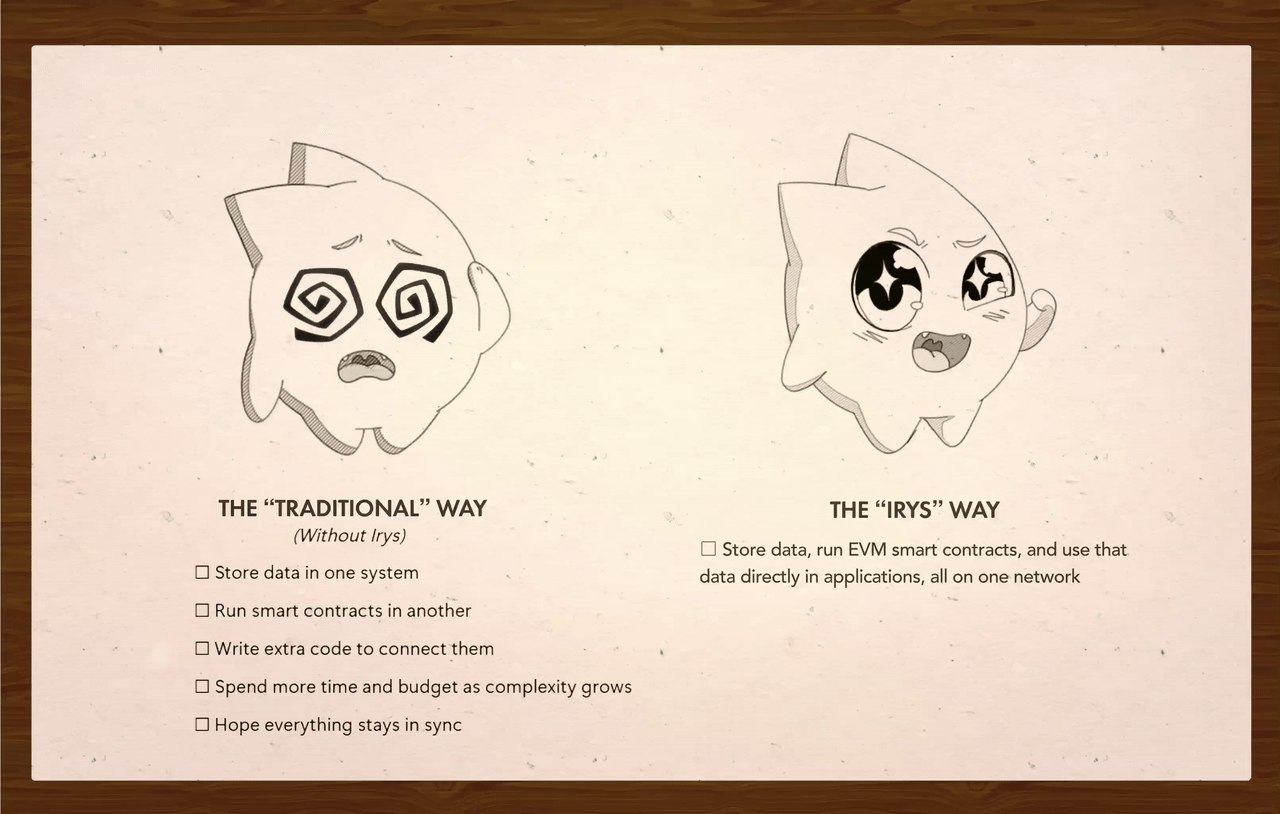
1. Disruptive Positioning: Leap from 'Storage Layer' to 'Data Assetization Platform,' capturing the core pain points of Web3 and AI integration.
2. Technological Integration Innovation: 'Storage + Computing' Integration and Programmable Data create significant differentiated barriers.
3. Significant Performance and Cost Advantages: High TPS, low latency, and extremely low storage costs offer strong practical appeal.
4. Strong Founding Background and Capital Support: With successful product experience and top venture capital endorsements, the foundation is solid.
Potential Risks of Irys
1. Security and Risk Control Events: Recent airdrop attacks exposed vulnerabilities in operational security, undermining community trust.
2. Complex Concepts, Difficult Implementation: The grand blueprint entails higher realization difficulty and longer verification cycles.
3. Market Competition is Fierce: It needs to break through in a battlefield surrounded by giants.
4. Easily Confused by Counterfeits: Emerging concepts are easily exploited by counterfeit projects, disrupting market judgment.
For investors, Irys represents a high-odds bet on the future of Web3 infrastructure. It could become an invisible pillar supporting the prosperity of the next cycle, but it may also falter due to technology, execution, or market competition.
 The real test lies in whether it can convert an elegant technical architecture into a prosperous and secure ecosystem that attracts developers in droves. The crypto world craves heroes, but it also never lacks meteors.