
If we say that the internet has changed the way information is transmitted (for example, you can now see this article), then Web3 and blockchain are changing the way **'value'** is transmitted.
The top crypto venture capital firm in Silicon Valley, a16z (the legendary fund that invested in Facebook and Twitter), has just released its 6 major predictions for 2026.
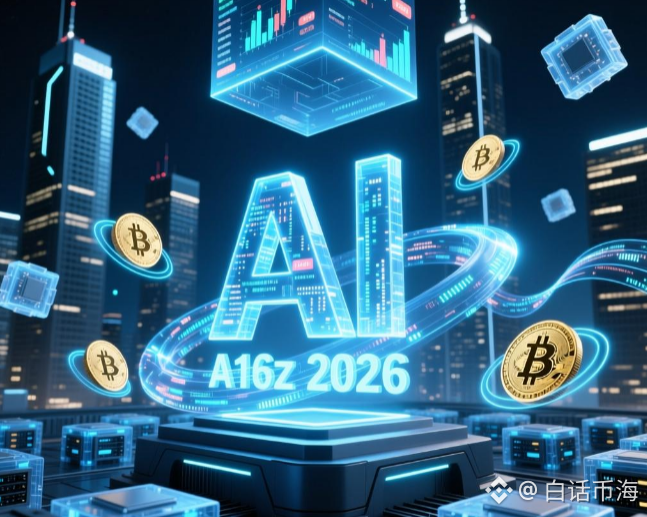
Don't be scared off by those lofty terms; today we will use plain language to unpack what these 6 trends really mean and how they will affect our wallets.
Trend 1: Stablecoin payments are finally going to be as seamless as 'WeChat red envelopes'.
📝 Key point: Last year, the trading volume of stablecoins reached 46 trillion USD! What does this mean? It's 20 times that of PayPal and 3 times that of Visa. Although on-chain transfers are very fast (less than a cent, in less than a second), the pain point is: How to convert fiat currency (like US cash) into stablecoins on the chain?
🔍 Beginner's terminology card:
Stablecoin: Can be understood as 'digital dollars'. Its price is stable, usually pegged 1:1 to the dollar. On/Off Ramps: The bridge connecting 'real-world bank cards' and 'blockchain wallets'.
🚀 a16z predicts: In 2026, more smart startups will come to fix this 'bridge'. In the past, you might have needed complicated operations; in the future, you might just scan a QR code or use your familiar local payment system to directly convert money into stablecoins for spending. Conclusion: Stablecoins will no longer be a tool for speculating on cryptocurrencies, but will become the foundational settlement layer of the internet. In the future, sending cross-border wages and doing business across borders may be as simple as sending a WeChat red envelope.
Trend 2: Old banks 'hacking the system' by embracing new technologies.
📝 Key point: Did you know? Many large banks today still use outdated software (COBOL language) from the 1960s to 1980s for their back-end systems. It's like installing GPS on a horse-drawn carriage; no matter how fast you want to go, you can't. To completely change the bank's system? It's too difficult, and the risks are too high.
🚀 a16z predicts: Banks have discovered a 'hack': without changing the old systems, they can directly connect to the blockchain. By embracing stablecoins and tokenized deposits, banks can provide 24/7 real-time payment services without having to start over.
Conclusion: Traditional finance (TradFi) will not die; it will 'patch' itself to become trendier and faster.
Trend 3: Stop 'scanning'; directly issue 'native'!
📝 Key point: A currently popular term is RWA (real-world assets on-chain). For example, mapping offline loan contracts onto the blockchain. But this is somewhat like scanning a paper contract into a PDF; although it has become electronic, the essence is still the same process.
🔍 Beginner's terminology card:
Tokenization: Generating a corresponding Token on the chain for offline assets (such as real estate and bonds). Origination: The asset is on the chain from the moment of its birth.
🚀 a16z predicts: In 2026, we will no longer be 'moving' offline things onto the chain, but directly 'creating' assets on the chain. Especially for debt-like assets (such as IOUs and bonds), they will be issued, contracted, and circulated directly on the chain.
Conclusion: Only 'native' can truly eliminate the cumbersome costs of back-end operations, making borrowing cheaper and more transparent.
Trend 4: It's getting serious! Not just tokenization, but also 'derivation'.
📝 Key point: Moving US stocks and gold onto the chain is great, but the current approach is somewhat 'forced' (reification). In the crypto world, there is something more popular than spot trading: perpetual contracts.
🔍 Beginner's terminology card:
Perps (perpetual contracts): As long as you put down a little margin, you can hold a position in a certain asset without actually buying the asset itself. This is very popular in the crypto space.
🚀 a16z predicts: Rather than laboriously bringing Apple stocks onto the chain, it is better to directly make perpetual contracts for Apple stocks on the chain. This aligns more with the habits of crypto natives and offers better liquidity.
Conclusion: Future RWAs (real-world assets) may circulate more in the form of 'derivatives' on the chain, significantly improving trading efficiency.
Trend 5: Private banking services are becoming accessible to ordinary people.
📝 Key point: In the past, if you wanted someone to manage your wealth and globally allocate assets, you had to be a VIP high-net-worth client of a bank, which had a high threshold. Ordinary people? Could only invest in things like Yu'ebao.
🚀 a16z predicts: In 2026, AI + blockchain = the private bank for the poor. When all assets are transformed into tokens on the chain, AI can help you automatically adjust your portfolio and automatically find the highest yielding financial products (like lending protocols in DeFi) at a very low cost.
Conclusion: Whether you are a Fintech giant (like R......d) or an exchange (like C......e), you will compete for this market. Your wallet is your best financial advisor.
Trend 6: The ultimate form! The internet itself is a bank.
📝 Key point: This is the most mind-blowing aspect. In the future, not only humans will run on the internet, but also a large number of AI agents. When an AI books a ticket, buys data, or rents computing power for you, how does it pay? It doesn't have a bank card, nor can it sign.
🔍 Beginner's terminology card:
AI Agent: An AI with autonomous action capabilities that can help you work.
🚀 a16z predicts: Blockchain is the 'financial system' prepared for AI. AIs can instantly and automatically pay each other with cryptocurrencies without the need for invoices or bank approvals.
Conclusion: In the future, 'payment' will no longer be a separate action, but a fundamental function of the internet. The internet will no longer 'support' the financial system; the internet 'is' the financial system.
Let's summarize:
In a16z's view of 2026, it is not a world that only trades cryptocurrencies. It is a new world where stablecoins become as common as water, electricity, and coal, AI becomes the main force in finance, and ordinary people can enjoy top financial services.
------------I---------am-------the--------dividing--------line--------------
Disclaimer: The content published in this article is intended to share business economic models and disseminate knowledge, and is not intended to provide any specific advice. The editor does not participate, invest, operate, advise, share, or privately analyze any projects. We strongly recommend that you conduct independent research and analysis and make informed decisions based on your personal circumstances before making any decisions.
If you like this content, feel free to like, follow, comment, and share for more technical analysis, etc. 🌹#AI #stablecoin #a16z
