

@Walrus 🦭/acc Walrus doesn’t feel important when everything is calm. In calm markets, calm teams, calm relationships between apps and their users, “storage” sounds like background noise.Walrus was built for high-stress situations where proof matters: tracking changes, showing what data existed before, and keeping it retrievable even if some operators go offline. It treats storage as a long-term obligation, not a “nice-to-have.”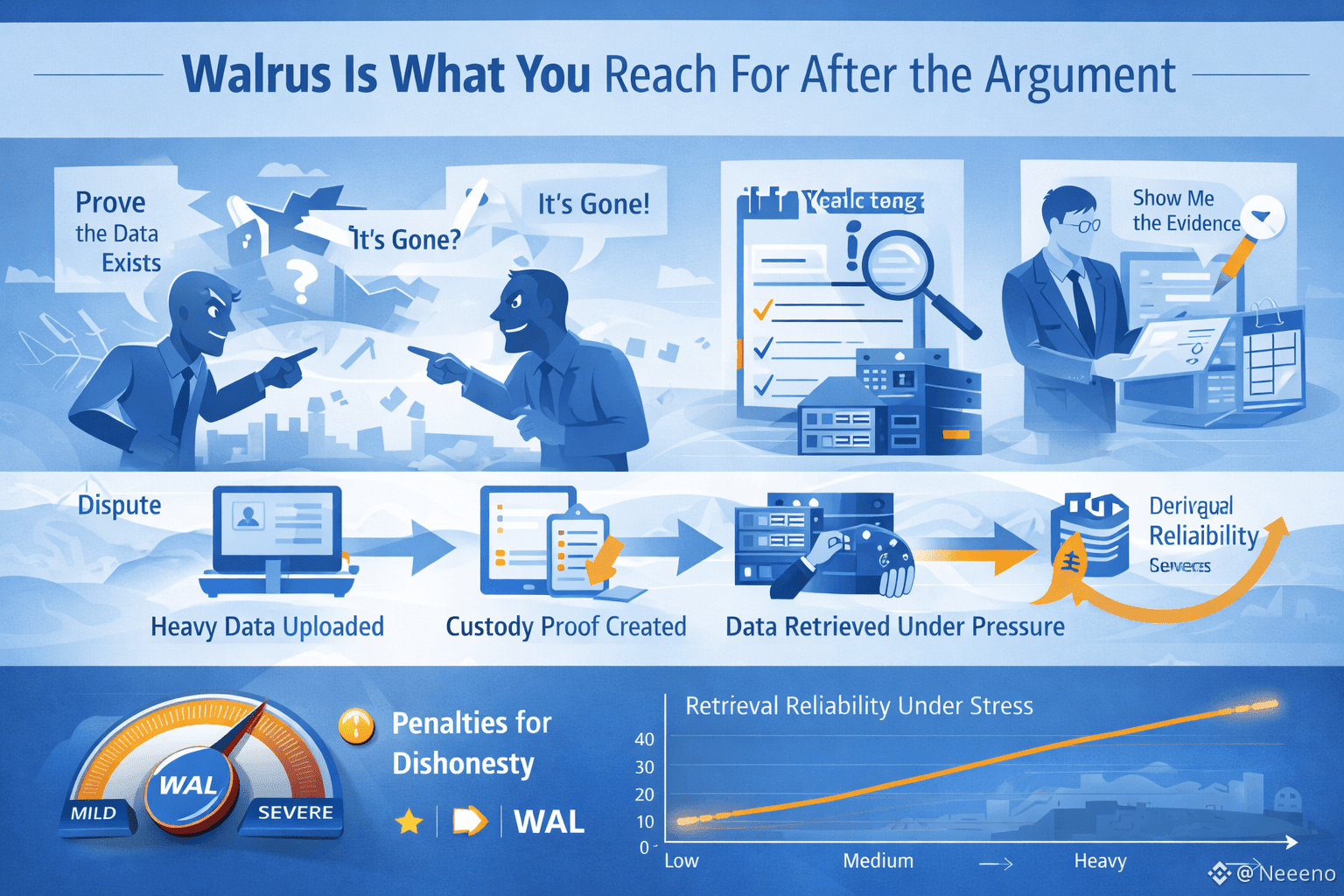
When you use Walrus closely, you start to see on-chain truth as more than transactions—it becomes verifiable evidence tied to real data. A chain is good at agreeing on small facts—balances, permissions, the sequence of events. But real life isn’t small. Real life is media libraries, medical histories, training sets, receipts, model outputs, the messy artifacts that people later use to defend themselves, to settle disputes, to rebuild when the world goes sideways. Walrus exists because the industry kept pretending those heavy artifacts were someone else’s problem. Walrus insists they are part of the same moral surface area as the ledger: if you can’t reliably hold the evidence, you can’t honestly claim you’ve built trust.
What makes Walrus feel different in practice is that it doesn’t ask you to “believe” in a provider. It asks you to believe in a pattern of behavior enforced by coordination and penalties. From the outside, it looks like a storage network built with Sui as the coordination layer, and that’s true: the control logic and the public commitments live where fast finality and composable state make sense, while the weight of the bytes lives with independent operators who do the physical work. But from the inside, the lived experience is simpler: you’re not uploading a file so much as you’re purchasing a time-bounded duty from a distributed group, and the chain is keeping score of who owes you what.
That distinction matters when you imagine failure. In centralized systems, failure is often a social decision disguised as a technical one: an account is closed, a region is throttled, a policy changes, a bill isn’t paid, and suddenly your “data” is a story you used to tell yourself. Walrus pushes failure back into the realm of measurable behavior. It’s designed so that the network can lose a lot of participants and still behave like it remembers what it promised. Walrus’ own mainnet launch materials describe a posture where availability is meant to hold even with extreme node disruption. The emotional consequence is subtle but real: builders stop feeling like they’re gambling their product’s continuity on a single throat to choke.
Under the hood, Walrus treats your upload like something that must be survivable, not just storable. Data is split, encoded, and scattered so that no single operator is the custodian of “the whole thing,” and so that recovery does not require heroic coordination. Walrus is intentionally built for churn—machines going offline, operators making mistakes, networks becoming unreliable—because churn is not an edge case in permissionless infrastructure. It’s the default weather. When you build on Walrus long enough, you stop asking “will a node fail?” and start asking “what does failure look like when the system expects it?”
That expectation is where Walrus’ engineering feels most adult. Instead of relying on simple duplication, Walrus uses a more nuanced redundancy strategy—one that’s meant to heal without forcing the network to drag full objects around every time a fragment disappears. The point isn’t academic elegance; it’s humane behavior under pressure. If repairs are too expensive, networks postpone them. If repairs are too complex, teams avoid them. If repairs require too much bandwidth, they happen only when it’s already too late. Walrus is designed so repairs can be routine, quiet, and boring—because boring repair is what prevents dramatic loss.
The psychological shift for users shows up during retrieval. Retrieval is where trust is tested, not where it is claimed. You don’t learn whether a storage promise is real when you upload in a stable moment; you learn when you need the bytes back quickly, when your app is already under scrutiny, when your customers are already angry, when a regulator or an auditor wants the evidence now. Walrus aims to make retrieval feel like it’s not negotiating with anyone’s mood. In the mainnet launch framing, the model is built to keep data available even through large-scale operator outage. That isn’t a marketing benefit. It’s emotional safety for teams who know they’ll be blamed for failures they didn’t directly cause.
Walrus also forces you to think clearly about privacy. Privacy here isn’t theatre. It’s the simple fact that most valuable data cannot be broadcast without harming someone: a patient, a trader, a creator, a company, a community. Walrus’ ecosystem updates in 2025 emphasize a move toward on-chain enforced access policies over encrypted data—so that confidentiality can exist without sliding back into “trust the gatekeeper.” The human consequence is that builders can offer users dignity by default, rather than asking them to trade dignity for convenience.
When you combine durable availability with enforceable confidentiality, a new kind of argument becomes possible: the argument where both sides can agree the data exists, agree it wasn’t silently altered, and still not expose it to everyone. That’s a different posture than the typical internet posture where either everything is public, or everything is private behind a company’s discretion. Walrus makes it easier to build systems where disclosure is deliberate, limited, and provable—because the public layer can attest to the existence and continuity of the data without revealing its contents.
None of this holds if the economics are soft. Walrus is unusually explicit that the token is not decoration—it is the accounting system that turns “please store my data” into “you are paid over time to remain responsible.” The WAL token is described as the payment rail for storage, with an upfront payment that is distributed across time to operators and stakers, designed to keep costs stable in fiat terms and reduce the psychological burden of pricing volatility on ordinary users. In practice, that means a user isn’t forced to become a trader just to buy reliability. They can buy a duration of custody and let the system convert that into ongoing obligation
WAL also matters because Walrus treats responsibility as something you can bond and punish. Delegated staking gives the network a way to assign work and weight to operators, and it gives ordinary token holders a way to participate in security without pretending everyone will run infrastructure. The important part is not ideology; it’s consequence. When someone can lose value for underperformance, they start engineering differently. They invest in redundancy, monitoring, operational discipline. They stop shipping excuses and start shipping uptime
The recent tone of Walrus updates has been clear about something many protocols avoid saying out loud: instability in stake and operator sets isn’t free. If people jump around chasing short-term yields, real costs appear—data has to move, repair work spikes, the network spends energy rearranging itself instead of serving users. Walrus’ own token documentation describes penalties for short-term stake shifts, with part of the fee burned and part redirected to long-term stakers, explicitly to discourage behavior that forces expensive migration. The human layer here is fairness: it is a refusal to let impatient capital impose hidden costs on patient users.
Walrus has also been explicit that “bad performance” shouldn’t be an aesthetic disappointment; it should be a financial event. The same token documentation describes slashing tied to low-performing operators, with a portion burned, so that delegators are incentivized to choose competence rather than hype. This is one of those design choices that feels harsh until you’ve lived through the opposite: a world where everyone can promise reliability, nobody is penalized for breaking it, and users pay the price in lost history.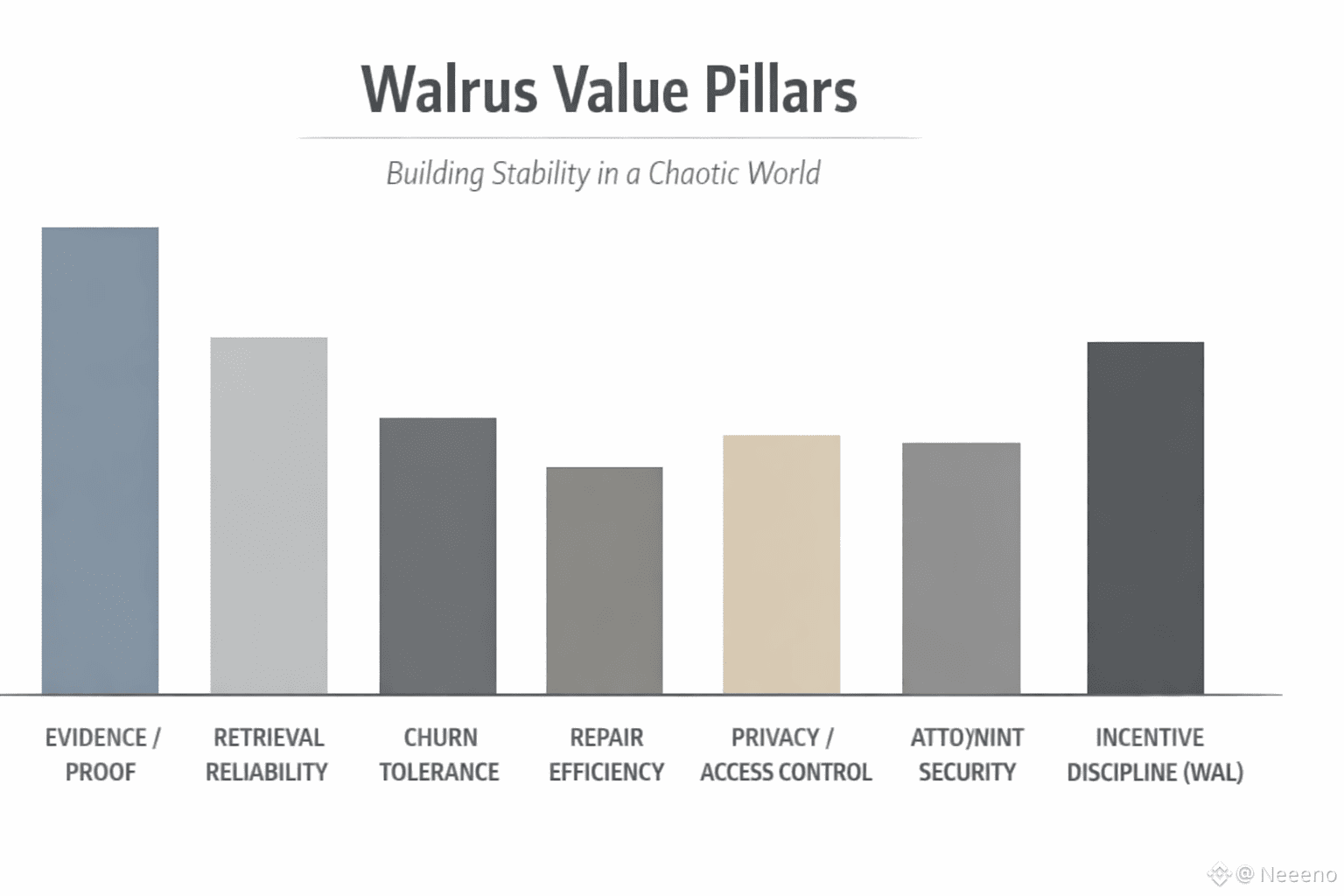
Supply and distribution matter here because incentives are political even when they’re encoded. WAL’s maximum supply is stated as 5,000,000,000, with an initial circulating supply of 1,250,000,000, and with over 60% allocated to community-oriented categories through a reserve, a user-focused distribution, and adoption support. The community reserve is described as unlocking linearly through March 2033, while the investor allocation is described as unlocking 12 months from mainnet launch—placing a visible date on when the market will be asked to absorb new supply. If you actually build in this ecosystem, these aren’t abstract tokenomics slides; they are calendar events that shape sentiment, hiring plans, runway assumptions, and how confidently teams can commit to multi-year products.
The market, right now, is pricing that responsibility in real time. As of January 2026, public market trackers show WAL trading around fifteen cents, with a circulating supply around 1.577B and a market capitalization around $237M. I don’t cite those numbers as a scorecard. I cite them because they describe the emotional environment builders are operating in: enough liquidity and visibility to onboard users, enough volatility to punish careless treasury management, enough uncertainty to force teams to build like adults.
Visibility has also arrived from institutions in a way that tends to change the conversations around a project. Walrus’ own year-in-review notes that Grayscale launched an investment vehicle tied to WAL in June 2025. Grayscale’s fund page lists an inception date of 06/16/2025 and shows it tracking WAL via a reference rate, with reported AUM and daily NAV updates as of early January 2026. This matters not because institutions are “validation,” but because institutional participation changes the kinds of questions people ask: custody, disclosure, risk, governance continuity, operator concentration. Walrus becomes less of a narrative and more of a system that must endure scrutiny.
Exchange access is part of that same shift. Walrus publicly announced WAL becoming available on Binance in October 2025, framing it as a milestone following mainnet and ongoing technical progress, and reiterating that the token underpins payments, staking, and governance, with an upcoming move toward burning on transactions. Broader access cuts both ways: it helps users get in, and it invites faster sentiment swings. A serious protocol doesn’t get to complain about that. It has to keep behaving predictably while people project their emotions onto the chart
What I keep coming back to, though, is how Walrus’ recent product work is aimed at reducing the number of ways honest users can accidentally fail. In the 2025 review, Walrus describes shipping a method for bundling many small files into a single stored unit—an efficiency move that reportedly saved partners millions of WAL in storage costs. That’s not a “feature.” That’s a recognition that teams in production don’t fail only from adversaries; they fail from friction, from overhead, from the thousand tiny costs that make people cut corners. Lower those costs and you get more honest behavior without moralizing.
The same review describes an upload pathway that shifts complexity away from thin clients—especially mobile and unreliable connections—so that distribution to many operators is handled in a way that remains dependable even when the user’s network is not. Again, the point isn’t convenience for its own sake. It’s reliability under imperfect conditions. Real users don’t upload from laboratory networks. They upload from commuter trains, overloaded cafés, regions with inconsistent routing, environments where partial failure is ordinary. A storage promise that only works for perfect clients isn’t a promise; it’s a demo
Adoption in Walrus’ 2025 story also reads like a map of where modern pressure points live. Teams used Walrus for health data where users want control, for advertising data where people fear manipulation, for vehicle telemetry where ownership and monetization are contested, for autonomous agents where “memory” becomes part of economic behavior, and for prediction markets where credibility depends on verifiable histories. Each of these domains shares a common anxiety: someone will rewrite the story after the fact. Walrus is attractive in these zones because it tries to make rewriting expensive, visible, and punishable.
When you put all of this together, the deepest thing Walrus is doing is not “decentralizing storage.” It’s giving builders a way to stop outsourcing responsibility. WAL is not just a payment chip; it’s a discipline mechanism that forces the ecosystem to price the cost of being dependable over time. The network’s posture toward burning and penalties is not primarily about scarcity; it’s about making certain kinds of harmful behavior—cheap churn, careless delegation, underperformance—feel painful enough that people choose stability instead.
And that’s why Walrus feels like quiet infrastructure rather than a spectacle. It is designed for the day after the hype, the day after the argument, the day after the market swings, when someone opens their hands and asks the system to return what it was paid to hold. Mainnet went live on March 27, 2025, and the network described itself as already relying on over a hundred independent operators to keep that obligation real. Since then, the updates have mostly been about tightening the screws on reliability: making privacy enforceable, making uploads more dependable, making small-file usage less wasteful, making the token’s incentives harder to game.
In the end, Walrus is a lesson that the most important systems rarely feel thrilling while they’re doing their job. They feel quiet. They feel predictable. They feel like the absence of panic. Walrus is trying to become the kind of infrastructure you don’t have to talk about—because it keeps showing up the same way in good times and bad. That’s a heavy responsibility, and it’s also the point: reliability matters more than attention, because attention can’t restore lost evidence, can’t repair broken history, and can’t comfort a user whose trust was violated. Walrus, at its best, is the discipline of holding what was entrusted—calmly, repeatedly, and without needing applause.

