
Most traders don’t lose money because they picked the “wrong chain.” They lose money because they misunderstand what kind of chain they’re dealing with.
If you’ve been in crypto long enough, you’ve probably seen this movie: a token pumps on hype, people assume adoption is around the corner, and then months later nothing meaningful has changed except the chart. That’s why Dusk Network is interesting in a different way. It’s not trying to be the loudest Layer 1. It’s trying to solve a problem that only becomes obvious when you’ve watched how real finance actually works: in regulated markets, privacy is not optional, but neither is compliance.
Right now (January 13, 2026), DUSK trades around $0.073 with roughly $41M in 24-hour volume and about a $35.7M market cap, with a circulating supply near 487M DUSK and a max supply of 1B. Those numbers matter for a trader because they show liquidity and market attention. But they do not explain the investment case. The investment case is the direction: building regulated, privacy-capable financial rails without pretending rules don’t exist.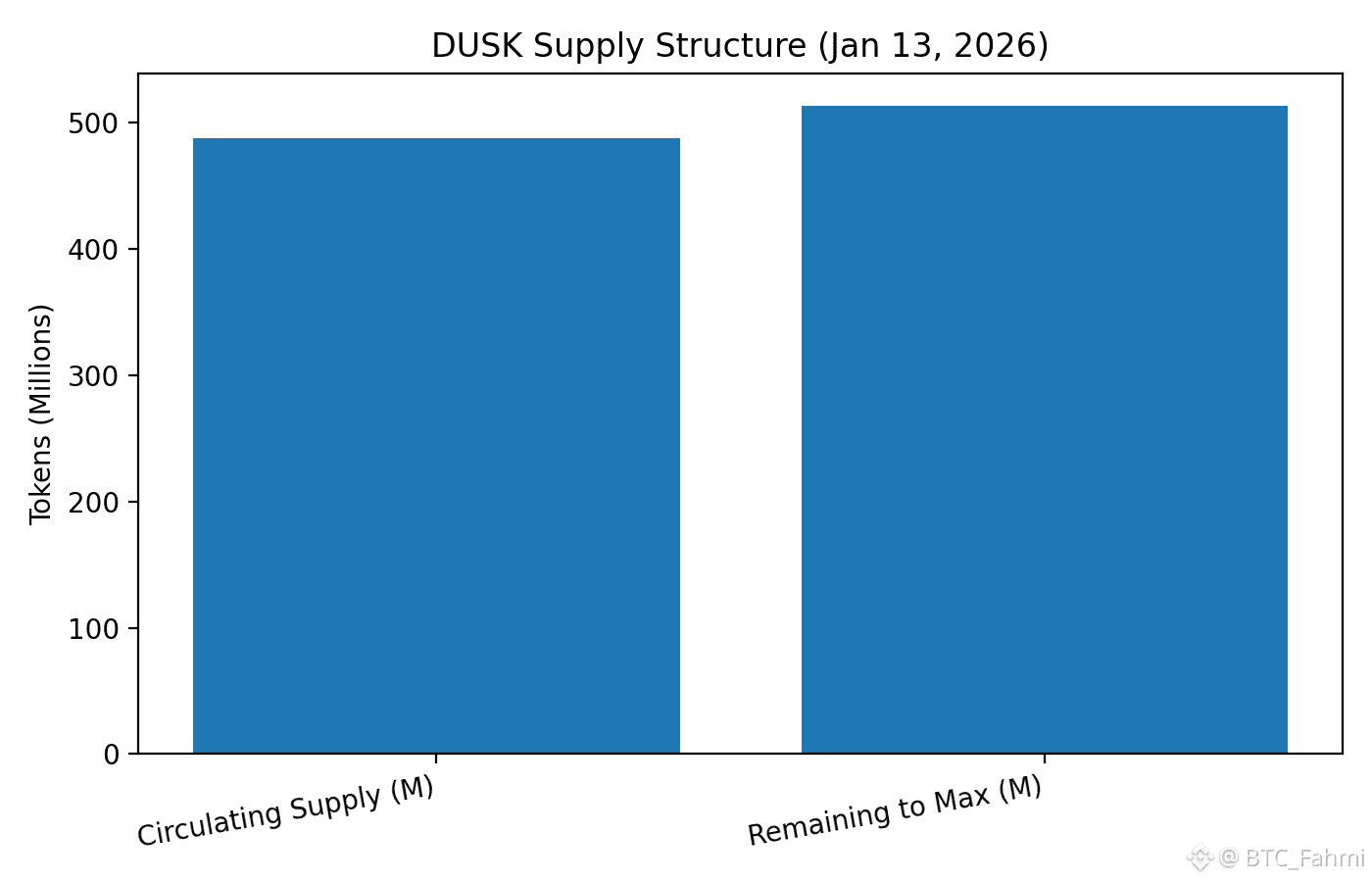
To understand why Dusk’s approach is unusual, you have to look at the contradiction at the heart of public blockchains. Transparency is powerful, but it’s also unrealistic for many financial use cases. In traditional finance, transaction details are not broadcast to the public. If a market maker is rebalancing inventory, if a fund is accumulating a position, if a bank is settling an asset transfer, the entire point is that sensitive information stays confidential. Transparency in crypto has created a culture where people assume “open” equals “fair,” but in institutional finance, radical transparency often equals “unusable.”
At the same time, institutions cannot operate in a private system that has no audit trail. A privacy-only chain that makes it impossible to prove compliance is basically dead on arrival for regulated environments. That is where Dusk tries to sit: privacy where it matters, auditability where it’s required.
Dusk’s documentation frames this as combining zero-knowledge technology with on-chain compliance so that activity can remain confidential while still being provably aligned with regulatory requirements. The simplest way to describe the idea is selective disclosure. You don’t show the world everything. You show the right parties exactly what they need to verify.
This is more than a philosophical stance. It changes how financial products can be built. Think about tokenized real-world assets, regulated securities, or institution-facing DeFi products. In these markets, KYC/AML requirements exist. Reporting exists. Supervisors exist. But the entire trading book can’t be public. If you are running a desk, you don’t want your competitors front-running your flow because your settlement trail is fully visible. And if you are a regulated issuer, you need proof that buyers meet requirements without publishing their identity to anyone watching the mempool.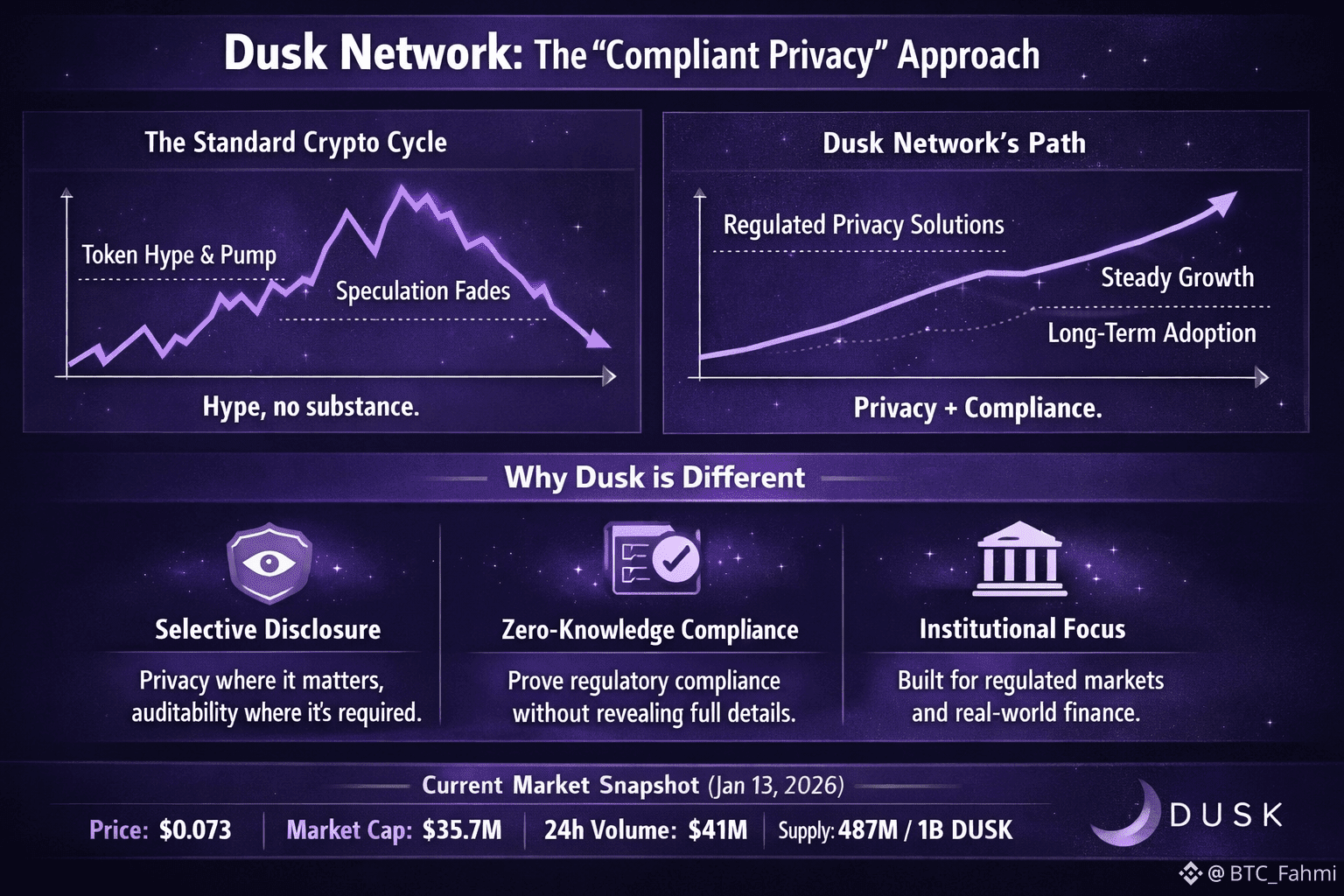
Dusk describes a framework often summarized as “zero-knowledge compliance,” where participants can prove they satisfy requirements without exposing personal details or full transaction context. If that sounds abstract, here is a real world example that makes it concrete.
Imagine a regulated fund is experimenting with issuing shares as on-chain tokens. The fund manager wants investors to transfer these tokens freely, but only among verified eligible holders. If they build on a fully public chain, every transfer reveals counterparties, timing, and holdings patterns. Now picture how that looks during a sensitive period like a redemption wave or major reallocation. Even if nothing illegal happens, the optics become a risk. The market can infer distress, strategy shifts, or concentration levels. That data becomes weaponized.
In the traditional world, those details are protected. In crypto, they’re often exposed by default.
In a Dusk-style setup, the chain’s design aims to let the transfer happen privately while still being able to prove that compliance conditions were met. That is the “middle path” institutions keep asking for: not anonymity, not radical transparency, but controlled visibility.
Now let’s be honest, because traders and investors need honesty more than they need narratives. Building for compliance slows you down. It forces you to design for rules that differ across regions. It requires governance maturity, careful architecture, and credibility. It also means the market for your product is smaller in the short term. Retail loves permissionless chaos. Institutions don’t.
So the real question isn’t “can Dusk pump?” The real question is whether markets are gradually moving toward the type of infrastructure Dusk is building.
And there are reasons to think they are. Regulation is tightening globally. Europe’s MiCA framework and related regulatory structures have pushed the conversation away from “crypto as rebellion” and toward “crypto as financial technology.” Dusk has been positioning itself explicitly around this regulated reality for years.
From an investor’s lens, the most relevant insight is this: if regulated token markets scale, privacy and compliance will stop being competitors. They will become a bundled requirement. Nobody serious wants a financial system where every account balance is publicly traceable. But nobody serious can build a market that can’t be audited.
That is the unique lane Dusk is trying to own.
For traders, DUSK is still a crypto asset, meaning it will behave like one: sentiment-driven volatility, liquidity cycles, and rotation-based pumps. The recent price action and volume show there is still active speculative interest. But for longer-term investors, the story is not the candlestick. It’s whether Dusk’s “compliant privacy” becomes a standard requirement rather than a niche preference.
My own view, as someone looking at this through a market structure lens, is that privacy is one of those features everyone pretends they don’t care about until they absolutely need it. Retail doesn’t feel it immediately. Institutions feel it immediately. And when institutions finally move, they don’t adopt what’s trendy. They adopt what reduces risk.
If Dusk succeeds, it won’t be because it outshouted other chains. It will be because it solved a problem most chains avoided: letting financial activity stay private, without asking regulators to look away.

Article
Dusk Network's Unique Approach: How Financial Privacy and Regulatory Compliance Come Together.
Disclaimer: Includes third-party opinions. No financial advice. May include sponsored content. See T&Cs.

DUSK
0.1027
-5.08%