
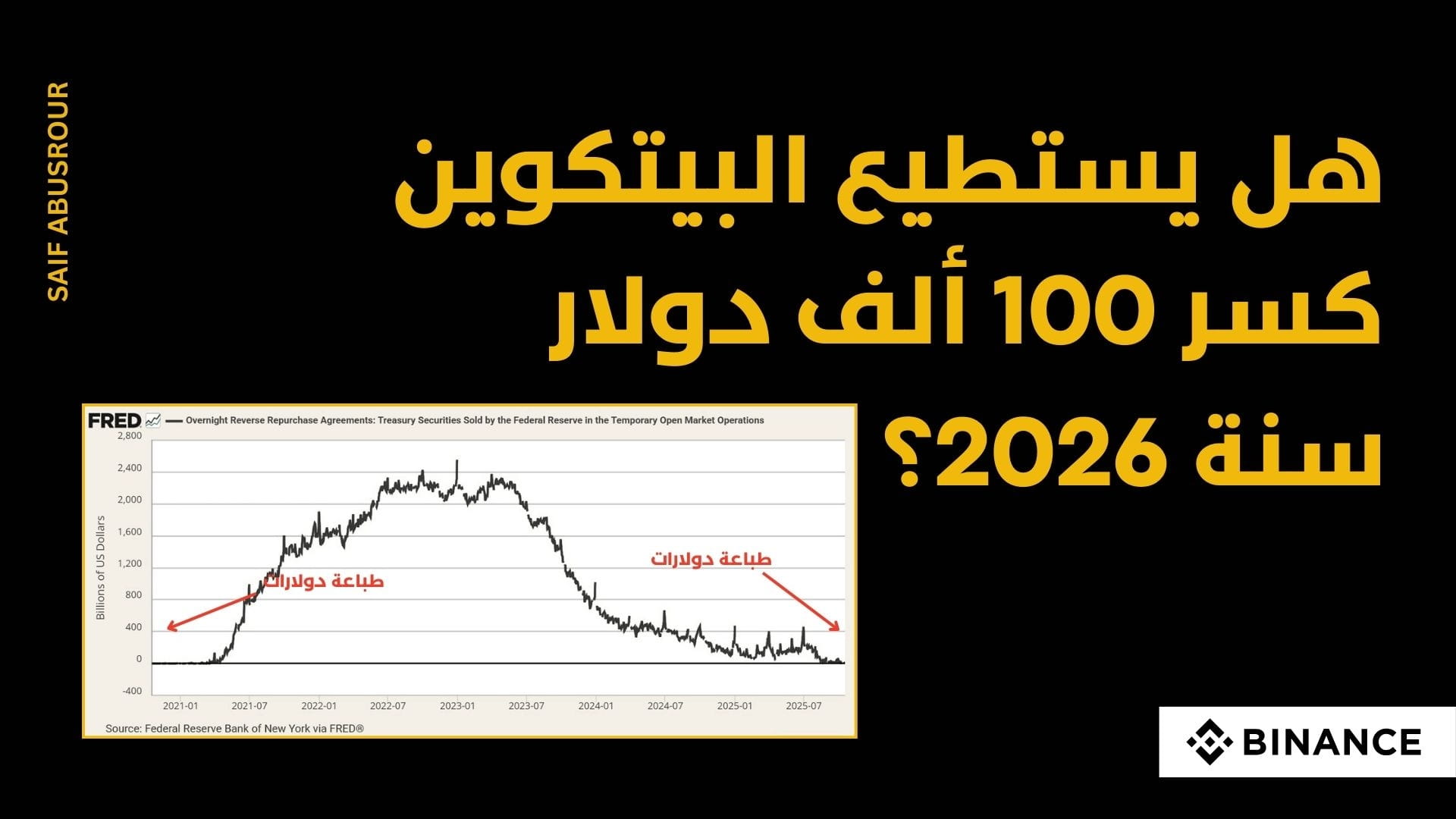
Economic analysis based on liquidity, monetary policy, and pricing structure
Breaking Bitcoin to the level of $100,000 before 2026 is not a matter of price timing, but a direct result of global liquidity balance, monetary policy, and supply structure with the realization of specific price conditions. The market does not price a story, but rather economic and structural conditions that, if coincided, achieve the breakthrough.
Prediction markets like Polymarket show non-extreme probabilities: no sharp bullish consensus nor pricing for a collapse. This cautious pricing reflects an understanding that reaching 100,000 is conditional on macro factors and subsequent price confirmation, not on internal momentum in the crypto market. Historically, when the outcome is related to liquidity, these markets excel in prediction because they aggregate real capital, not opinions.
Economically, there are three main driving forces:
First: inflation and the limits of monetary tightening
Inflation has slowed but has not returned to target levels. Prolonged tightening raises the cost of financing, pressures growth, and increases recession risks. At this stage, the market does not need a formal announcement of a shift; it is enough for the sustainability of tightening to become economically impossible. At this point, expected real yields decline, and the repricing of scarce assets begins. Bitcoin benefits here as an asset not directly linked to bond yields, with a fixed supply against a politically flexible monetary base.
But this effect does not translate into a sustainable price trend without structural confirmation in the price.
Second: quantitative easing (QE) as an expected path, not an event
Quantitative easing is not a sudden shock, but a gradual path that markets price in advance.
Even before any official decision, stopping the budget reduction, easing liquidity constraints, or a change in central banks' tone all push capital to reposition itself. Historically, Bitcoin moves before the official decision because capital precedes policy.
However, past experiences show that the first expansion in liquidity often creates volatility and price traps, not a final direction. The true trend begins when markets stop responding immediately to news, and the price begins to move quietly.
Third: ETF funds and the structure of supply and pricing
ETF fund flows do not represent short-term trading, but a permanent transfer of supply from the free market to long-term institutional balances. This not only reduces supply elasticity but also changes the nature of pricing itself.
When an asset is held within inactive wallets, prices do not gradually rise but rather through sharp jumps at moments of dislocation. Therefore, a breach of 100,000 — if it occurs — is likely to be sudden rather than cumulative, and does not require broad participation in fragmentation, but rather a slight dislocation between steady institutional demand and structurally constrained supply.
An additional supporting factor is global liquidity (Global M2). The statistical relationship between M2 expansion and Bitcoin price increases is time-lagged but recurrent across cycles. Every previous monetary expansion was followed by a rise in Bitcoin after weeks or months, reinforcing the breakout scenario if the liquidity trend continues.
However, the absence of immediate price interaction is not considered a failure, but rather often a phase of accumulation before repricing.
Pricing conditions that cannot be ignored
Economically, breaking 100,000 is possible without a bubble, but price-wise it remains conditional on a structural close above previous peaks, and the price staying above the average institutional cost of holding. Liquidity expansion without this confirmation means amplifying volatility, not building a trend.
The scenario of invalidation
This scenario fails if real yields remain positive, and liquidity is absorbed through debt instruments rather than transferring to scarce assets, which re-applies pressure on Bitcoin pricing despite improved nominal liquidity.
What should be monitored closely?
Language shifts in central bank data before decisions
Net ETF flows not their daily fluctuations
The direction of global liquidity has no news noise
Price behavior during news: silence is more important than the rise
The economic summary
Breaking 100,000 dollars before 2026 does not require an exceptional demand surge, but rather a simultaneous marginal expansion in liquidity with constrained supply and structural price confirmation. These conditions have begun to form, but the moment of explosion is not measured by the news, but by price behavior afterward.
