
On October 25, 2025, the cryptocurrency market witnessed a phenomenal event. The x402 protocol, developed primarily by Coinbase, saw its daily trading volume exceed 150,000 transactions, an astonishing increase of 492.63% compared to the previous week. This payment protocol, based on the HTTP 402 status code, attracted the participation of tech giants like Visa, Google, and Cloudflare within just six months, and even gave rise to the PING token, which has a market value of over $20 million. This raises the question: how could an apparently ordinary technical protocol create such a massive upheaval in the industry in such a short time?
The unfulfilled dream of internet payments
The story begins in 1997. When the HTTP/1.1 protocol was established, engineers reserved a special status code - 402 "Payment Required". Their vision was simple: the future internet should facilitate payments as easily as transmitting information. However, this forward-thinking idea had to be shelved due to the technological conditions at the time. Credit card processing fees reached as high as $0.3, making it impossible to support micropayments of just a few cents; there was a lack of global digital payment infrastructure; and more importantly, there was no urgent demand for automated payments at that time.
Today, thirty years later, three technological breakthroughs have finally awakened this dormant dream. The market size of stablecoins has soared from 4 billion dollars in 2020 to 280 billion dollars, providing a foundation for global payments; Layer 2 solutions have reduced transaction costs to a few cents, making micropayments possible; and the explosive growth of AI agents has created a genuine demand for automated payments. It is in this context that Coinbase launched the x402 protocol in early 2025, injecting new vitality into the HTTP 402 status code.
How does x402 achieve "request to pay"?
The core innovation of the x402 protocol lies in seamlessly embedding the payment process into the HTTP request-response cycle. When an AI agent or user requests paid resources, the server returns a 402 status code and payment information (amount, receiving address, etc.). The client automatically completes the on-chain payment using stablecoins like USDC, and can retrieve the resources after the payment is completed. The entire process requires no manual intervention and can be completed within seconds.
Behind this seemingly simple process lies a sophisticated technical design. x402 adopts a strategy of separating "payment intent verification" from "on-chain settlement," ensuring the immediate delivery of services. More importantly, Coinbase provides official "coordinator" services to handle complex on-chain operations, allowing developers to focus less on blockchain technology details and significantly lowering the access threshold. This design ensures both the security of payments and the smoothness of user experience.
Why are both Visa and Google betting on x402
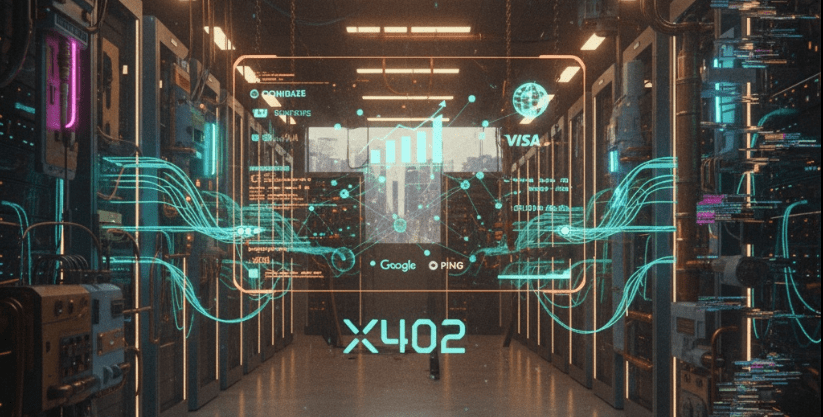
The rapid rise of x402 cannot be separated from the collective endorsement of tech giants. Cloudflare, as the traffic gateway for 20% of the world's websites, has supported the x402 protocol, allowing websites to charge fees to AI crawlers. Visa announced that it would interconnect x402 with its own protocol TAP, paving the way for traditional payment networks to access the blockchain world. Google has integrated x402 into its AI agent communication standard AP2, building a complete ecosystem from service discovery to payment.
The participation of these giants highlights the strategic value of the x402 protocol. It is not only a payment tool but also a bridge connecting Web2 and Web3, serving as the infrastructure for the AI economy era. As Erik Reppel, the engineering director of Coinbase, said: "We are laying the foundation for an economy operated not only by humans but also by software—autonomous, intelligent, and never-ending."
From AI agents to the revolution of content payment
The application prospects of the x402 protocol are broader than imaginable. In the field of AI agents, it enables agents to autonomously purchase data, computing power, and services. Imagine your AI assistant automatically paying 0.01 dollars to query the weather API and 0.05 dollars to call flight data to help you plan a trip, all without your intervention. In the content creation field, authors can charge directly per instance, allowing readers to pay just a few cents to read an article, completely transforming the current advertising or subscription models.
The API economy is the natural stage for x402. Developers can set precise prices for each API call, achieving true pay-per-use. Dune Analytics data shows that the API service call volume using x402 has increased by an average of 150%, proving the tremendous potential of this model. In the field of DePIN (Decentralized Physical Infrastructure Networks), x402 enables automatic micropayments between devices, providing a new way for value circulation in the Internet of Things economy.
The significance of the x402 protocol goes far beyond being a new payment method. It represents a shift in the internet from an "advertising economy" to a "value economy," providing new monetization pathways for content creators and developers. With the popularization of AI agents, x402 is expected to become the infrastructure for economic activities between machines, giving rise to new business models and economic forms.
In October 2025, the daily transaction volume of the x402 protocol has exceeded 230,000, with a market value approaching 800 million dollars. Behind these numbers is a rising new ecosystem. From technological experiments to commercial applications, the evolution of x402 has surpassed many people's expectations. As noted in the report by a16z, x402 far exceeds traditional payment networks in speed, cost, and programmability, and is expected to become the core infrastructure of the AI-driven economy.
The story of the x402 protocol has only just begun. Can it truly reshape the internet economy and become the next generation payment standard? Let's wait and see. But one thing is for sure: when payments become as simple as an HTTP request, the future of the internet will be full of infinite possibilities.
