


When we get used to defining the value of Web3 with 'decentralization, security, and composability', these terms often become too abstract in real user experiences. For most users, they care less about how advanced the consensus algorithm is, and more about whether 'I can smoothly complete operations across different wallets and applications', 'Will my data be monitored?', 'If a certain service suddenly goes offline one day, can I still use it?'.
The role that WalletConnect has taken on in the past few years is precisely to implement these seemingly distant technological commitments into daily interactions. Its next evolutionary stage—decentralized networks and WCT token governance—is not just a technical upgrade, but a foundational infrastructure revolution centered around privacy protection and anti-censorship.
1. Why are privacy and anti-censorship the next pain points for Web3? 🔑
When we talk about the widespread adoption of Web3, we often focus on performance (TPS, gas costs), interoperability (cross-chain bridges), and asset scale (TVL). However, if we closely observe the regulatory and social events of the past two years, another trend is gradually surfacing:
The risk of data abuse is increasing
Centralized wallets or exchanges often accumulate user data through logs, address behaviors, KYC binding, etc. This data appears to be 'for compliance' on the surface, but once abused, it could become a new invisible monitoring system.Service interruptions and insufficient anti-censorship
In some countries and regions, users suddenly find that their wallets cannot be updated normally, or that transactions are being censored. This 'passive failure' is an invisible high wall for ordinary users.The pressure of large-scale migration from Web2 platforms
More and more traditional financial and social applications are trying to enter Web3. If they rely on centralized connection methods, user experiences may be sacrificed in the logic of 'privacy in exchange for convenience'.
So the question arises: if Web3 continues down the path of centralized APIs or semi-open source SDKs, it may ultimately replicate the fate of Web2—exchanging seemingly free and convenient services for users' most core rights: privacy and freedom.
The choice of WalletConnect takes this contradiction as the first principle of network design.
2. End-to-end encrypted relay: An invisible privacy moat 🔒
WalletConnect's relay service is the 'communication artery' of the entire network. Unlike traditional APIs, it emphasizes from the outset:
Relays do not see user wallet addresses, transaction hashes, or KYC information;
All communications are end-to-end encrypted, even node operators cannot peek;
Service abstraction, applications only need to call the connection without accessing sensitive user data.
What does this mean? 🤔
For example, if you sign a transaction at a decentralized exchange using a certain wallet, traditional centralized service providers may leave clear behavioral traces, whereas WalletConnect's network is responsible only for transmitting encrypted messages; it does not know who you are or what you bought.
It can be said that this is one of the few truly 'privacy by default' designs in the Web3 world.

3. Decentralized Nodes and Anti-Censorship: From Vulnerabilities to Shields 🛡️
Decentralization is not just a concept for WalletConnect, but a matter of life and death for engineering.
A centralized service node can theoretically:
Forced to revoke connection permissions for certain applications;
Blocking user requests in specific regions;
Even slowing down certain transaction channels through 'traffic selective blocking'.
The introduction of a decentralized node architecture dismantles this potential single point of risk:
Service node distribution: Each node acts like a mailbox, ensuring data is securely stored even when users are offline;
State switching mechanism: Nodes enter different states like Active, Reserve, Standby, Jailed, etc., based on performance to avoid low-quality nodes from long-term pollution of the network;
Staking + penalty mechanism: Node operators must stake WCT, and improper behavior will trigger penalties.
This mechanism reminds me of the 'mining incentives' in the Bitcoin network. The difference is that WalletConnect's 'computing power' is not about hashing, but about low latency + high availability of service capabilities. In other words, nodes do not compete on who wastes more electricity, but on who can provide a smoother and more stable user experience.
4. WCT: Tokenizing 'Privacy and Experience' 💹
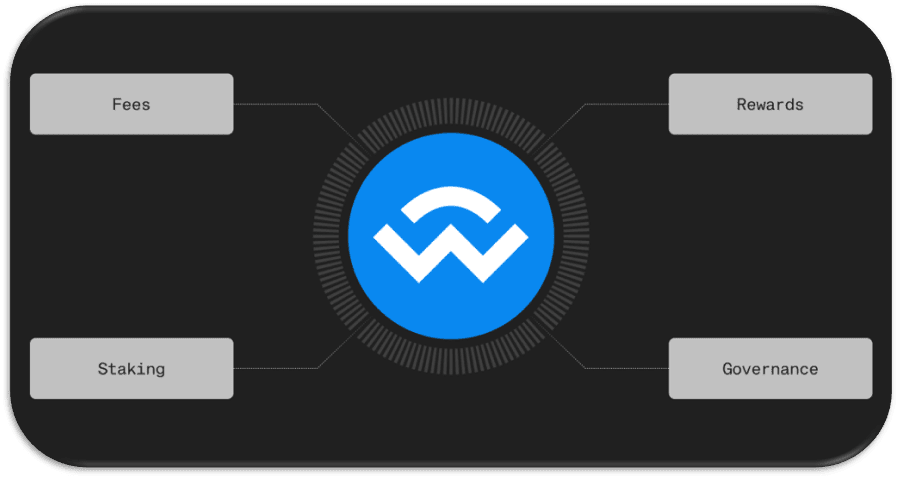
Many people may wonder, what is the significance of WCT? Its uniqueness lies in the fact that it is the first model to directly map privacy protection and anti-censorship capabilities to token incentives.
Staking → Anti-censorship: Nodes can only participate in services by staking enough WCT, avoiding 'zero-cost malice';
Rewards → User experience: Reward distribution is linked to latency and connection success rates, turning 'good use' into a measurable metric;
Governance → Privacy first: WCT holders can vote on whether to charge fees and how to allocate resources, which means letting users decide the 'price of privacy'.
The beauty of this mechanism lies in its transformation of originally vague privacy and experience into measurable, governable economic signals within the network.
5. From my observations: the triple space of future privacy narratives 🌍
In the past year, many wallet developers have been generally concerned about one issue: how to find a balance between compliance requirements and user privacy.
My observation is that WalletConnect provides three layers of paths:
Technical layer: End-to-end encryption and permissionless databases ensure that the infrastructure itself does not leak privacy.
Incentive layer: Through WCT, turn 'protecting privacy' and 'providing a good experience' into economic motivations for nodes and wallets.
Governance layer: Hand over decisions like 'whether to charge fees and how to charge'—which could normally be made by companies—to the user community.
These three layers together can support a truly privacy-friendly and scalable internet.

6. Future scenario imagination: when privacy becomes a competitive advantage 🛰️
Imagine a not-so-distant future:
Users open a cross-border payment application, log in with WalletConnect, complete transactions, but no centralized service knows their true identity or geographical location.
A social application wants to enter Web3, it directly adopts the WalletConnect standard without worrying about data being monetized by a centralized API.
A country tries to restrict on-chain interactions but finds that network nodes are distributed globally and cannot be completely blocked, allowing users to continue using freely.
At this point, privacy is no longer a marginal demand but will become a selling point for applications to attract users. Those wallets that can provide smooth and secure experiences through WalletConnect will gain a larger user base precisely because they 'protect privacy'.
7. My concerns and suggestions ⚠️
Of course, the road to privacy and anti-censorship is not easy:
If the fee mechanism is poorly designed, it may lead developers to migrate to centralized alternatives;
If governance is overly centralized, it may result in monopolistic voting by large holders;
If the ecosystem fails to uniformly support open standards (CAIP), it may be eroded by proprietary protocols.
My recommendations are:
In the early stage, governance support was carried out through the WalletConnect Foundation to avoid the premature loss of control over tokenized governance;
Strengthen the education of the community on the value of 'privacy by default', helping users understand the hidden costs of free centralized services;
Increase incentives for certified wallets and certified nodes, making 'good experience' an economically inevitable choice.
8. Conclusion 🌟
In the next stage of the internet, privacy and anti-censorship will no longer be just ideals for tech geeks, but will become a necessity for the masses. WalletConnect's decentralized network is attempting to turn this ideal into a reality of infrastructure. It transforms 'privacy' and 'good experience' into the economic rules of the network through relay encryption, permissionless databases, token incentives, and community governance.
Perhaps in a few years, when we are used to logging in, paying, and verifying identity across chains with a simple scan, people will forget these complex designs. But just as we do not constantly thank the TCP/IP protocol today, the value of WalletConnect may lie in its ability to become a forgotten privacy shield.
