


$FOGO for one reason that has nothing to do with leaderboard numbers, and everything to do with how the chain quietly pressures builders to grow up in their architecture, because when you build on an SVM based L1 you are not only choosing a faster environment, you are choosing an execution model that rewards good state design and exposes bad state design without mercy.
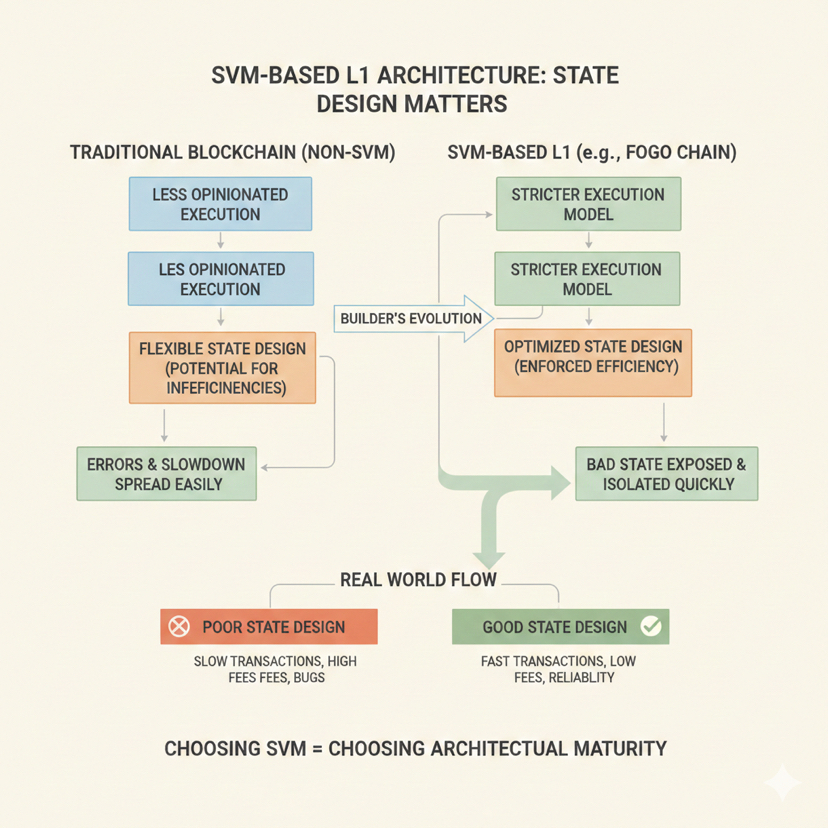
Fogo feels like it is being shaped around the idea that speed should not be a cosmetic claim, because if blocks are genuinely fast and the runtime can process independent work at the same time, then the application becomes the real bottleneck, and that shift is where the SVM story becomes interesting, since the runtime is basically asking every developer the same question the moment real users arrive, which is whether their transactions are actually independent or whether they accidentally designed one shared lock that everyone must touch.
Parallel execution sounds simple when it is explained as transactions running together, but the practical detail that changes everything is that it only works when two transactions do not fight over the same state, and on SVM the state is not an invisible blob that the chain interprets however it wants, the state is explicit and concrete, and every transaction has to declare what it will read and what it will write, which means the chain can schedule work confidently when those declarations do not overlap, and it also means the chain cannot save you from your own layout when you force everything to overlap.
This is the part that most surface level commentary misses, because people talk as if performance lives at the chain layer, but on Fogo the moment you begin to model an application, performance becomes something you design into the way accounts and data are separated, and that is why two apps on the same chain can feel completely different under stress, with one staying smooth while the other becomes oddly stuck, even though both are sitting on the same fast execution environment.
I have noticed that when builders come from sequential execution habits, they carry one instinct that feels safe but becomes expensive on SVM, which is the instinct to keep a central state object that every action updates, because it makes reasoning about the system feel clean, it makes analytics easy, and it makes the code feel like it has a single source of truth, but on an SVM chain that same design becomes a silent throttle, because every user action is now trying to write to the same place, so even if the runtime is ready to execute in parallel, your application has created a single lane that everything must enter.
What changes on @Fogo Official is that state layout stops being just storage and starts being concurrency policy, because every writable account becomes a kind of lock, and when you put too much behind one lock you do not just slow a small component, you collapse parallelism for the entire flow, and the chain does not need to be congested for you to feel it, because your own contract design is generating the congestion by forcing unrelated users to collide on the same write set.
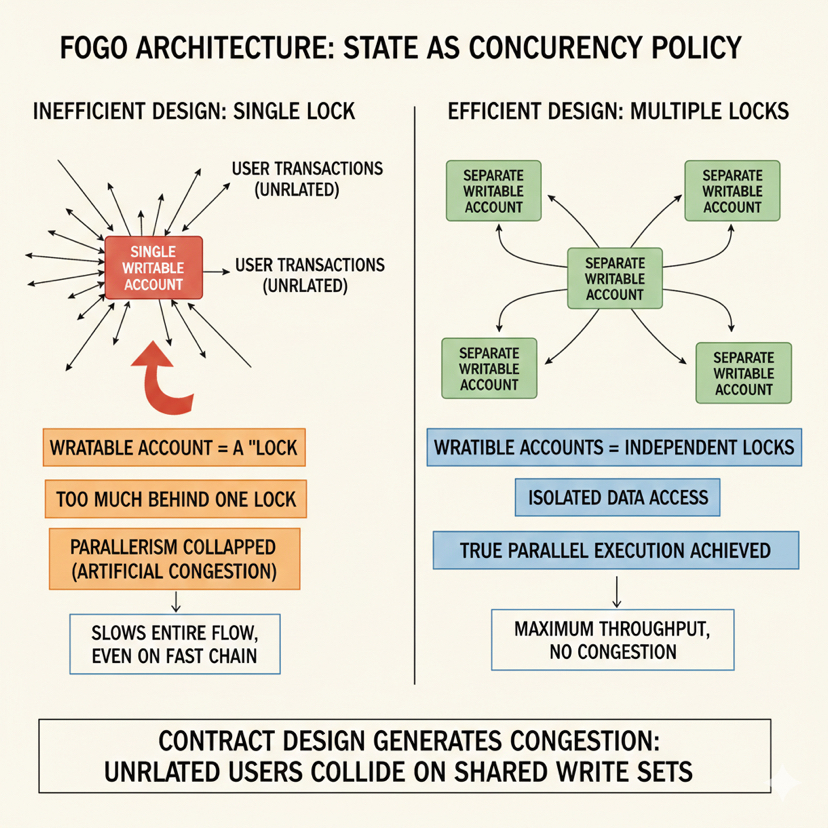
The most useful way to think about it is to treat every writable piece of state as a decision about who is allowed to proceed at the same time, and the design goal becomes reducing unnecessary collisions, which does not mean removing shared state completely, because some shared state is essential, but it means being disciplined about what must be shared and what was only shared for convenience, because convenience is where parallel execution quietly dies.
On Fogo, the patterns that keep applications feeling fast are rarely complicated, but they are strict, because they require a developer to separate user state aggressively, to isolate market specific state instead of pushing everything through one global protocol object, and to stop writing to shared accounts that are mostly there for tracking and visibility, since those derived metrics can exist without becoming part of the critical write path for every transaction.
When I look at successful parallel friendly designs, they tend to treat user actions as mostly local, where a user touches their own state and a narrow slice of shared state that is truly necessary, and the shared slice is structured in a way that does not force unrelated users to contend, which is why per user separation is not just a neat organization trick, it is a throughput strategy, and per market separation is not just a clean architecture choice, it is the difference between one active market dragging everything down and multiple markets flowing independently.
The hidden trap is that developers often write shared state because they want instant global truth, like global fee totals, global volume counters, global activity trackers, global leaderboards, or global protocol metrics, and the problem is not that those metrics are bad, the problem is that when you update them in the same transaction as every user action, you inject a shared write into every path, so every path now conflicts, and suddenly you have built a sequential application inside a parallel runtime, and it does not matter how fast Fogo is, because your own design is forcing the chain to treat independent work as dependent work.
What parallel execution changes, in a very practical sense, is that builders are pushed to separate correctness state from reporting state, and they are pushed to update reporting state on a different cadence, or to write it into sharded segments, or to derive it from event trails, because once you stop forcing every transaction to write the same reporting account, the runtime can finally schedule real parallel work, and the application begins to feel like it belongs on an SVM chain instead of merely running on one.
This becomes even more visible in trading style applications, which is where Fogo’s posture makes the discussion feel grounded, because trading concentrates activity, and concentration creates contention, and contention is the enemy of parallel execution, so if a trading system is designed around one central orderbook state that must be mutated for every interaction, the chain will serialize those interactions no matter how fast the blocks are, and the user experience will degrade exactly when it matters most, which is why builders are forced into harder but better designs, where the hottest components are minimized, where state is partitioned, where settlement paths are narrowed, and where the parts that do not need to be mutated on every action are removed from the critical path.
The same logic shows up in real time applications that people assume will be easy on a fast chain, like interactive systems that update frequently, because the naive approach is to maintain a single world state and mutate it constantly, but on @Fogo Official that becomes a guaranteed collision point, since every participant is trying to touch the same writable object, so the better approach is to isolate state per participant, to localize shared zones instead of globalizing them, and to treat global aggregates as something that is updated in a more controlled manner, because the moment you stop making every action write to the same shared object, the runtime can start running many actions together, and that is where the perceived speed becomes real.
In high frequency style logic, which is where low latency chains are often judged harshly, parallel execution makes design flaws impossible to hide, because when many actors submit actions quickly, any shared writable state becomes a battleground, and instead of building a system where many flows progress independently, you build a system where everyone is racing for the same lock, and the result is not just a slower app, it is a different market dynamic, because ordering becomes dominated by contention rather than by strategy, which is why the best designs tend to isolate writes, reduce shared mutation, and treat the contested components as narrow and deliberate rather than broad and accidental.
Data heavy applications show the same pattern in a quieter way, because most data consumers only need to read, and reads are not the problem, but when consumer flows begin to write shared data for convenience, such as stamping values into global accounts or updating shared caches, they poison parallelism for no real gain, and the better approach is to let consumers read shared data and write only their own decisions, because once you keep shared writes confined to dedicated update flows, you protect concurrency for everyone else.
The tradeoff that Fogo implicitly asks developers to accept is that parallel friendly architecture is not free, because once you shard state and separate accounts, you are managing more components, you are reasoning about more edges, and you are building systems where concurrency is real rather than theoretical, which means testing has to be stricter, upgrade paths have to be more careful, and observability has to be better, but the reward is that the application can scale in the way an SVM runtime is designed to support, where independent actions truly proceed together instead of waiting behind a global bottleneck.
The mistake that destroys most of the parallel advantage is not an advanced error, it is a simple one, which is creating a single shared writable account that every transaction touches, and on a chain like Fogo that mistake is especially costly, because the faster the chain becomes, the more visible it is that your own design is the limiter, and that visibility is not a failure of the chain, it is the chain revealing what the architecture really is.
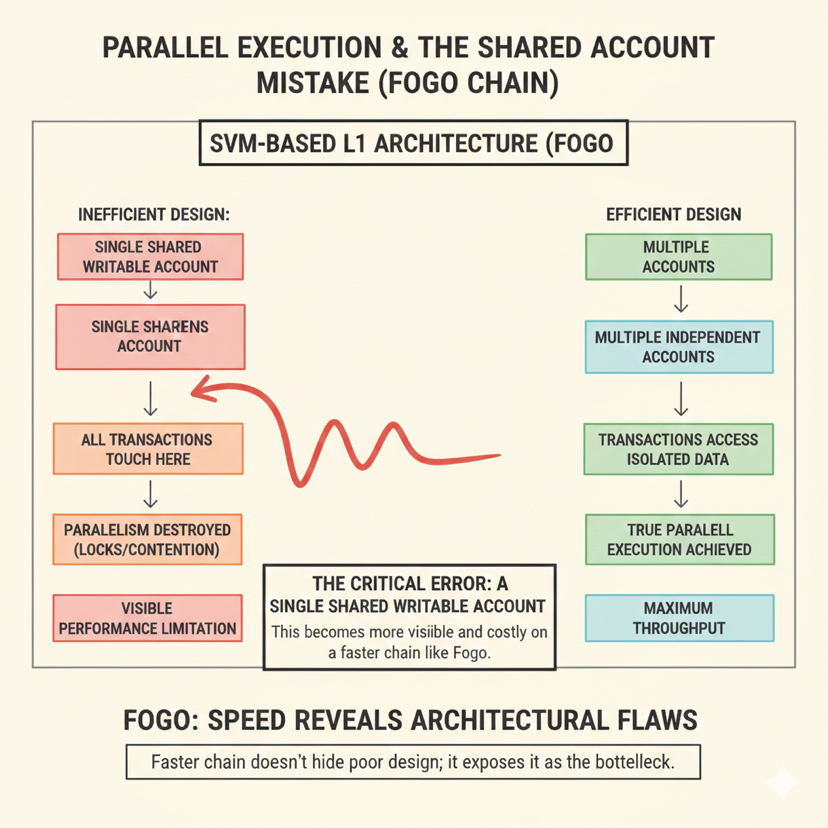
Fogo in this context is that it makes the builder conversation more honest, because it is not enough to say the chain is fast, the chain’s model forces a developer to prove they deserve that speed, and the proof is in the way state is shaped, partitioned, and accessed, which is why parallel execution is not a marketing detail, it is a discipline that changes how applications are built, and it is also why an SVM based L1 like Fogo is not simply faster, it is more demanding, since it asks developers to design with conflict in mind, to treat state as a concurrency surface, and to build systems that respect the idea that performance is as much about layout as it is about runtime.
