
@Fogo Official I was in a quiet coworking room in Karachi, late afternoon light slipping through dusty blinds, when my phone buzzed with a message from a founder I trust: “We’re thinking Fogo. Can we move our Solana program over without touching the core?” I stared at the same Rust crate I’d been shipping for months. What’s going to snap?
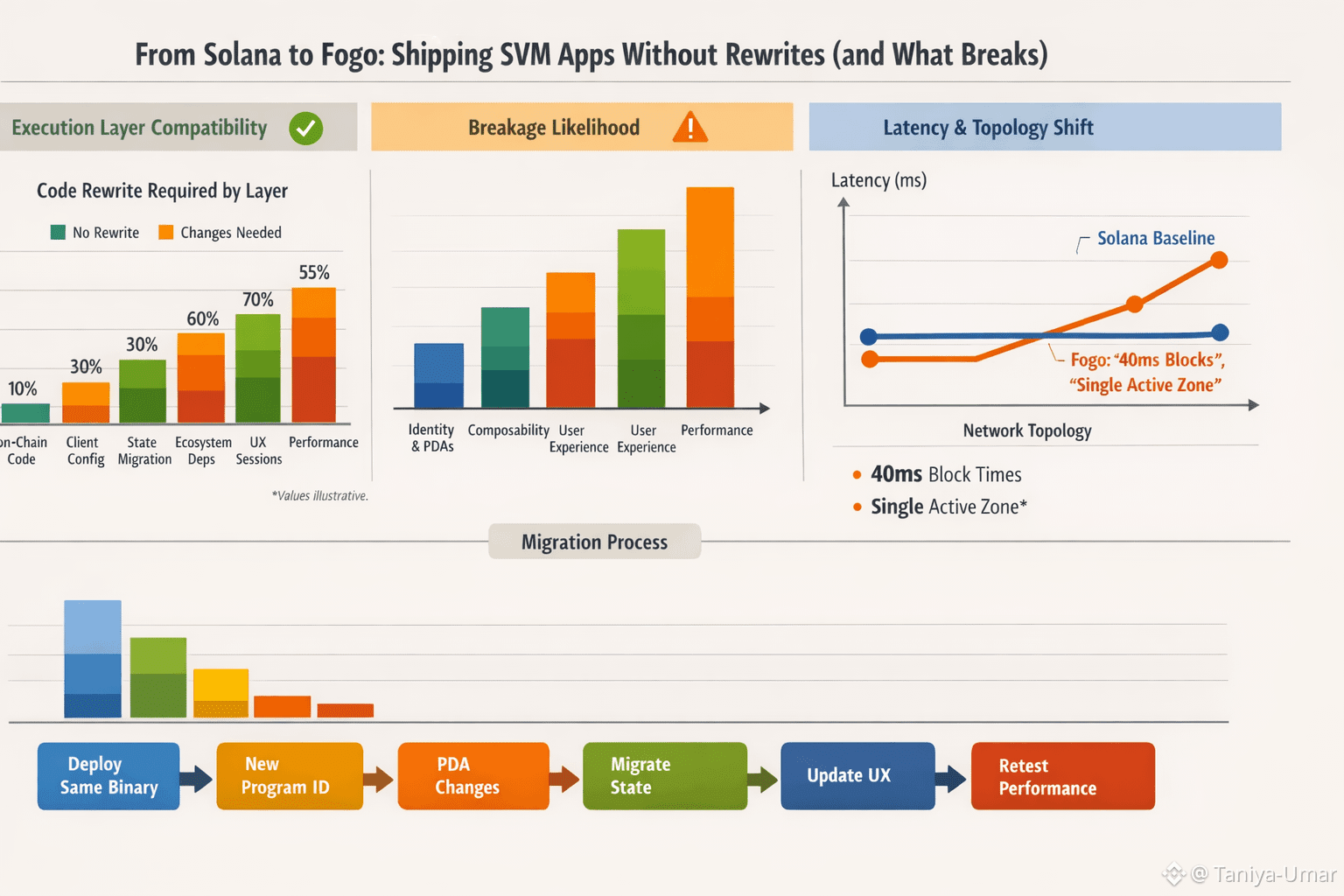
The reason Fogo is showing up in so many technical conversations right now is that “SVM portability” is no longer a niche idea. Eclipse’s public mainnet launch in November 2024 helped make the SVM feel like an execution layer you could pick up and place elsewhere. Fogo pushes that same direction from a different angle: it’s an SVM-based Layer 1 built around DeFi use cases, and its own materials emphasize minimal latency, multi-local consensus, and a validator client approach tied to Firedancer.
When people say “ship SVM apps without rewrites,” Fogo’s documentation leans into the narrow version of that claim. It says Solana programs can be deployed on Fogo without modifying the program logic because the chain aims to keep execution-layer compatibility with the SVM. It also positions itself around very fast block times and geographic zone optimization. That’s what makes me pay attention. If my on-chain logic can stay stable while the underlying network is tuned for time-sensitive workloads, that’s a practical reason to consider a move.
The mechanics match what I already know from Solana. On Solana, programs live in accounts that store executable code, and deployment is basically uploading a compiled program binary and marking the program account executable. Fogo’s “happy path” reads similarly: point familiar tooling at a different endpoint, deploy, and keep going. When it works, it feels almost suspiciously straightforward.
But “no rewrites” doesn’t mean “nothing changes,” and Fogo is a good example of why. The first thing that breaks is identity. My program address on Solana is not my program address on Fogo, and that single fact ripples outward. Every PDA I derive from seeds plus program ID will land somewhere else, so anything stateful needs a migration plan or a clean reset. Even if the Rust code is untouched, my client configuration, my allowlists, and my monitoring rules all need to learn a new map.
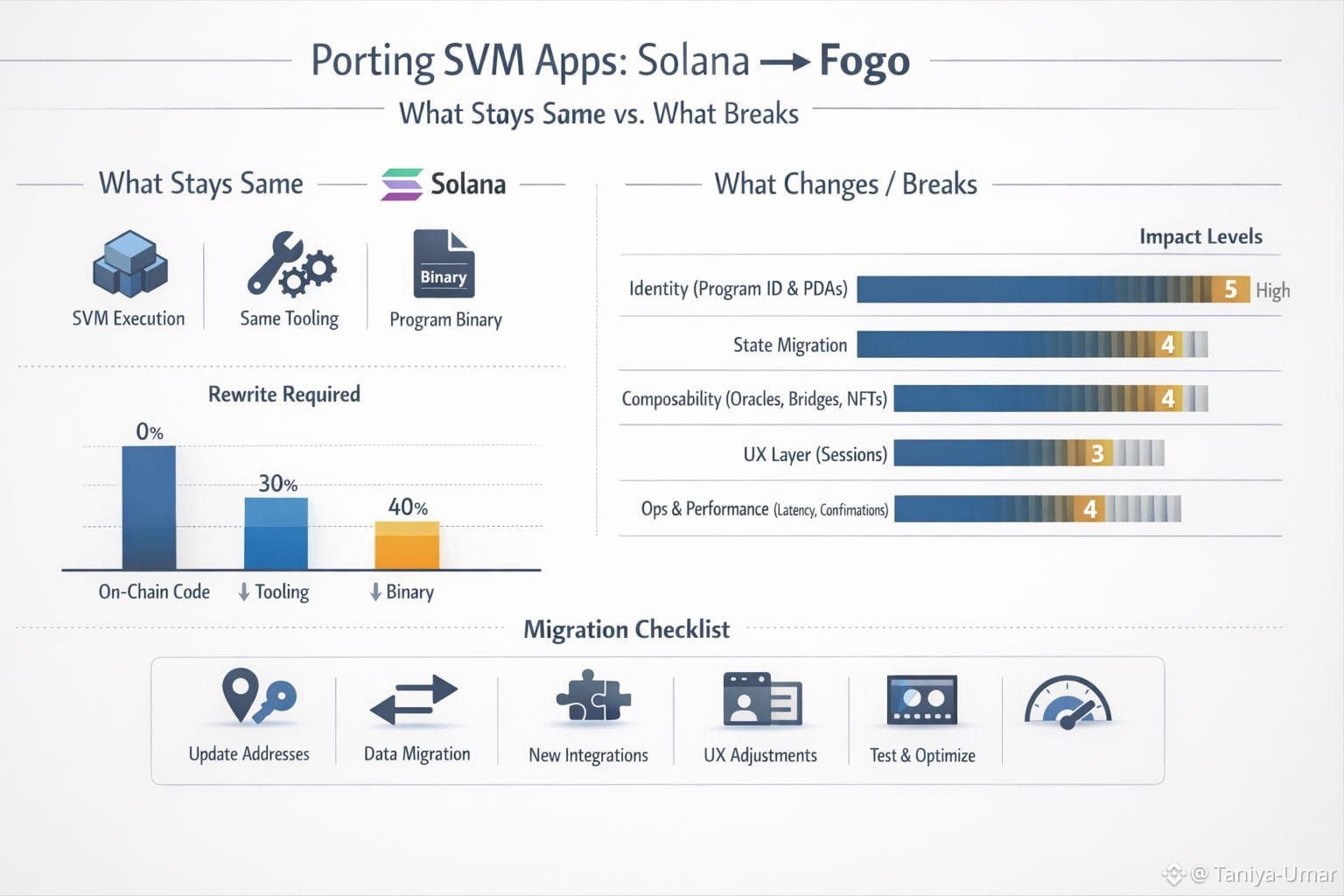
The second break is composability, and this is where Fogo becomes more than a generic “SVM chain.” My program expects an ecosystem around it: price feeds, bridges, metadata standards, and indexers. Fogo points to specific building blocks such as low-latency oracle options, cross-chain transfer infrastructure, and common token and NFT tooling. That’s encouraging, but it also means I can’t assume the exact same contracts, addresses, or market conventions I relied on elsewhere. If a dependency is missing, new, or versioned differently, my CPI calls don’t fail politely—they fail like I wrote the bug.
Then there’s the part nobody wants to admit is “a rewrite,” even though it can feel like one: the user experience layer. Fogo Sessions stands out here because it’s framed as a primitive for gasless, low-friction flows using paymasters and spending limits. If I port my app to Fogo and keep the same old interaction pattern—prompting for signatures and approvals the way I do on Solana—I’m technically compatible, but I’m also ignoring one of the reasons Fogo exists. Taking advantage of Sessions means touching the frontend and operational setup, not the on-chain program, but users experience it as the product changing.
Performance is the last break, and it’s the one that can trick me because it looks like a win. Fogo describes a zone-based setup and notes that mainnet is currently running with a single active zone. That’s not just trivia. Latency-sensitive apps behave differently when the network topology changes, and my own timeouts, retry logic, and confirmation assumptions need to be re-tested. Firedancer’s goal is higher performance and resiliency through an independent validator client, which helps explain why chains like Fogo highlight it, but it doesn’t exempt me from profiling compute budgets, retries, and backoff on a new network.
I still like the title claim, with a qualifier I try to say out loud: I can ship my SVM program to Fogo without rewriting the core on-chain code, and that’s real progress. The stuff that breaks is mostly everything around the program—addresses, migrations, dependencies, UX expectations, and ops. If I treat Fogo as “Solana with a new RPC,” I’ll get bitten. If I treat it like a new production environment that happens to run the same execution model, the port stops being magical and starts being manageable.
@Fogo Official $FOGO #fogo #Fogo

