

What if tomorrow your entire digital existence was switched off?
No warning. No appeal. No recovery.
A photographer friend of mine recently experienced exactly that. His cloud account was permanently banned due to what appears to have been a misjudgment. Ten years of work disappeared in a moment. Client archives, contracts, family photos, the recorded growth of his child — erased. Watching him break down, one phrase echoed in my head:
Digital lobotomy.
In a centralized world, our memories do not belong to us. They belong to servers. And servers belong to corporations. As long as the platform is willing, it can reduce you to a “blank person” at any time.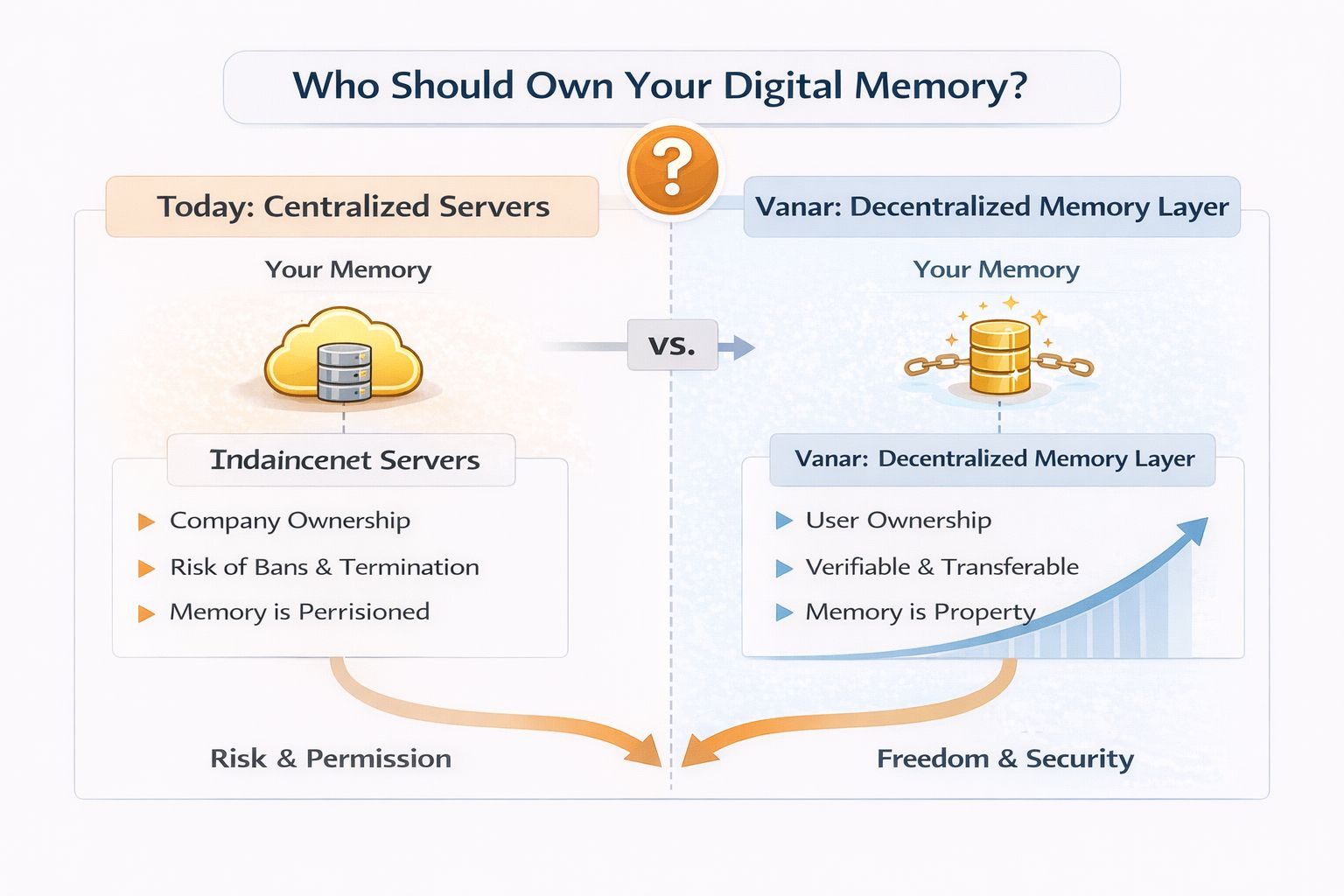
That fear — memory sovereignty — is what made me pay very close attention to the recent AMA from Vanar Chain and CEO Jawad Ashraf. What I heard was not another TPS competition or ecosystem incentive pitch. It was something far more structural: the idea that AI memory should be ownable.
Today’s AI agents are powerful in capability but fragile in existence. Their memories — context windows, preference layers, trading logic, adaptive behavior — live inside centralized infrastructures like OpenAI or Google. That means API pricing changes can kill profitability. Policy adjustments can disable functionality. Platform bans can wipe accumulated intelligence. A trading agent that learned six months of market behavior can instantly revert to zero.
Vanar’s Neutron external memory layer proposes something radical in its simplicity: separate memory from centralized servers and anchor it on-chain. When memory becomes persistent, verifiable, and portable, the AI is no longer dependent on a single corporation’s continuity. Even if infrastructure providers change, even if APIs shift, the accumulated experience remains intact and owner-controlled.
This is not merely a technical upgrade. It is a sovereignty layer.
The more thrilling leap, however, is from function to asset. Traditionally, if you train an AI agent, you can only sell access. The intelligence remains locked behind your infrastructure. Under Vanar’s architecture, the memory stack itself can become tokenized. That means experience becomes transferable. Imagine training an AI agent in 2026 that masters meme coin arbitrage, refining liquidity detection, volatility mapping, and execution timing. In the traditional model, you rent access. In Vanar’s framework, you could package the memory bank into a tokenized asset. Another user loads it and inherits that experience instantly.
That is the financialization of experience.
It transforms AI from a power-consuming tool into a container of accumulated capital. Memory becomes equity-like. Intelligence becomes portable.
Meanwhile, the market still largely evaluates $VANRY through conventional Layer-1 logic: trading pairs, TPS metrics, short-term volatility. That is understandable. Markets price what they understand. But Vanar is not competing primarily on speed narratives. It appears focused on predictable infrastructure and AI-native architecture. That kind of structural positioning is often underpriced early because it lacks adrenaline.
The most underestimated advantage Vanar holds is its infrastructure discipline. Builders do not care about hype. They ask practical questions: Is the RPC stable? Are WebSocket endpoints live for real-time feeds? Is the chain ID clear? Is there a reliable explorer? Is testnet structured properly? Can my team integrate within a week?
Vanar provides clean mainnet RPC endpoints, WebSocket support critical for AI agents, structured testnet configuration, official explorer visibility, and clear operator documentation. This may not trend on Twitter, but plumbing is what scales. Chains that are easy to connect to, test on, monitor, and deploy with confidence become default platforms over time.
If we truly believe in an AI-agent future, then we are implicitly acknowledging a world of continuous execution. Systems that run 24/7. Agents that ingest live data, react in real time, and accumulate state over months and years. That future demands stable WebSockets, deterministic execution, predictable fee behavior, and graceful degradation under stress. Enterprises care less about maximum TPS and more about cost certainty and operational stability.
EVM compatibility within Vanar is often viewed as convenience, but in reality it is risk reduction. Businesses optimize for lower hiring friction, tooling familiarity, audit continuity, and integration predictability. Reducing unknown variables reduces operational cost. Reducing operational cost increases experimentation. Experimentation builds ecosystems.
The deeper thesis, though, is philosophical. If every individual eventually owns an AI agent, and that agent’s memory can be revoked by a centralized provider, then intelligence itself becomes leased. An AI without memory sovereignty is platform-dependent labor. Vanar’s direction suggests separating intelligence from centralized control.
Crypto markets reward momentum cycles. Infrastructure rewards durability. The networks that survive long term are rarely the loudest; they are the ones that stay online, finalize deterministically, integrate seamlessly, and upgrade without chaos. Vanar is still building. Adoption is never guaranteed. But structurally, it is addressing memory centralization risk, AI infrastructure fragility, and operational unpredictability.
If your Google account disappeared tomorrow, what would remain?
In centralized systems, your past is permissioned. In a decentralized memory architecture, your past becomes property. Vanar is not merely competing in Layer-1 throughput. It is attempting to redefine who owns AI experience, where memory resides, and how intelligence becomes transferable.
This narrative may feel early. It may feel abstract. But structural shifts often appear boring before they become obvious.
The question is simple: when AI becomes universal, will its memory belong to corporations — or to you?
I’d genuinely like to hear your perspective. Is memory ownership the next major infrastructure battle in AI, or is the market still too distracted to see it?
