
Good evening again👋. Let's keep it brief today.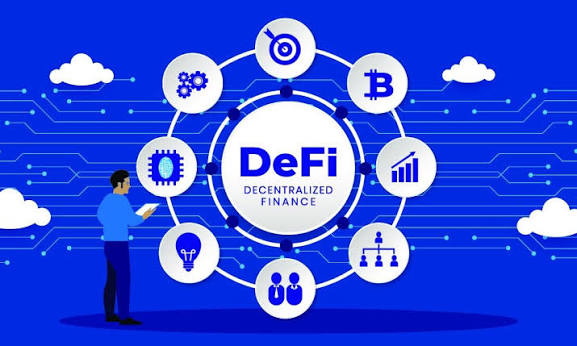
What is DeFi?
I think I should start revealing this topic by explaining what DeFi is. I believe that no one can explain it better than Gpt. Therefore, I will simply quote: "DeFi (Decentralized Finance) is decentralized finance, meaning financial services that operate on the blockchain without traditional intermediaries — banks, brokers, or payment companies. Instead of a centralized institution, operations are performed by smart contracts — automated programs on the blockchain." I won't delve into this topic in more detail. After all, this article is intended for #vanar .
What does “going beyond DeFi” mean?
Now let's move on to explaining what the title of our article means. After studying this issue, I realized that most blockchain ecosystems focus on decentralized finance. Experts have recognized that this creates initial liquidity, but it will also make the market cyclical and dependent on speculative capital. Therefore, the fact that when @Vanarchain and other similar projects “go beyond DeFi”, it means diversifying the use cases of blockchain.
How “going beyond DeFi” strategically relates to Vanar Chain
This will be a large section, so I will definitely break it down into points.
1️⃣ Shifting focus from finance to digital ecosystems
This point directly relates to the previous section because #Vanar positions itself as a network for games, digital assets, interactive content, and metaverses. Unlike other blockchain ecosystems that focus purely on finance, such as DEX, farming, lending. This provides greater opportunities for the development of the token $VANRY .
2️⃣ Another model of demand for the token $VANRY
Here I want to first talk about the use of the token in DeFi and outside of DeFi.
In DeFi: | Outside of DeFi:
staking | microtransactions in games
farming | buying NFTs and digital assets
management. | intra-ecosystem payments
speculation. | user interaction with products
You may ask: "So what does all this mean?". I will answer you, it means that $VANRY can receive utility demand tied to real user activity, not just liquidity.
3️⃣ Reducing cyclical dependency
I also noticed during my study of the topic that DeFi is very sensitive to market cycles. During a “bear” market, TVL drops, activity decreases. But for #vanar this is not a problem, as the gaming and digital segment has a different dynamic — users play and interact regardless of the short-term token price.
4️⃣ Market scale
We talked about this aspect yesterday, so briefly: gaming is a billion-dollar audience. If Vanar integrates into gaming products, it gains access to a much broader market than the typical DeFi segment.
Conclusion
Well, now let's summarize, I think that after my explanation no one doubts that “Going beyond DeFi” for @Vanarchain is not a refusal of financial instruments, but an expansion of the network's economic base.
In my opinion, if the ecosystem of games and digital services scales, $VANRY can receive long-term utility support, which is a stronger model than an exclusively financial focus.
Thank you for your attention 🤗, I hope you found something new for yourself here.
